Duval Lung Grasping Forceps: Thoracic Tissue Handling Guide
Duval forceps guide: triangular jaw geometry, 160-240 mm sizes, thoracic and intestinal uses, handling rules and pre-tray inspection checks.
A right upper lobectomy is twenty minutes in. The lobe needs to come anteriorly so the surgeon can reach the truncus anterior, and the assistant reaches for a grasper. Pick the wrong one and the lung tears along the staple line before the vessel is even looped.
That is the job the Duval was designed for — moving aerated lung tissue without punching holes in it.
Why the Triangular Jaw Exists
Most grasping forceps concentrate load. A Babcock spreads it over a narrow fenestrated loop; an Allis converts it into a row of teeth. Lung parenchyma tolerates neither. It is a low-tensile, air-filled sponge that shears under point loading and leaks for days afterward.
The Duval answers this with a wide triangular jaw — typically 10 mm to 25 mm across the base — carrying shallow horizontal serrations and, on most patterns, a central fenestration. Three things happen at once when it closes:
- The contact area is large, so grip pressure per square millimetre stays low
- The fenestration lets a fold of tissue bulge upward instead of being crushed flat
- The horizontal serrations resist sliding along the axis of traction, which is the direction the assistant actually pulls
The triangle is not decorative. A rectangular jaw of the same area would put its widest section at the tip, where the mechanical advantage of the box joint is lowest and control is worst. Tapering the jaw toward the tip keeps the broad grip near the hinge, where closing force is most predictable.
Sizes and Specifications
Catalogue naming varies between makers — Duval, Duval-Collin, and Duval-Crile all appear for closely related jaw geometries. What matters at the ordering stage is overall length and jaw width.
| Overall length | Jaw width | Typical application |
|---|---|---|
| 160 mm (6¼”) | 10 mm | Paediatric thoracic, small-bowel handling |
| 180 mm (7″) | 13–15 mm | Open intestinal work, appendix, gallbladder |
| 200 mm (8″) | 20 mm | General adult thoracotomy — the default |
| 220 mm (8¾”) | 20–25 mm | Deep hilar dissection, obese chest wall |
| 240 mm (9½”) | 25 mm | Posterolateral approach, lower lobe mobilisation |
Standard construction is martensitic stainless to AISI 420 for the ratchet and jaw, satin finished to cut glare under theatre lighting. Tungsten carbide jaw inserts exist but are rarely specified here — TC earns its price on needle holders and scissors, not on an atraumatic grasper where the whole point is a compliant, low-pressure contact.
Ring handles carry a ratchet, normally two or three teeth. Two is preferable for lung. Three positions tempt the assistant into one more click, and one more click is how a staple line opens.
Thoracic Use — and the Other Half of the Catalogue
In open chest surgery the instrument does three distinct things. It delivers the lobe out of the hemithorax after the ribs are spread. It holds counter-traction while the fissure is completed. And during hilar dissection it parks the lobe out of the operative axis so the pulmonary artery branches can be looped.
Two per tray is the working minimum, for the simple reason that lung work is bimanual — one holds position while the other repositions. Units doing regular lobectomies stock a third. That sizing logic is covered in our thoracotomy instrument set guide, alongside the Finochietto rib spreader that creates the working window in the first place.
The same pattern shows up in abdominal trays under the Duval-Collin name, where it grasps stomach, small bowel, and gallbladder. The reasoning is identical: hollow viscus, thin wall, no tolerance for serrated point loading.
For thoracoscopic work the geometry is redesigned rather than borrowed. An endoscopic lung grasper runs a 5 mm or 10 mm shaft with a fenestrated dual-action jaw; the open Duval cannot pass a port and should never be forced through a utility incision as a substitute. Our VATS instrument set guide covers those equivalents.
Handling Rules That Prevent Parenchymal Tears
Most lung injuries attributed to the instrument are actually technique.
Ratchet to the first click only. The jaw is designed to hold at low closing force. Second and third positions are for tougher tissue such as gastric wall, not aerated lung.
Grasp full thickness where you can. A partial-thickness bite on the pleural surface concentrates shear at the jaw edge. Taking a fold gives the fenestration something to work with.
Pull along the jaw axis, never across it. Lateral levering turns a broad atraumatic grip into an edge, and the edge cuts.
Never regrip the same spot. Serration marks are already a weakened zone. Move 15–20 mm and take fresh tissue.
Keep it off vessels. The jaw is atraumatic for parenchyma, not for the pulmonary artery. Vascular control belongs to Satinsky and DeBakey patterns.
Inspection Before It Reaches the Tray
Four checks catch nearly every defect worth catching, and they take under a minute:
- Jaw alignment. Close to the first ratchet position and hold to the light. The serrated faces should meet across the full triangle. A visible wedge of daylight at the tip means the box joint has spread — the instrument grips only at the hinge and shears everything else.
- Ratchet security. Close, then tap the ring handles against a gloved palm. It should hold. A ratchet that jumps under load releases a lobe mid-dissection.
- Serration condition. Worn-smooth serrations slip, and slipping is what forces the assistant to over-close. Replace rather than tolerate.
- Fenestration edge. Run a gloved fingertip around the opening. Any burr from a previous repair or drop is a laceration waiting to happen.
For reprocessing, the box joint is the risk area. It must be opened fully during ultrasonic cleaning and lubricated with a water-soluble instrument milk before autoclaving; oil-based lubricants block steam penetration. Protein left in a hinge is both a sterilisation failure and the seed of pitting corrosion.
What to Specify When Ordering
State four things and the order will not go wrong: overall length in millimetres, jaw width, straight or curved shank, and ratchet tooth count. Fizza Surgical manufactures the full Duval range in Sialkot under ISO 13485, CE marked, from certified AISI 420 stock with laser-marked traceability — see our surgical instruments range or the certifications page for the compliance documentation that accompanies each shipment.
Frequently Asked Questions
What are Duval forceps used for?
Grasping and retracting lung tissue during thoracotomy and lobectomy, and — in the Duval-Collin variant — handling stomach, small bowel and gallbladder in open abdominal surgery. The common factor is thin-walled tissue that will not tolerate toothed graspers.
What is the difference between Duval and Babcock forceps?
Jaw geometry and load distribution. A Babcock uses a narrow fenestrated loop suited to tubular structures such as bowel or appendix. The Duval presents a wide triangular face — 10 to 25 mm — that spreads force across a much larger area, which is what aerated lung requires.
Are Duval forceps atraumatic?
Relatively, not absolutely. The broad serrated jaw keeps pressure per unit area low, but ratcheting past the first click or levering sideways will still tear parenchyma. Treat “atraumatic” as a description of the design intent, not a guarantee.
What size Duval is standard for adult thoracotomy?
200 mm overall with a 20 mm jaw covers most adult cases. Deep hilar dissection or a heavy chest wall justifies stepping up to 220–240 mm so the surgeon’s hand stays clear of the intercostal window.
Can Duval forceps be used in laparoscopic or thoracoscopic surgery?
No. They are open instruments with ring handles and cannot pass a port. Minimally invasive work uses purpose-built 5 mm and 10 mm fenestrated lung graspers with the same atraumatic principle applied to an endoscopic shaft.
Need precision surgical instruments?
Configure complete instrument sets with our team — ISO 13485 certified, CE marked, made in Sialkot since 1980.
Related Guides
View all articles →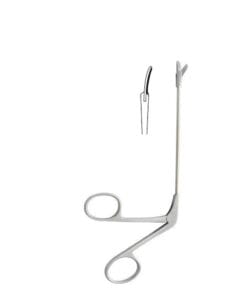
Where We Serve
Fizza Surgical exports to 50+ countries. Browse our country-specific pages with local regulatory guidance and pricing: