
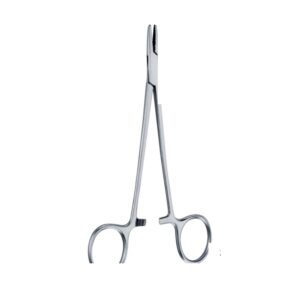
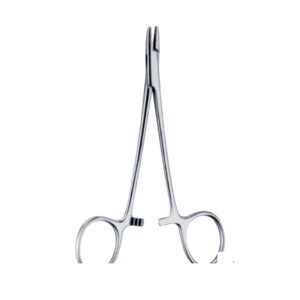
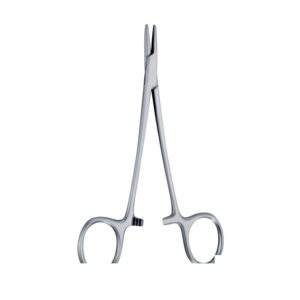
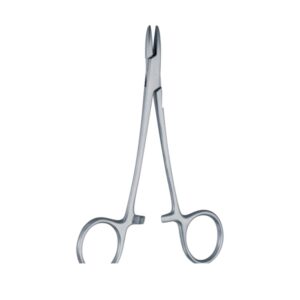
Tungsten-carbide tip inserts extend service life roughly ten-fold versus plain stainless and retain grip integrity through hundreds of autoclave cycles. Catalogue reference NH 10-280-04 TC.
| Reference / SKU | NH 10-280-04 TC |
| Pattern | Crile |
| Tip configuration | TC tips |
| Material | AISI 420 martensitic stainless steel (tungsten-carbide insert variants on TC SKUs) |
| Sterilization | Steam autoclave to 134 °C · EtO compatible |
| Quality system | ISO 13485:2016 · CE-marked under EU MDR 2017/745 · FDA establishment-registered |
Where Halsted-Mosquito handles the finest bleeders, Crile hemostatic forceps step up one tier — medium-calibre vessels and tissue clamping during routine dissection. George Washington Crile, founder of the Cleveland Clinic in 1921, developed the pattern as a workhorse general-surgery clamp. The 14 cm and 16 cm lengths cover bowel resection, appendectomy, thyroidectomy, and the bulk of routine hemostasis. Crile forceps are fully serrated like Halsted-Mosquito but heavier, with wider jaws for slightly larger vessels. Many general-surgery trays include four Criles (two straight, two curved) alongside two Halsted-Mosquito pairs and a Kelly for graduated vessel-size coverage.
- Crile-Wood Needle Holder TC — Vascular Open AAA (NH 10-280-03 TC)
- Crile-Wood Needle Holder TC — Transplant Surgery (NH 10-280-05 TC)
- Crile Hemostatic Forceps — 140 mm (14 cm), Pattern 86 (HF 04-86-02)
Sialkot has been the world’s primary cluster for surgical-instrument manufacturing since the late nineteenth century, when local steel workshops began supplying instruments to British military and civilian hospitals. Fizza Surgical’s facility continues that tradition, combining workshop craftsmanship with the metallurgy and quality systems modern medical regulation requires. Fizza products are exhibited at international medical-device trade fairs in Europe, the Middle East, and North America.

Reviews
There are no reviews yet.