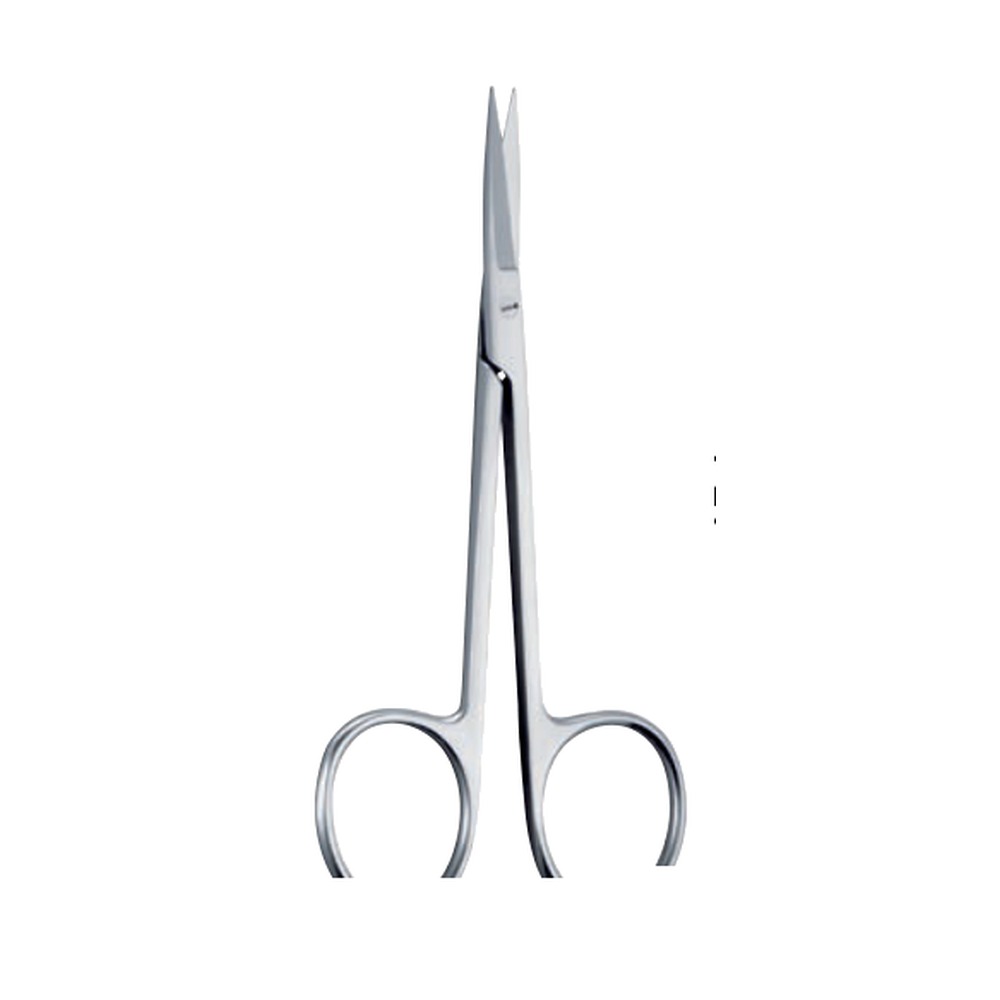
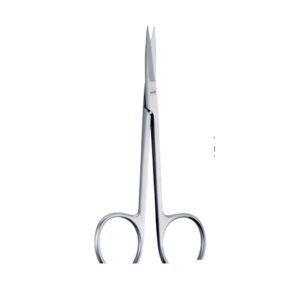
Iris scissors were originally designed for ophthalmic iridectomy in the nineteenth century — small, sharp, pointed scissors for cutting the iris under magnification. Modern usage extends well beyond ophthalmology: plastic surgeons use Iris for fine dissection, dermatologists for minor excisions, microsurgeons for delicate tissue work, dental surgeons for intraoral suture trimming. The defining features are short blade length (typically 11.5 cm overall with 2.5 cm blade), sharp-sharp pointed tips, and a fine box-lock joint. Tungsten carbide tip variants (TC Iris) hold a cutting edge through hundreds more autoclave cycles than plain stainless. Both straight and curved configurations cover most surgical needs.
Iris Scissors — Curved, 12 cm (12.0 cm) — manufactured under reference SC 02-526-01. The curved jaw improves visibility around tissue edges and around the surgeon’s hand — the standard configuration for most dissection and clamping tasks.
| Reference / SKU | SC 02-526-01 |
| Pattern | Iris |
| Working length | 12 cm (120 mm) |
| Shape | Curved |
| Material | AISI 420 martensitic stainless steel (tungsten-carbide insert variants on TC SKUs) |
| Sterilization | Steam autoclave to 134 °C · EtO compatible |
| Quality system | ISO 13485:2016 · CE-marked under EU MDR 2017/745 · FDA establishment-registered |
- Iris Scissors — Straight, 12 cm (SC 02-525-01)
- Iris Scissors — Laterally Curved, 11.5 cm (SC 02-533-01)
Fizza Surgical exports to hospital groups, surgical distributors, and OEM partners across Europe, North America, the Middle East, Africa, and Asia. Container-load shipments move via DHL Express, UPS, FedEx, and major sea-freight lines on all Incoterms (EXW, FOB, CIF, DDP). All Incoterms 2020 commercial documentation, including health certificates and certificates of origin attested by the Sialkot Chamber of Commerce, is prepared in-house.

Reviews
There are no reviews yet.