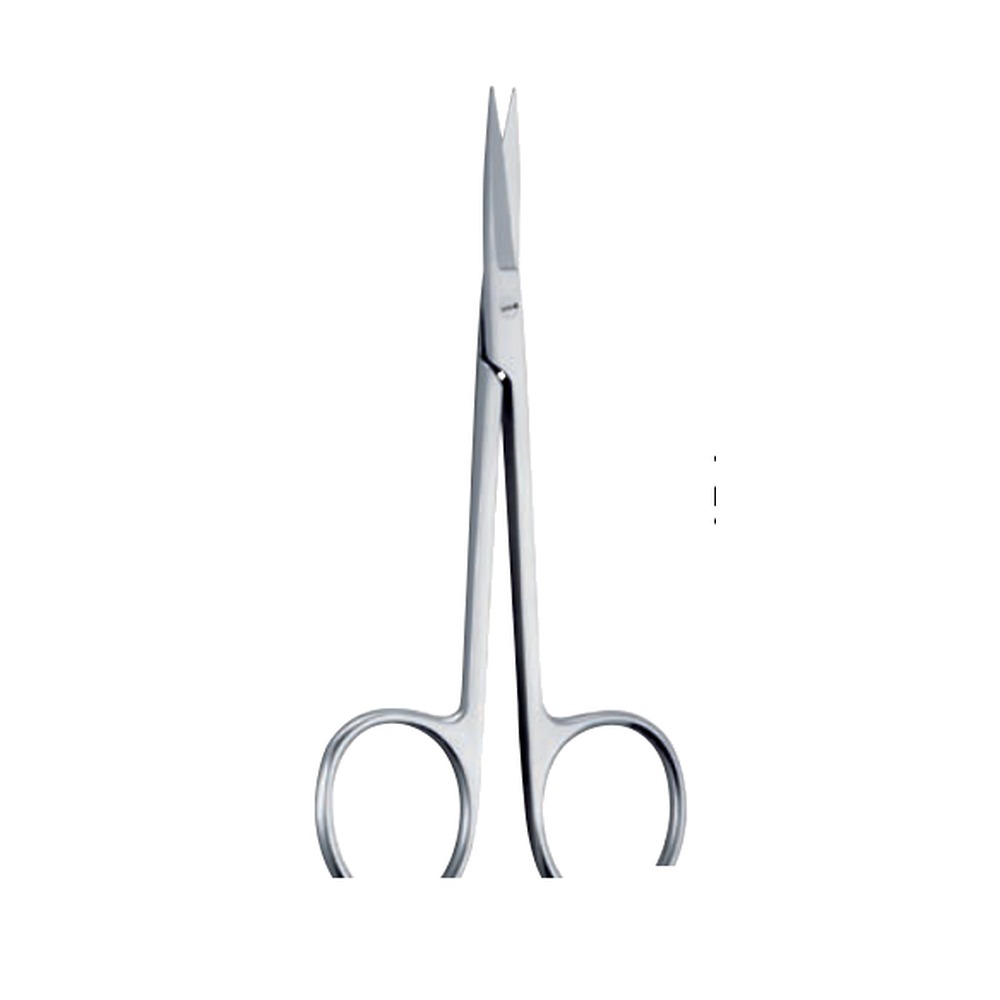
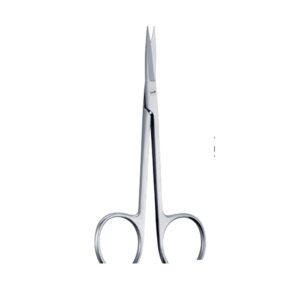
Iris Scissors — Curved, 11.5 cm (Ref SC 02-531-01), supplied as a standard catalogue line. The curve angles the working tip away from the line of sight, the standard geometry for dissection in confined fields.
Iris scissors were originally designed for ophthalmic iridectomy in the nineteenth century — small, sharp, pointed scissors for cutting the iris under magnification. Modern usage extends well beyond ophthalmology: plastic surgeons use Iris for fine dissection, dermatologists for minor excisions, microsurgeons for delicate tissue work, dental surgeons for intraoral suture trimming. The defining features are short blade length (typically 11.5 cm overall with 2.5 cm blade), sharp-sharp pointed tips, and a fine box-lock joint. Tungsten carbide tip variants (TC Iris) hold a cutting edge through hundreds more autoclave cycles than plain stainless. Both straight and curved configurations cover most surgical needs.
| Reference / SKU | SC 02-531-01 |
| Pattern | Iris |
| Working length | 11.5 cm (115 mm) |
| Shape | Curved |
| Material | AISI 420 martensitic stainless steel (tungsten-carbide insert variants on TC SKUs) |
| Sterilization | Steam autoclave to 134 °C · EtO compatible |
| Quality system | ISO 13485:2016 · CE-marked under EU MDR 2017/745 · FDA establishment-registered |
- Iris Scissors — Straight, 11.5 cm (SC 02-530-01)
- Iris Scissors — Angular, 11.5 cm (SC 02-532-01)
Every instrument is forged, machined, and finished at the Sialkot facility from German-origin stainless billet — austenitic 304 / 316 grades for non-cutting, mucosal-contact, and hollow-ware lines where corrosion resistance is the priority, martensitic 420 / 440 grades for cutting and edge-retention patterns where heat-treatable hardness matters, and 17-4 PH precipitation-hardened stainless for high-load orthopedic and implant-handling applications. Polishing, passivation, and final inspection are performed in-house under documented quality procedures aligned with ISO 13485:2016.

Reviews
There are no reviews yet.