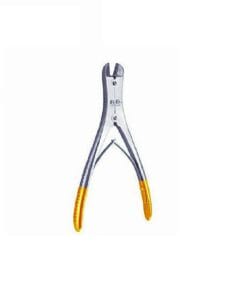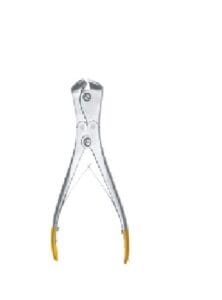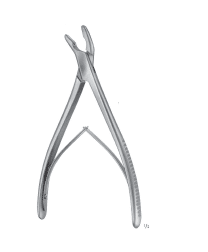
Bone rongeurs are essential cutting instruments in orthopedic, neurosurgical, and maxillofacial procedures. But with dozens of patterns from Kerrison to Leksell to Stille to Jansen, procurement teams often struggle to determine which rongeurs they actually need. This guide provides a clear clinical framework.
What is a bone rongeur?
A bone rongeur is a hinged cutting instrument used to remove small bone fragments, smooth bone edges, and shape bone during surgical procedures. The word “rongeur” is French for “gnawer” — reflecting how the instrument works: sharp cutting jaws progressively remove bone in small bites rather than making large cuts.
Rongeurs use either single-action or double-action mechanisms. Single-action rongeurs have one hinge and transmit force directly from handle to jaw. Double-action rongeurs have two hinges for mechanical advantage — they multiply hand force, making them easier to use on dense bone.
The major rongeur patterns
Kerrison Rongeurs
The signature spinal rongeur. Punch-style design with an angled cutting jaw, typically 90° or 40° angles. Used extensively in spinal decompression (laminectomy, foraminotomy, discectomy) and neurosurgery. Available in bite sizes from 1mm to 6mm.
When to use Kerrison: Spinal procedures — the angled cutting face allows precise removal of small bone fragments around delicate neural structures. Every spine surgery OR should stock Kerrison 1mm, 2mm, 3mm, 4mm, and 5mm in both 90° and 40° configurations.
Leksell Rongeurs
The general orthopedic workhorse. Double-action mechanism for mechanical advantage on dense bone. Used in joint arthroplasty, bone cavity preparation, and general orthopedic bone removal.
When to use Leksell: Orthopedic procedures requiring rapid bone removal — hip/knee arthroplasty acetabular preparation, spinal fusion bone removal, trauma debridement. Stock 2-3 per OR.
Stille-Luer Rongeurs
Heavy-duty rongeur for aggressive bone removal. Larger jaws than Leksell, greater cutting force. Used when you need to remove substantial bone quickly.
When to use Stille-Luer: Major orthopedic procedures requiring rapid bone debulking. total joint revision surgery, large tumor resections, severe bone spur removal.
Jansen Rongeurs
Curved rongeur with narrow, curved jaws. Used in nasal and sinus surgery, maxillofacial procedures, and ENT applications.
When to use Jansen: ENT procedures (FESS, functional endoscopic sinus surgery), maxillofacial reconstruction, nasal bone work.
Ruskin Rongeurs
Classic double-action orthopedic rongeur. Similar to Leksell but with slightly different jaw profile. Reliable general-purpose instrument.
Pediatric Rongeurs
Miniaturized versions of standard patterns (Leksell, Kerrison, Stille) for infant and pediatric surgery. Smaller jaws, lighter weight, proportional force transmission.
Single-action vs double-action
Single-action rongeurs (like basic Kerrison) transmit force 1:1 from handle to jaw. Pro: simpler, fewer failure points, more precise feel. Con: requires more hand strength for dense bone.
Double-action rongeurs (like Leksell, Stille) use compound mechanism to multiply force ~2x. Pro: easier on surgeon’s hand during prolonged use, better for dense bone. Con: more moving parts, slightly less tactile feedback.
Most orthopedic departments stock both for different applications.
Up-biting, down-biting, side-cutting
Kerrison and other rongeurs come in three cutting configurations:
- Up-biting (reverse): Cutting jaw opens upward from the tip. Used when cutting bone above the approach angle.
- Down-biting (standard): Cutting jaw opens downward. Used for typical access angles (most common).
- Side-cutting: Jaw cuts laterally. Used in confined spaces where up/down cutting isn’t possible.
A complete Kerrison rongeur set should include both up-biting and down-biting variants in each size.
Quality indicators in bone rongeurs
Jaw hardness
Cutting jaws should be HRC 55+ hardened stainless steel. This is especially critical because rongeur jaws experience severe stress. both cutting force and repeated impact with hard bone.
Hinge precision
The hinge mechanism is where most rongeur failures occur. A quality rongeur’s hinge should operate smoothly with no lateral play, even after 10,000+ actuation cycles. Cheap rongeurs develop hinge slop quickly, reducing cutting precision.
Ergonomics
Handle design affects surgeon fatigue over a 4-hour procedure. Look for rongeurs with ergonomic grip patterns and balanced weight distribution.
Autoclave durability
Rongeurs undergo more mechanical stress per use than simpler instruments. Quality rongeurs maintain cutting performance through 3,000+ autoclave cycles with proper maintenance.
Recommended inventory by specialty
Spine surgery
- Kerrison 1mm, 2mm, 3mm, 4mm, 5mm, up and down-biting (10 total)
- Leksell 150mm and 230mm
- Bone rongeur set for backup
General orthopedic (joint arthroplasty)
- Leksell 150mm and 230mm. 2 of each
- Stille-Luer 230mm and 290mm, 1 of each
- Bone mallet for impactor work
ENT / maxillofacial
- Jansen rongeurs in multiple sizes
- Blakesley nasal cutting forceps (related but distinct)
- Small Kerrison for craniofacial work
Sourcing from Fizza Surgical
Fizza Surgical manufactures the complete bone rongeur range. Our rongeurs feature:
- HRC 55+ hardened cutting jaws
- Precision-machined hinge mechanisms tested for 15,000+ cycles
- AISI 420 surgical stainless steel construction
- Ergonomic handles with textured grips
- ISO 13485, CE Marked, FDA Registered
- Lifetime warranty on rongeur body (hinge serviceable)
- OEM manufacturing with custom branding
Browse our bone rongeur range or request a factory quote.
FAQ
How long does a bone rongeur last?
A quality stainless steel bone rongeur with proper maintenance should last 8-10+ years in typical orthopedic use (assuming 3,000+ autoclave cycles). The hinge mechanism is usually the limiting factor. some manufacturers offer hinge replacement services.
Can Kerrison rongeurs damage nerve roots?
Yes, improperly controlled Kerrison use is a risk factor for nerve root injury during spinal decompression. Training emphasizes controlled, deliberate bites with visualization of the nerve root before each cut. Quality Kerrison rongeurs with sharp cutting jaws reduce required force and improve control.
Are titanium rongeurs worth the premium?
Titanium rongeurs are non-magnetic and MRI-compatible. Useful in intraoperative MRI suites. For standard OR use, the 2-3x cost premium over stainless steel is usually not justified.
Where We Serve
Fizza Surgical exports to 50+ countries. Browse our country-specific pages with local regulatory guidance and pricing: