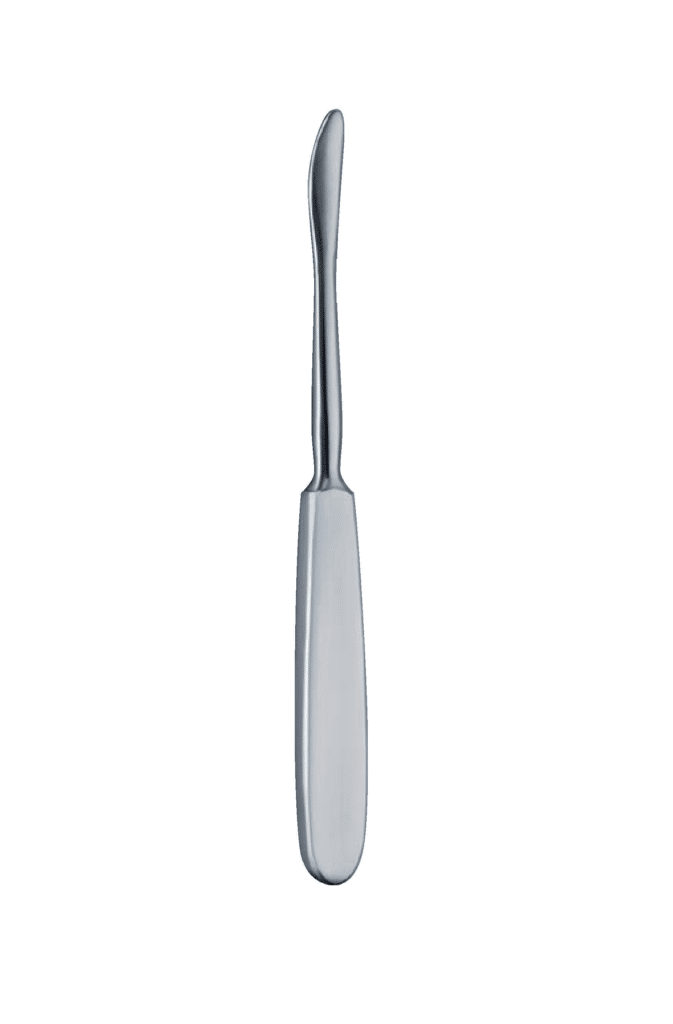
Periosteal elevators are among the most-used orthopedic instruments — yet they often get less procurement attention than showier equipment like power drills or implant systems. This guide covers the major patterns (Langenbeck, Freer, Key, Cobb) and how to stock them for different surgical specialties.
What is a periosteal elevator?
Periosteal elevators lift the periosteum (the fibrous membrane covering bone) away from the underlying bone surface. They’re essential in virtually every bone surgery procedure because bone cannot be accessed without first elevating the periosteum.
Think of a periosteal elevator as a specialized chisel designed for separation rather than cutting. The tip is polished smooth (not sharpened) so it slides between periosteum and bone without cutting either. The angle of the tip allows it to follow bone contours while gently peeling the periosteum away.
The major patterns
Langenbeck Periosteal Elevators
The classic general orthopedic elevator. Straight shaft with a rounded, spatula-shaped tip. Available in multiple blade widths (5mm, 10mm, 15mm, 20mm). Used in general orthopedic procedures — hip arthroplasty, fracture reduction, bone graft harvesting.
When to use Langenbeck: Any general orthopedic procedure requiring periosteal elevation. Stock all major sizes (5mm through 20mm) in every orthopedic OR.
Freer Periosteal Elevators
Double-ended design with one sharp blade and one blunt blade. Classic instrument in rhinoplasty, septoplasty, and ENT procedures. The sharp end elevates periosteum from cartilage; the blunt end safely separates tissues without cutting.
When to use Freer: ENT procedures, rhinoplasty, septoplasty, neurosurgical work. Every ENT and plastic surgery OR needs multiple Freers.
Key Periosteal Elevators
Heavy-duty elevator with a wide, stout blade. Used in major orthopedic procedures requiring substantial force — hip arthroplasty, spinal exposure.
When to use Key: Hip replacement, spinal approach, major trauma cases. Stock 2-3 per major orthopedic OR.
Cobb Elevators
Curved elevator designed for spinal exposure. Long shaft with a curved working tip that follows the vertebral contour during spinal muscle elevation.
When to use Cobb: Spinal procedures — essential for every spine surgery OR. Stock in both left-handed and right-handed variants.
Williger Elevators
Fine-tipped elevators for neurosurgical use. Precision instrument for delicate tissue separation around neural structures.
Howarth Elevators
ENT specialty elevator for nasal surgery. Angled shaft for access through nasal anatomy.
Molt Periosteal Elevators
Dental specialty. used in oral surgery and periodontal procedures for periosteal elevation from the alveolar bone.
Mitchell Trimmers
Dental instrument combining periosteal elevator and curette functions. Used in dental extractions and alveolar bone preparation.
Design considerations
Blade width
Narrow blades (3-6mm) for delicate work around small bones. Standard blades (10-15mm) for general orthopedic use. Wide blades (20mm+) for heavy retraction in major procedures.
Tip shape
Spatula tips (rounded) for safe elevation. Sharp tips for starting elevation at the bone-soft tissue junction. Curved tips for following bone contours.
Shaft length
Short shafts (100-150mm) for superficial work. Standard (150-200mm) for most applications. Long (250mm+) for deep spinal or hip procedures.
Handle type
Round handles for general use. Hexagonal handles for better tactile feedback. Fluted handles for grip in bloody fields.
Recommended inventory by specialty
General orthopedic OR
- Langenbeck 5mm, 10mm, 15mm, 20mm, 2 of each
- Key elevators. 2
- Freer double-ended, 2 (for minor soft tissue work)
Spine surgery OR
- Cobb left and right. 2 of each
- Langenbeck 10, 15, 20mm, 2 of each
- Williger fine-tip. 2
ENT / Rhinoplasty
- Freer double-ended, 4-5 (primary instrument)
- Howarth angled. 2
- Narrow Cottle elevator, 2
Dental / Oral Surgery
- Molt elevators. 4-6
- Mitchell trimmers, 4-6
- Seldin periosteal elevator. 2
Quality factors
Material
AISI 420 surgical stainless steel. Lower grades pit under autoclaving and damage the polished tip.
Tip polish
The tip must be polished to a mirror finish to slide between tissues smoothly. Any roughness causes tissue damage and makes the instrument harder to use.
Balance
Well-balanced elevator handles reduce surgeon fatigue. Imbalanced elevators cause wrist strain over long procedures.
Edge precision
For Freer elevators specifically, the sharp edge must be finely ground. A dull sharp-end Freer is frustrating to use, it won’t cleanly elevate cartilage periosteum.
Sourcing from Fizza Surgical
Our periosteal elevator range includes all major patterns: Langenbeck, Freer, Key, Cobb, Williger, Howarth, Molt, Mitchell. Each is:
- AISI 420 surgical stainless steel with mirror-polished tips
- Individually inspected for dimensional accuracy
- ISO 13485, CE Marked, FDA Registered
- Lifetime warranty
- OEM manufacturing with custom engraving
- 30-50% below premium European brand pricing
Browse our elevator range or request a factory quote.
FAQ
How do I know when an elevator needs replacement?
Look for: tip deformation (rolled, bent), loss of mirror polish (scratches, discoloration), handle cracks, or mechanical play in the shaft-handle joint. Quality elevators typically last 8-10 years in standard orthopedic use.
Can I sharpen the sharp end of a Freer elevator?
Professional sharpening is possible but should be done by trained instrument repair services. DIY sharpening usually damages the precise edge geometry. Most manufacturers offer sharpening services for ~$15-30 per instrument.
Where We Serve
Fizza Surgical exports to 50+ countries. Browse our country-specific pages with local regulatory guidance and pricing: