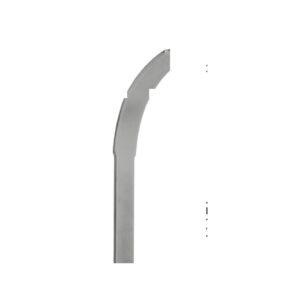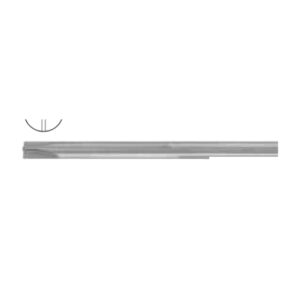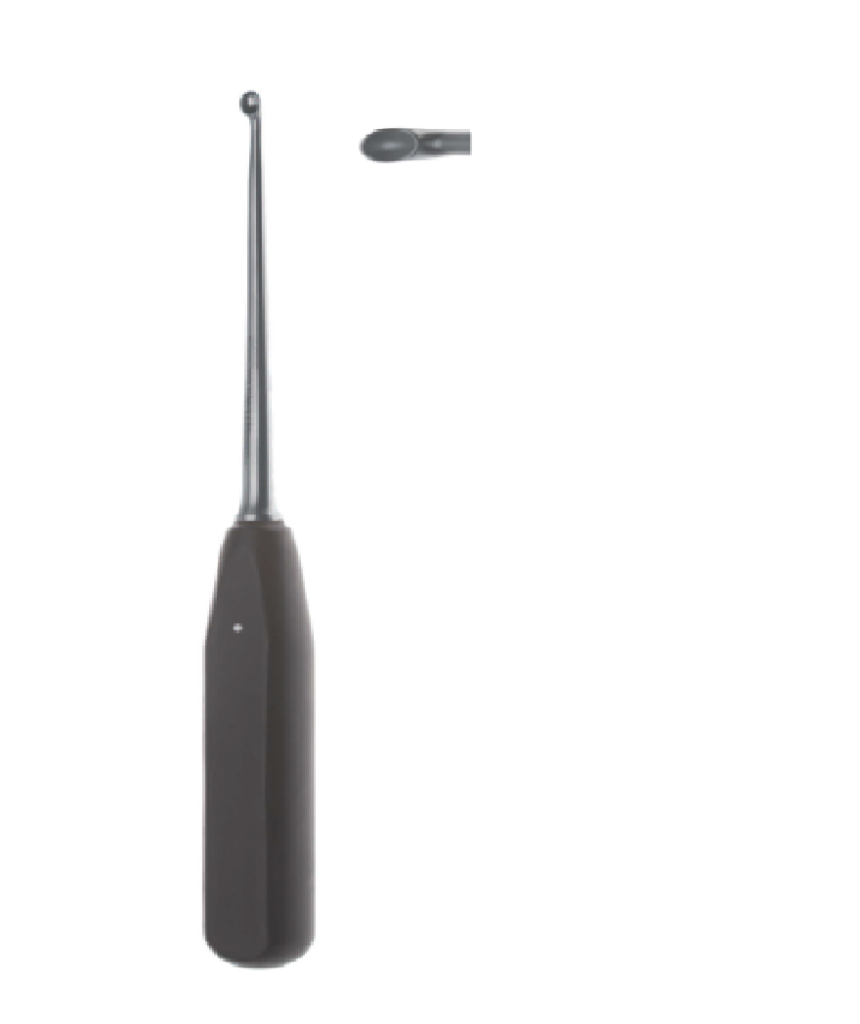
Bone curettes are essential orthopedic instruments used to remove diseased tissue from bone cavities, debride bone fragments, and shape bone during reconstructive procedures. This guide covers the Volkmann, Bruns, and Spratt patterns — the three dominant curette families in orthopedic surgery — plus specialty variants for dental and spinal use.
What is a bone curette?
A bone curette is a sharp-edged cup-shaped instrument used to scoop out bone and soft tissue from bone cavities. The curette’s working end is a shallow bowl with cutting edges around the perimeter. Force applied to the handle while scraping removes thin layers of bone progressively.
Unlike rongeurs (which bite chunks of bone) or chisels (which cut flat surfaces), curettes excel at:
- Cleaning bone cavities (removing marrow, infected tissue, cysts)
- Debriding bone surfaces (removing damaged or necrotic tissue)
- Shaping bone beds (preparing cavities for implants)
- Removing granulation tissue from fracture sites
The three major curette families
Volkmann Curettes
The classic orthopedic curette. Ring-shaped (oval) cup with sharp cutting edge around the perimeter. Available in sizes from 000 (smallest) to 6 (largest).
Volkmann curettes are the general-purpose workhorse for bone cavity cleaning. Used in nearly every orthopedic OR. Size 3 is the most common adult size; sizes 0, 1, 2 for smaller cavities; 4, 5, 6 for larger cavity work.
Typical uses: General bone cavity cleaning, bone cyst removal, osteomyelitis debridement, bone graft site preparation.
Bruns Curettes
Oval cup shape with slightly different geometry than Volkmann — often described as “deeper” cup. Used in orthopedic procedures requiring more aggressive bone removal. Similar size range to Volkmann.
Typical uses: Aggressive bone cavity debridement, large bone graft harvesting, severe osteomyelitis cases.
Spratt Curettes
Fine bone curettes for delicate procedures. Smaller cup sizes, precise cutting edges. Essential for pediatric orthopedics, maxillofacial surgery, and dental procedures.
Typical uses: Pediatric orthopedics, maxillofacial bone work, precision bone debridement.
Specialty curettes
Mastoid Curettes
Specialized for ear surgery. Small cup sizes (0, 00, 000), long thin shaft for deep mastoid access. Used in ENT surgery for mastoidectomy and temporal bone procedures.
Spinal Curettes
Long-handled curettes (often angled) for spinal decortication, disc space preparation, and interlaminar debridement. Available with various cup angles — 0°, 30°, 60°, 90°. to match approach geometry.
Dental Curettes
Small precision curettes for tooth extraction socket debridement and periodontal work. Often double-ended with different cup sizes on each end.
Double-Ended Curettes
Curettes with different cup sizes on each end (e.g., size 2 and 4). Space-saving and reduces instrument count in the surgical tray. Common in dental and ENT procedures.
Sizing conventions
Curette sizes use different numbering systems, a common source of procurement confusion:
| Size | Cup Diameter (approximate) | Common use |
|---|---|---|
| 000 | 2mm | Neonatal, mastoid, precision dental |
| 00 | 3mm | Pediatric, ear surgery |
| 0 | 4mm | Pediatric, small bones |
| 1 | 5mm | Small adult cavities |
| 2 | 6mm | Standard adult (common) |
| 3 | 7mm | Standard adult (most common) |
| 4 | 8mm | Large cavity work |
| 5 | 9mm | Major bone graft harvesting |
| 6 | 10mm | Major procedures |
Recommended inventory by specialty
General orthopedic OR
- Volkmann 0 through 6. 1 of each size
- Bruns 2, 3, 4, 1 of each for aggressive debridement
Spine surgery OR
- Spinal curettes in 0°, 30°, 60°, 90° angles
- Volkmann 2, 3, 4 for general bone work
Pediatric orthopedic
- Volkmann 000, 00, 0, 1. 1 of each
- Spratt small-size curettes, 2-3
ENT / Mastoid surgery
- Mastoid curettes 000, 00, 0. 2 of each
- Long-handled variants for deep access
Dental / Oral surgery
- Double-ended curettes with matched small/medium cups
- Spratt or similar fine-cup dental curettes
Quality indicators in bone curettes
Cutting edge sharpness
The most important quality factor. A sharp curette cuts bone easily with controlled force; a dull curette requires excessive force and damages adjacent healthy tissue.
Edge hardness
AISI 420 stainless steel hardened to HRC 55+ at the cutting edge. This preserves sharpness through hundreds of surgical uses.
Cup geometry
The cup shape should be uniform, no uneven rim, no deformation. Quality manufacturers use precision grinding on each cup.
Handle balance
Curette handles should be balanced for precision work. Fluted handles improve grip during long procedures.
Durability through autoclaving
Quality curettes maintain sharpness through 1,000+ autoclave cycles. Cheap curettes dull rapidly under repeated sterilization.
Sourcing from Fizza Surgical
We manufacture the complete bone curette range:
- Volkmann 000 through 6. all sizes
- Bruns oval cup curettes
- Spratt fine curettes
- Mastoid specialty curettes
- Spinal angled curettes (0°, 30°, 60°, 90°)
- Dental and double-ended curettes
All are AISI 420 surgical stainless steel, HRC 55+ cutting edges, ISO 13485 / CE / FDA certified, lifetime warranty on the curette body.
Browse our bone curette range or request a factory quote.
FAQ
How often do bone curettes need sharpening?
Professional sharpening is recommended every 100-300 surgical uses or when the cutting edge noticeably dulls. Some hospitals contract with instrument sharpening services for quarterly or semi-annual maintenance.
Can I sharpen curettes in-house?
DIY sharpening usually damages the precise cup geometry. Use professional sharpening services, they’re relatively inexpensive ($10-25 per curette) and preserve instrument geometry.
What’s the difference between bone curettes and dental curettes?
Dental curettes are smaller, finer, and designed for soft tissue work around teeth. Bone curettes are larger, more robust, and designed for aggressive bone removal. While some overlap exists (like Spratt patterns), they’re generally specialized for different applications.
Where We Serve
Fizza Surgical exports to 50+ countries. Browse our country-specific pages with local regulatory guidance and pricing: