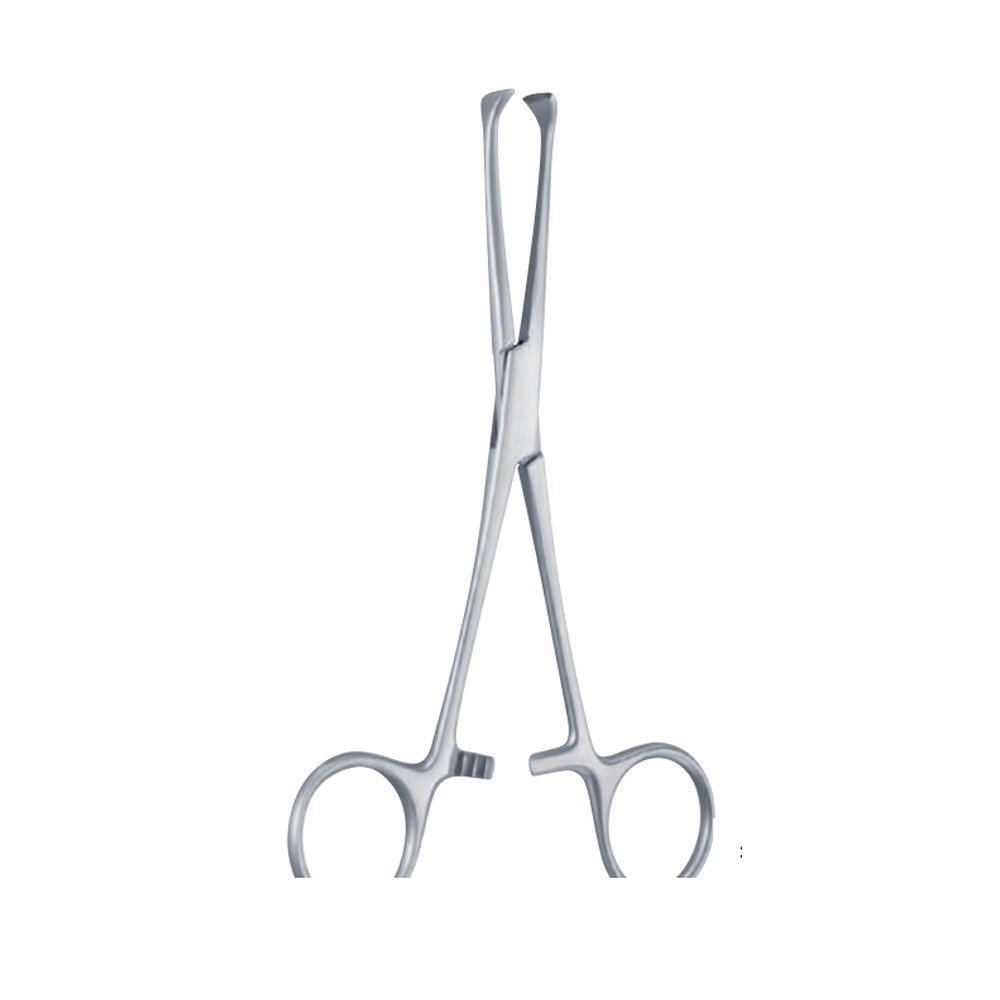
Allis tissue forceps occupy a specific niche between atraumatic instruments and the crushing toothed forceps like Kocher: firm enough to retract or manipulate, without Kocher’s destructive grip. The hallmark is the multi-tooth tip — typically 4×5 or 5×6 teeth in a single row across the working end — distributing pressure across a wider area. Oscar Huntington Allis developed the pattern in late-nineteenth-century Philadelphia for laparotomy and bowel surgery. Today the Allis is standard for grasping the appendix base, stomach wall during gastric procedures, peritoneum during entry, and any structure needing firm but non-destructive traction. The Allis is to general surgery what Babcock is to bowel.
Allis-Adair Tissue Forceps — 10×11 Teeth, 155 mm (15.5 cm), manufactured by Fizza Surgical under reference TI 08-20-01.
| Reference / SKU | TI 08-20-01 |
| Pattern | Allis |
| Working length | 155 mm (15.5 cm) |
| Material | AISI 420 martensitic stainless steel |
| Sterilization | Steam autoclave to 134 °C · EtO compatible |
| Quality system | ISO 13485:2016 · CE-marked under EU MDR 2017/745 · FDA establishment-registered |
- Judd-Allis Tissue Forceps — 3×4 Teeth, 150 mm (15 cm) (TI 08-50-01)
- Boys-Allis Tissue Forceps — 5×6 Teeth, 155 mm (15.5 cm) (TI 08-45-01)
- Allis-Atrauma Tissue Forceps — 160 mm (16 cm) (TI 08-85-01)
Every instrument is forged, machined, and finished at the Sialkot facility from German-origin stainless billet — austenitic 304 / 316 grades for non-cutting, mucosal-contact, and hollow-ware lines where corrosion resistance is the priority, martensitic 420 / 440 grades for cutting and edge-retention patterns where heat-treatable hardness matters, and 17-4 PH precipitation-hardened stainless for high-load orthopedic and implant-handling applications. Polishing, passivation, and final inspection are performed in-house under documented quality procedures aligned with ISO 13485:2016.


Reviews
There are no reviews yet.