
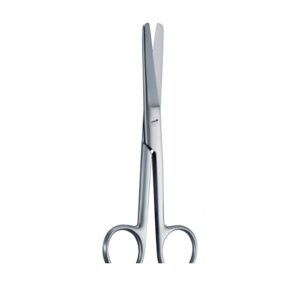
McKenty x = 4mm, sharp 205mm (Ref SE 15-45-01) — a standard catalogue line supplied to hospitals, distributors, and OEM partners worldwide.
In the rhythm of an operating-room procedure, forceps move between the surgeon’s hand, the scrub nurse, the Mayo stand, and the tissue field hundreds of times. That workflow shapes the design priorities: a forceps must seat positively in the surgeon’s grip without finger-ring fatigue, the ratchet must lock and release cleanly with a single motion, the jaws must close on tissue without sliding, and the surface finish must withstand repeated cycles through autoclave and chemical disinfection without pitting. The dominant patterns — Halsted, Crile, Kelly, Kocher, Allis, Babcock, Mayo — emerged at the close of the nineteenth century and remain essentially unchanged because the underlying anatomy and surgical requirements haven’t changed. Fizza manufactures the full range under ISO 13485:2016.
| Reference / SKU | SE 15-45-01 |
| Working length | 4 mm (0.4 cm) |
| Material | AISI 420 martensitic stainless steel |
| Sterilization | Steam autoclave to 134 °C · EtO compatible |
| Quality system | ISO 13485:2016 · CE-marked under EU MDR 2017/745 · FDA establishment-registered |
- McKenty x = 4mm, sharp 150mm (SE 15-37-01)
- Ritter-Halle x = 4.0mm, Frontal sinus bougies 160mm (SI 15-15-02)
- Hajek x = 4mm x 4mm 140mm (PB 15-10-02)
Every instrument is forged, machined, and finished at the Sialkot facility from German-origin stainless billet — austenitic 304 / 316 grades for non-cutting, mucosal-contact, and hollow-ware lines where corrosion resistance is the priority, martensitic 420 / 440 grades for cutting and edge-retention patterns where heat-treatable hardness matters, and 17-4 PH precipitation-hardened stainless for high-load orthopedic and implant-handling applications. Polishing, passivation, and final inspection are performed in-house under documented quality procedures aligned with ISO 13485:2016.


Reviews
There are no reviews yet.