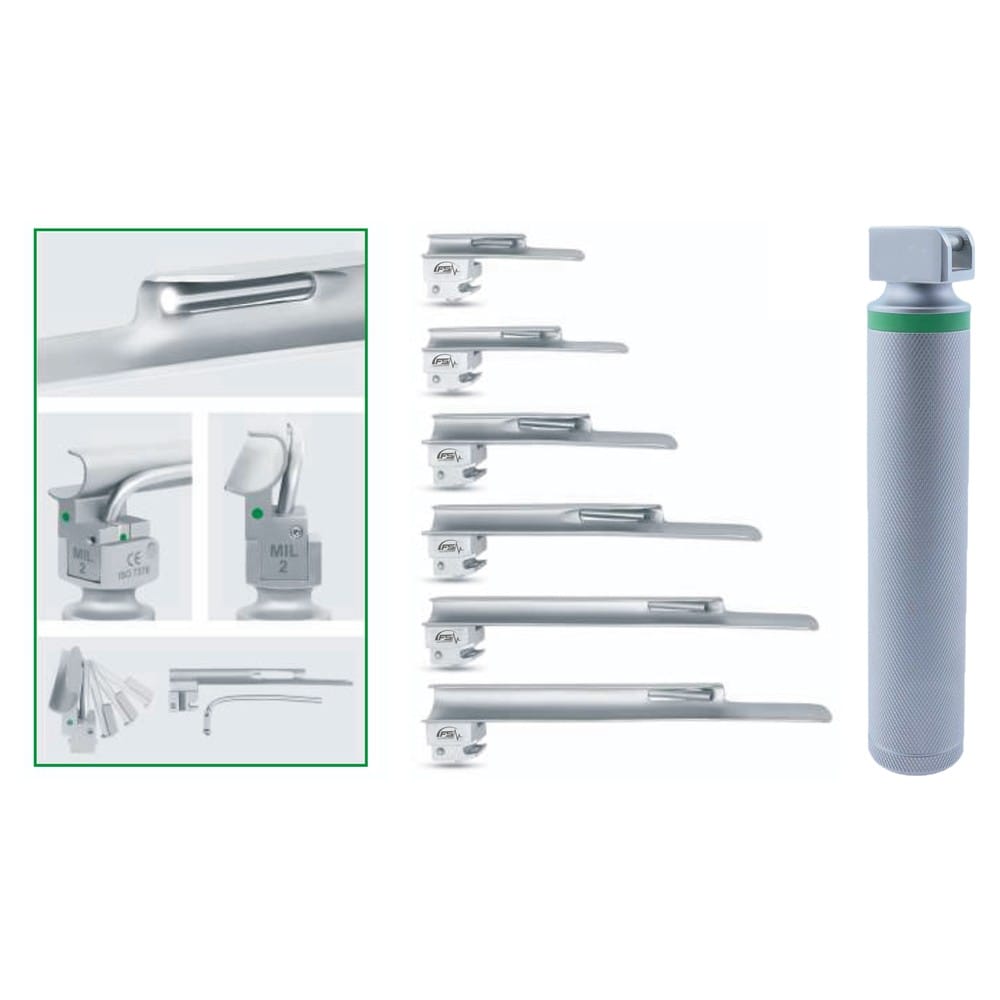
Miller Fiber Optic Blade 0 (Ref DI-210-02) — Catalogue reference DI-210-02.
- Miller straight blade with REMOVABLE light conductor (tool-free)
- Integrated fiber optic for best possible illumination
- 4 mm fiber-optic light conductor — up to 6,500 micro-fibers
- Compatible with all standard Fiber Optic handles
- AISI 303 / AISI 304 stainless steel with satin finish
- Smooth shape avoids sharp edges
- Fully autoclavable
- ISO 7376 standard fitting
| Reference / SKU | DI-210-02 |
| Pattern | Miller — straight blade, removable light conductor |
| Light system | 4 mm Fiber Optic · 6,500 micro-fibers |
| Handle compatibility | Fiber Optic · ISO 7376 standard |
| Power supply | 2 × C-size batteries (standard) · 2 × AA-size (paediatric/stubby) |
| Material | AISI 303 / AISI 304 stainless steel (AISI 316 on fiber-optic variants) |
| Sterilization | Steam autoclave to 134 °C · EtO compatible |
| Quality system | ISO 13485:2016 · CE-marked under EU MDR 2017/745 · FDA establishment-registered |
The laryngoscope blade and handle are the airway clinician’s primary intubation tools. Two blade families dominate: the Macintosh (curved, indirect epiglottis elevation) and the Miller (straight, direct epiglottis lift). Size 0 covers neonatal intubation; sizes 1 and 2 paediatric; sizes 3 and 4 adult. Conventional bulb-illumination blades remain in use in some settings; fiber-optic blades have largely replaced them in operating theatres for the brighter, glare-free light at the tip. Handles come in small (paediatric) and large (adult) variants and must mate with the chosen blade family. Manufacturing demands tight tolerance on the blade hinge and the bulb/fiber connection. Fizza supplies complete intubation sets in stainless steel with optional fiber-optic upgrades.
Every instrument is forged, machined, and finished at the Sialkot facility from German-origin stainless billet — austenitic 304 / 316 grades for non-cutting, mucosal-contact, and hollow-ware lines where corrosion resistance is the priority, martensitic 420 / 440 grades for cutting and edge-retention patterns where heat-treatable hardness matters, and 17-4 PH precipitation-hardened stainless for high-load orthopedic and implant-handling applications. Polishing, passivation, and final inspection are performed in-house under documented quality procedures aligned with ISO 13485:2016.


Reviews
There are no reviews yet.