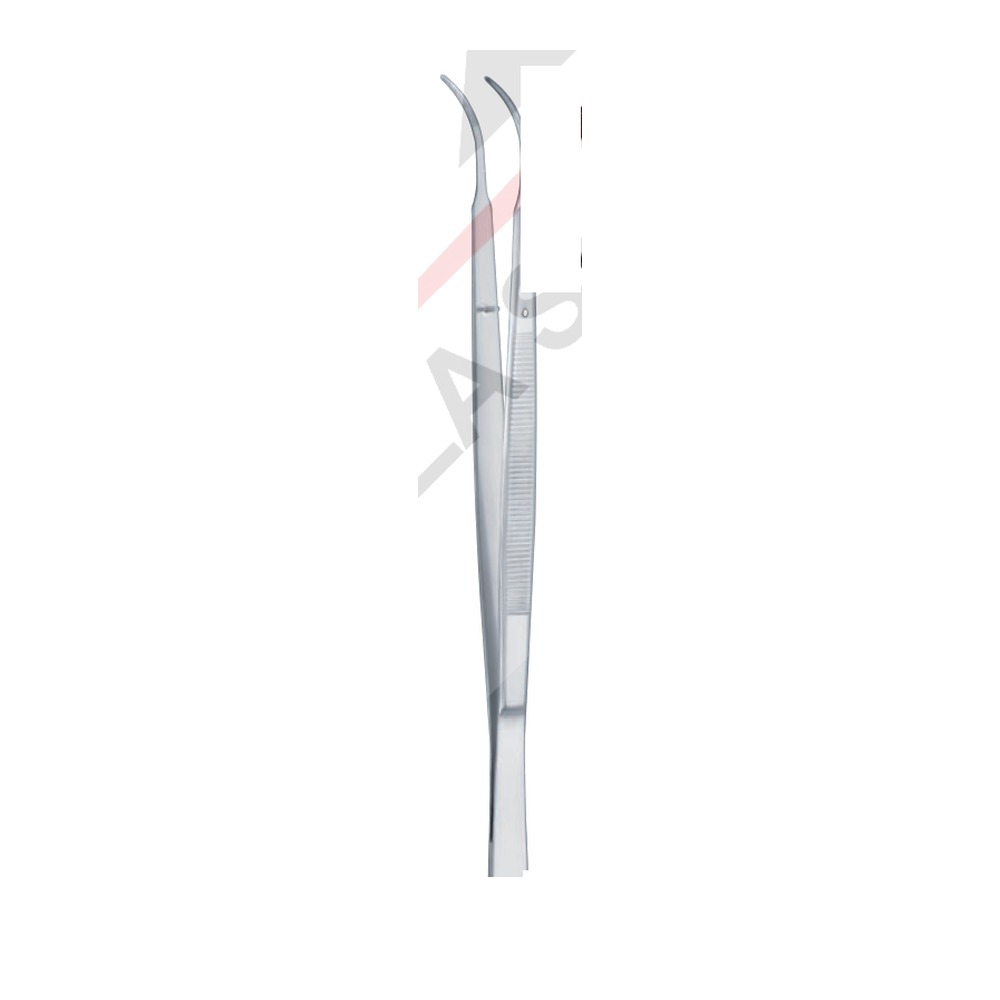
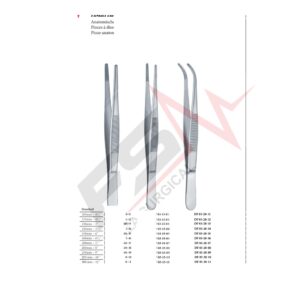
Gerald Curved Dressing Forceps — Around-The-Corner Pattern (Ref DF 03-56-00) — A curved working tip lets the surgeon work behind tissue planes and around vascular structures without obstructing the view.
| Reference / SKU | DF 03-56-00 |
| Shape | Curved |
| Material | AISI 420 martensitic stainless steel |
| Sterilization | Steam autoclave to 134 °C · EtO compatible |
| Quality system | ISO 13485:2016 · CE-marked under EU MDR 2017/745 · FDA establishment-registered |
From a procurement standpoint, surgical forceps are the most volume-intensive line in any operating-room instrument inventory: a standard general-surgery tray carries six to twelve forceps, and a large hospital cycles thousands through central sterile services every week. The metallurgy matters at that scale. AISI 420 stainless covers the majority of soft-tissue patterns where corrosion resistance and edge retention are the priority; AISI 440 and 17-4 PH are used on the heavier patterns where the jaws transmit higher closing force. Tungsten-carbide tip inserts roughly ten times the service life of plain stainless tips on toothed and serrated jaws. Fizza manufactures the full forceps catalogue at the Sialkot facility under ISO 13485:2016 with OEM private-label programs available from 300 units per SKU.
Manufacturing compliance is verified through ISO 13485:2016 certification (the international medical-device quality standard), CE marking under EU MDR 2017/745, and FDA establishment registration. Certificate copies and regulatory documentation are available on request for inclusion in hospital procurement files and EU technical documentation packages. Sterilization validation follows ISO 17665 for steam autoclave at 134 °C.

Reviews
There are no reviews yet.