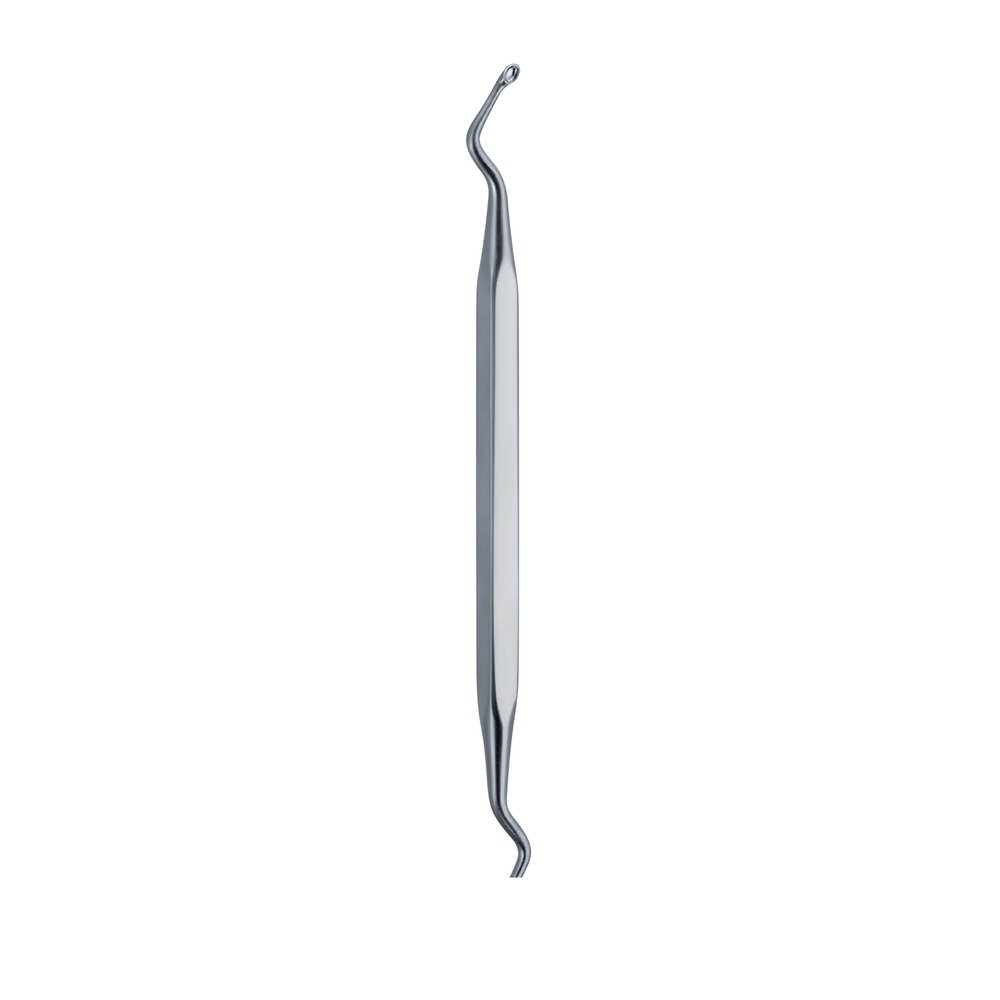
The Gross Ear Curette — Heavy-Duty CSOM Debris Removal (SKU EC 15-40-00) is part of the Fizza Surgical catalogue.
Forceps are the most numerous instrument family in any general-surgery tray — a class that spans hemostatic clamps, tissue-grasping instruments, dressing forceps, and specialty patterns developed for specific anatomical regions. Modern forceps design hasn’t changed fundamentally since the late nineteenth century: a box-lock joint, finger-ring handles, ratcheted closure, and working jaws shaped for the intended tissue type. What separates a workhorse pattern from a specialty instrument is the jaw geometry — toothed or atraumatic, serrated or smooth, straight or curved — and the choice depends on whether the surgeon needs to clamp, grip, manipulate, or simply hold. Fizza Surgical manufactures forceps to ISO 13485:2016 from German-grade AISI 420 stainless steel, with tungsten-carbide tip inserts available on premium variants.
| Reference / SKU | EC 15-40-00 |
| Material | AISI 420 martensitic stainless steel |
| Sterilization | Steam autoclave to 134 °C · EtO compatible |
| Quality system | ISO 13485:2016 · CE-marked under EU MDR 2017/745 · FDA establishment-registered |
- Gross Ear Curette — Loop Variant for Granulation (EC 15-45-00)
- Jansen Ear Curette — Large Variant for Antrum (EC 15-50-00)
- Jansen Ear Curette — Simple Mastoidectomy (EC 15-35-00)
Fizza Surgical exports to hospital groups, surgical distributors, and OEM partners across Europe, North America, the Middle East, Africa, and Asia. Container-load shipments move via DHL Express, UPS, FedEx, and major sea-freight lines on all Incoterms (EXW, FOB, CIF, DDP). All Incoterms 2020 commercial documentation, including health certificates and certificates of origin attested by the Sialkot Chamber of Commerce, is prepared in-house.


Reviews
There are no reviews yet.