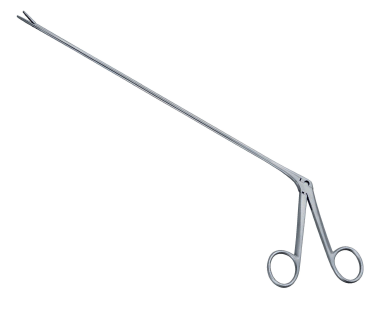
Mathieu needle holders are distinguished from the standard Mayo-Hegar by their squeeze-action handle design — the ratchet locks when the handles are squeezed together fully, and releases on a further squeeze. This single-handed operation appeals to surgeons working in confined spaces (oral surgery, deep cavity work) where the standard finger-ring Mayo-Hegar is cumbersome. The pattern is named for nineteenth-century French dental surgeon Paul Mathieu who developed it for intraoral suture work. Standard length is 14 cm. Tungsten carbide insert variants extend the working life of the jaw cross-hatching across thousands of autoclave cycles.
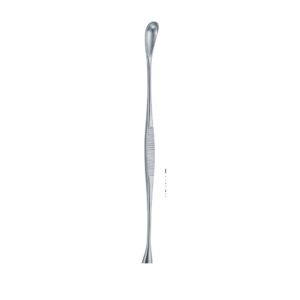
Mathieu Foreign Body Forceps — French Hypospadias Surgeon, manufactured by Fizza Surgical under reference UR 06-110-00.
| Reference / SKU | UR 06-110-00 |
| Pattern | Mathieu |
| Material | AISI 420 martensitic stainless steel (tungsten-carbide insert variants on TC SKUs) |
| Sterilization | Steam autoclave to 134 °C · EtO compatible |
| Quality system | ISO 13485:2016 · CE-marked under EU MDR 2017/745 · FDA establishment-registered |
Fizza Surgical International has manufactured surgical instruments at its Sialkot, Pakistan facility since 1980 — more than four decades of continuous operation under one family ownership. The factory holds ISO 13485:2016 certification for medical devices and CE marking under EU MDR 2017/745, the regulatory baseline European hospitals and distributors require. FDA establishment registration covers exports to the United States.

Reviews
There are no reviews yet.