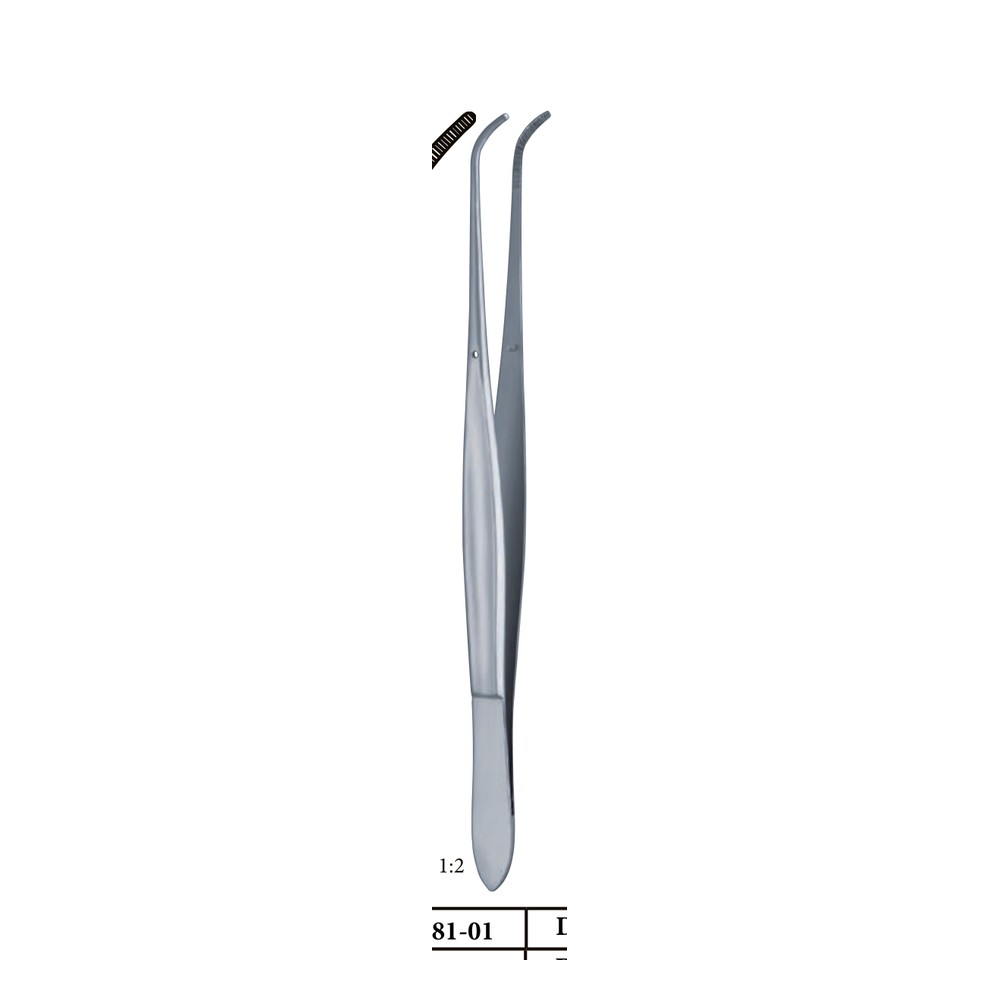
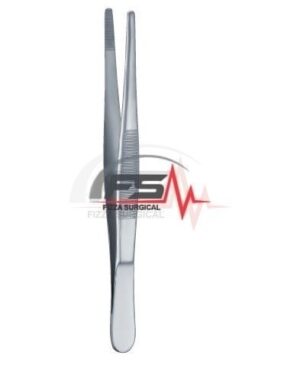
Reference DF 03-81-00: McIndoe-Cushing Dressing Forceps — Plastic-Neurosurgery Hybrid, supplied from the Fizza Surgical instrument catalogue.
| Reference / SKU | DF 03-81-00 |
| Pattern | Cushing |
| Material | AISI 440 / 17-4 PH precipitation-hardened stainless steel |
| Sterilization | Steam autoclave to 134 °C · EtO compatible |
| Quality system | ISO 13485:2016 · CE-marked under EU MDR 2017/745 · FDA establishment-registered |
Forceps are the most numerous instrument family in any general-surgery tray — a class that spans hemostatic clamps, tissue-grasping instruments, dressing forceps, and specialty patterns developed for specific anatomical regions. Modern forceps design hasn’t changed fundamentally since the late nineteenth century: a box-lock joint, finger-ring handles, ratcheted closure, and working jaws shaped for the intended tissue type. What separates a workhorse pattern from a specialty instrument is the jaw geometry — toothed or atraumatic, serrated or smooth, straight or curved — and the choice depends on whether the surgeon needs to clamp, grip, manipulate, or simply hold. Fizza Surgical manufactures forceps to ISO 13485:2016 from German-grade AISI 420 stainless steel, with tungsten-carbide tip inserts available on premium variants.
- Taylor-Cushing Dressing Forceps — Skull Base Combined (DF 03-52-01)
- Cushing Tissue Forceps Teeth 1×2 (DF 03-245-00)
Fizza Surgical International has manufactured surgical instruments at its Sialkot, Pakistan facility since 1980 — more than four decades of continuous operation under one family ownership. The factory holds ISO 13485:2016 certification for medical devices and CE marking under EU MDR 2017/745, the regulatory baseline European hospitals and distributors require. FDA establishment registration covers exports to the United States.

Reviews
There are no reviews yet.