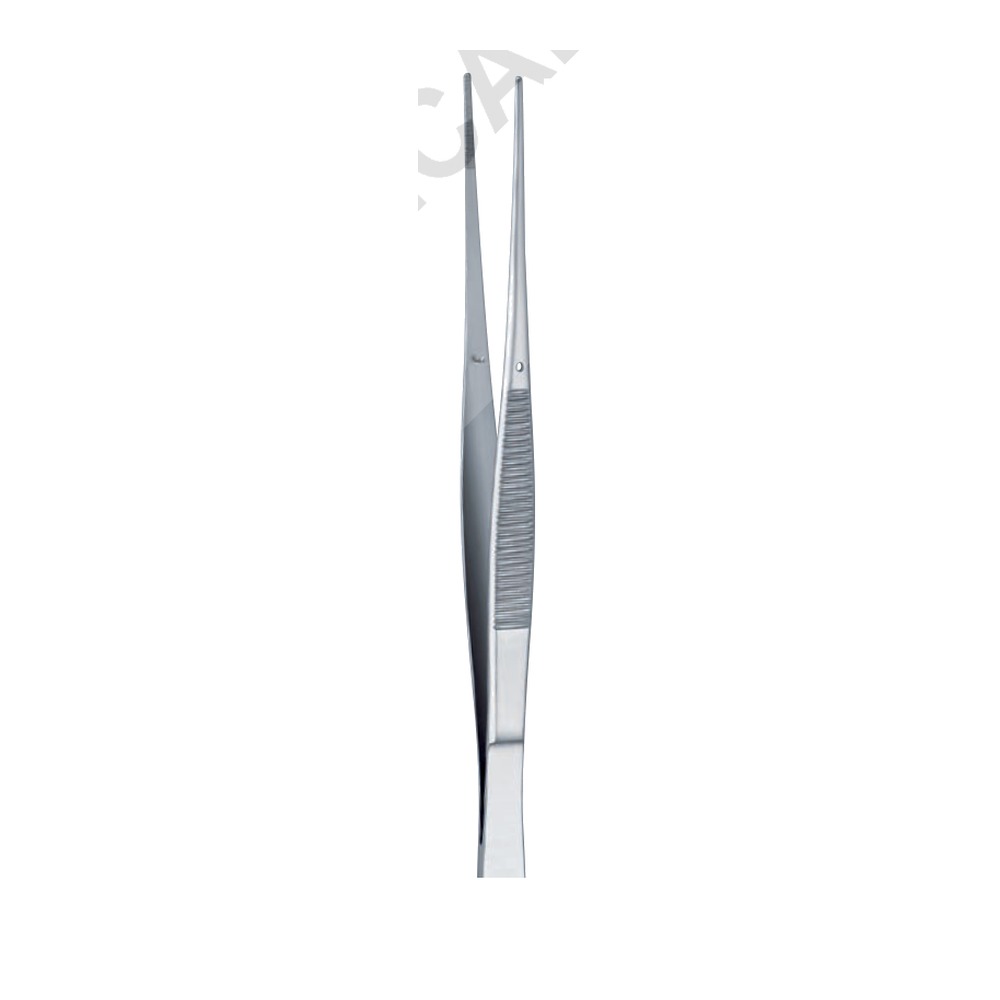
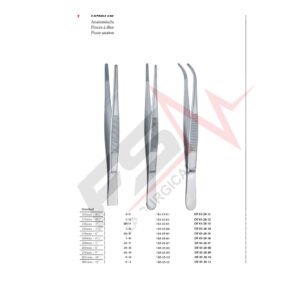
Potts-Smith Dressing Forceps — Paediatric Cardiac Pattern — catalogue reference DF 03-110-00.
Willis John Potts was a paediatric cardiothoracic surgeon at Northwestern who developed the angled scissors for cutting vessels during cardiac surgery — specifically the Blalock-Taussig and Potts shunts in early treatment of cyanotic congenital heart disease. Modern Potts scissors are used wherever angled vascular cuts are needed: vascular anastomosis, aortic surgery, vessel harvesting for coronary bypass, and trauma vascular repair. The defining feature is the angled blade — 25°, 45°, 60°, and 90° angles are all manufactured — letting the surgeon cut a vessel at any required angle without rotating the instrument. Most common in 18–20 cm overall length. Tungsten carbide tips are standard in modern vascular and cardiac sets.
| Reference / SKU | DF 03-110-00 |
| Pattern | Potts |
| Material | AISI 420 martensitic stainless steel |
| Sterilization | Steam autoclave to 134 °C · EtO compatible |
| Quality system | ISO 13485:2016 · CE-marked under EU MDR 2017/745 · FDA establishment-registered |
- Potts-Smith Curved Dressing Forceps — Coronary Anastomosis (DF 03-111-00)
- Potts-Smith Tissue Forceps Curved Teeth 1×2 (DF 03-151-00)
Fizza Surgical exports to hospital groups, surgical distributors, and OEM partners across Europe, North America, the Middle East, Africa, and Asia. Container-load shipments move via DHL Express, UPS, FedEx, and major sea-freight lines on all Incoterms (EXW, FOB, CIF, DDP). All Incoterms 2020 commercial documentation, including health certificates and certificates of origin attested by the Sialkot Chamber of Commerce, is prepared in-house.

Reviews
There are no reviews yet.