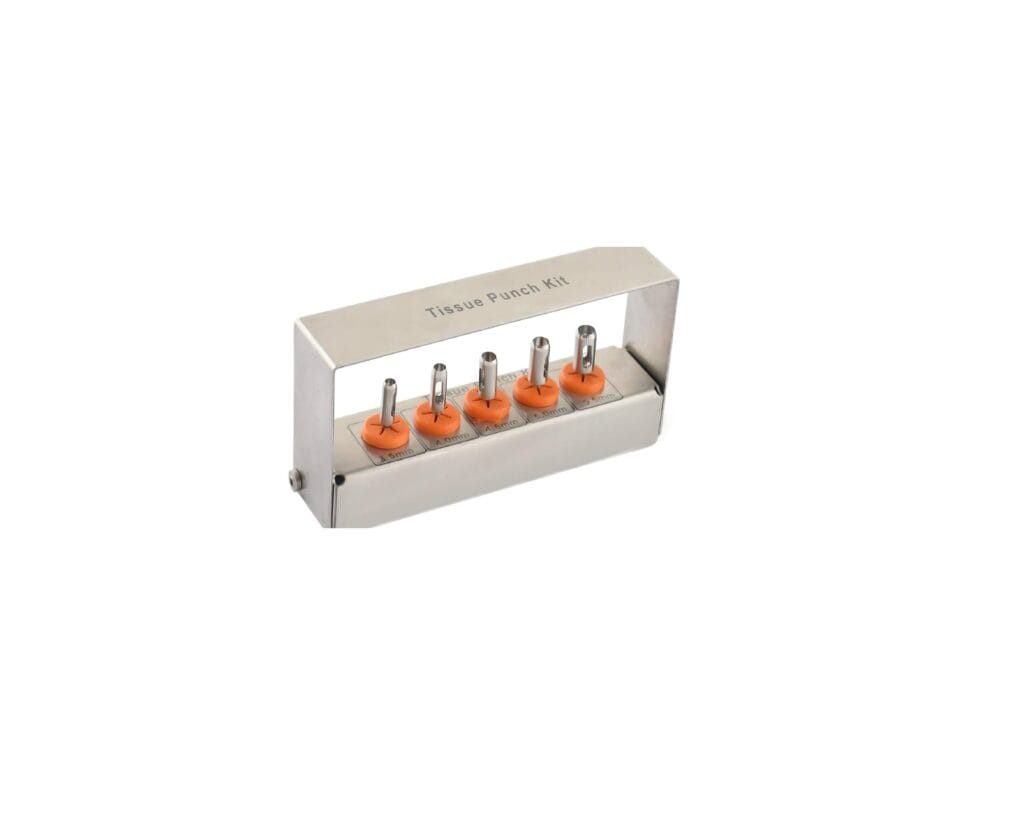
Tissue punch kit 5 pcs — Catalogue reference DI-105-01.
- McCoy lever-controlled flexible tip — adjustable through 90° for difficult intubation
- Outstanding light intensity with LED illumination via fiber bundle
- 3 mm Fiber Optic Light — 5,000 individual micro-fibers
- Reduced force required to visualize the larynx
- AISI 303 / AISI 304 stainless steel with satin finish
- Fully autoclavable and easier to clean
- ISO 7376 standard handle fitting
| Reference / SKU | DI-105-01 |
| Size | Size 1 (paediatric) |
| Blade dimensions | 92 mm × 71 mm |
| Pattern | McCoy flexible-tip — Macintosh-derivative |
| Light system | 3 mm Fiber Optic · 5,000 micro-fibers |
| Handle compatibility | Fiber Optic · ISO 7376 standard |
| Power supply | 2 × C-size batteries (in compatible handle) |
| Material | AISI 420 martensitic stainless steel |
| Sterilization | Steam autoclave to 134 °C · EtO compatible |
| Quality system | ISO 13485:2016 · CE-marked under EU MDR 2017/745 · FDA establishment-registered |
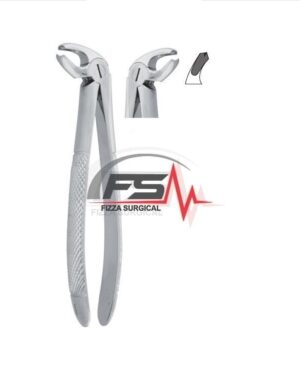
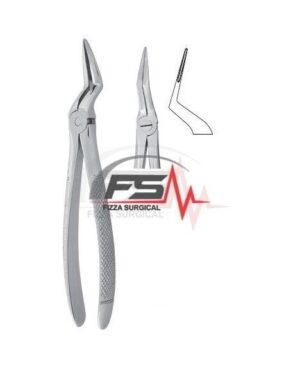
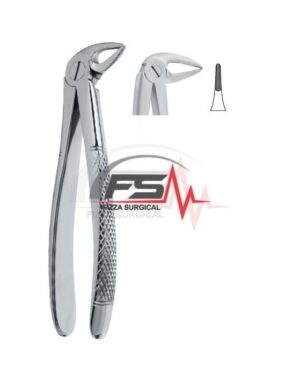
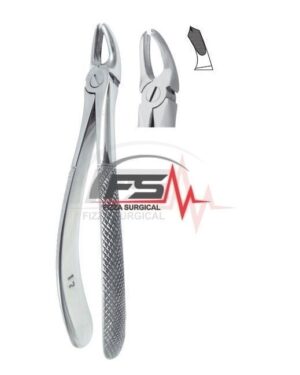
Dental instruments cover extraction forceps, elevators, excavators, scalers, scissors, mirror handles, and specialty patterns for endodontic and periodontal work. Extraction forceps are the workhorses — English-pattern (rotational grip) and American-pattern (lateral grip) cover the major tooth groups: incisors, canines, premolars, molars in both upper and lower arches. Dental scaler patterns (Gracey, Columbia, Younger-Good) target specific tooth surfaces during periodontal treatment. Elevators (Coupland, Cryer, Winter) loosen teeth before extraction. Modern dental instruments are manufactured from AISI 420 stainless for autoclavability and corrosion resistance; tungsten-carbide tips appear on scaler and curette variants where edge retention matters most. Fizza manufactures full dental sets to ISO 13485:2016.
Every instrument is forged, machined, and finished at the Sialkot facility from German-origin stainless billet — austenitic 304 / 316 grades for non-cutting, mucosal-contact, and hollow-ware lines where corrosion resistance is the priority, martensitic 420 / 440 grades for cutting and edge-retention patterns where heat-treatable hardness matters, and 17-4 PH precipitation-hardened stainless for high-load orthopedic and implant-handling applications. Polishing, passivation, and final inspection are performed in-house under documented quality procedures aligned with ISO 13485:2016.

Reviews
There are no reviews yet.