Circumcision Instrument Set: Gomco vs Plastibell Guide
Circumcision instruments compared: Gomco, Mogen and Plastibell neonatal sets plus the conventional surgical tray, with sizing and material guidance.
 Made in Sialkot · Since 1980
The instrument decides the technique. Choose a Gomco clamp and you are committed to a bell-and-baseplate method with a defined crush line. Choose a Plastibell and you are leaving a ring in place to separate on its own days later. Choose a Mogen clamp and you are working through a flat, fast crush. The same goal — removal of the foreskin — but three different trays, three different skill sets, and three different complication profiles.
This guide breaks down the instruments behind each neonatal method, plus the conventional surgical (sleeve/dorsal-slit) set used beyond the newborn period.
The three device methods at a glance
| Gomco clamp | Mogen clamp | Plastibell | |
|---|---|---|---|
| Mechanism | Bell over glans, baseplate crush | Flat slotted crush | Plastic ring, ligature, ring separates |
| Procedure time | ~10 min | Under 5 min | ~10 min |
| Training demand | Moderate | Lowest | Moderate |
| Glans protection | High (bell shields glans) | Lower (no glans shield) | High (ring shields glans) |
| Bleeding profile | Low | Lowest in trials | Low |
| Reusable? | Yes (metal) | Yes (metal) | No (single-use ring) |
The published comparisons are broadly reassuring: across Gomco, Mogen, and Plastibell, complication rates and ER return rates show no consistent clinically significant difference between methods. Where trials do separate them, the Mogen tends to come out faster and with slightly less bleeding and pain — which is why it is favoured where throughput and minimal training matter.
The Gomco clamp set
The Gomco is the most widely taught method in many hospitals. The clamp itself is a precision-machined assembly, and the set is built around it.
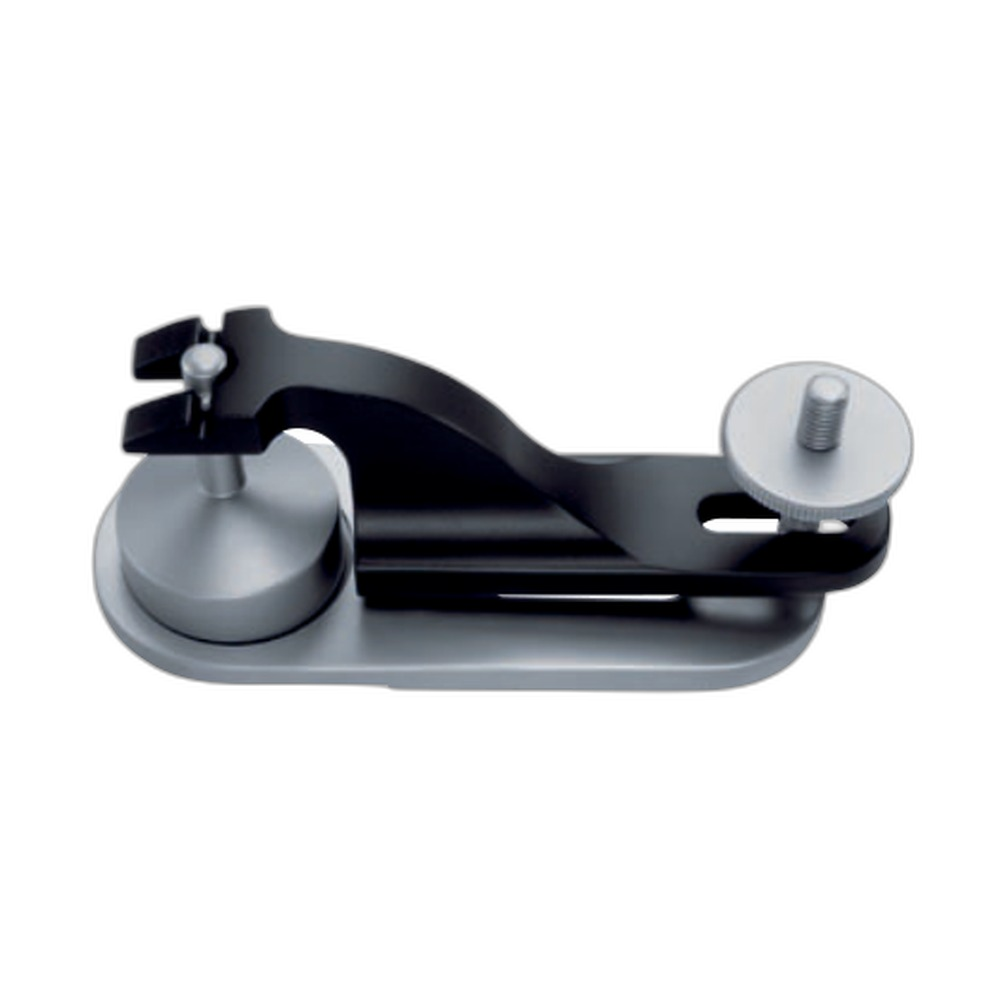
- Gomco clamp — bell, baseplate, yoke, and rocker nut, in graded bell sizes (commonly 1.1, 1.3, 1.45, 1.6 cm) matched to glans diameter.
- Mosquito hemostats — straight, to crush and open the dorsal adhesions and to hold the foreskin.
- Straight scissors — for the dorsal slit.
- Probe or blunt dissector — to free the inner preputial adhesions from the glans.
- Scalpel — to excise the foreskin against the baseplate after the crush.
- Forceps — fine tissue forceps for handling the prepuce.
Bell sizing is the part that matters most. Too small a bell and the crush is incomplete; too large and it will not seat. A complete Gomco set therefore carries the full range of bells, not a single size.
The Mogen clamp set
The Mogen is the minimalist tray. The clamp is a single hinged instrument with a slotted, flattened jaw. The foreskin is drawn through the slot, the clamp is locked, and the tissue is excised along the flat edge.
Because the method is fast and the instrument count is low, the supporting set is short: the Mogen clamp itself, a straight mosquito hemostat to crush the dorsal adhesions, a probe to free the glans, and fine scissors. The trade-off is the lack of a glans shield — the operator must be confident the glans is fully retracted clear of the slot before locking, which is the source of the rare but serious glans-injury reports tied to the method.
The Plastibell set
The Plastibell takes a different route. A correctly sized plastic bell is placed over the glans, the foreskin is drawn over it, a ligature is tied tightly in the groove of the bell, and the excess foreskin is trimmed. The handle snaps off, leaving the ring in place. The ring and the necrotic tissue separate and fall away over roughly five to ten days.
The set: graded Plastibell rings (sized to glans diameter), a ligature (suture tie), straight mosquito hemostats, a dorsal-slit scissors, and a probe. The rings are single-use, which is the defining logistical difference from the metal clamps — your procurement has to account for a consumable.
Conventional surgical (older children and adults)
Device methods are designed for the newborn, where adhesions are loose and the tissue is forgiving. Beyond the neonatal window, surgeons move to a freehand sleeve resection or dorsal-slit technique with a conventional fine surgical set:
- Scalpel and fine straight and curved scissors
- Multiple fine artery forceps (mosquito) for haemostasis
- Toothed and non-toothed dissecting forceps
- A needle holder for the absorbable sutures that re-approximate the skin edges
- Skin hooks or fine retractors
- Bipolar diathermy forceps for haemostasis
This is essentially a minor plastic-surgery tray, and the instrument quality requirements are the same as any fine soft-tissue set: scissors that cut to the tip, forceps that meet precisely, and needle holders that hold a fine needle without slipping.
Bell and ring sizing: the detail that drives outcomes
Across all three device methods, sizing is the variable that most affects the result. The device has to match the glans diameter — too small and the crush or the ligature is incomplete, leaving bleeding or a ragged edge; too large and the device will not seat correctly, risking either too little or too much tissue removal.
This is why a usable Gomco or Plastibell programme stocks the full graded range rather than a single popular size. A neonatal unit that orders only the mid-size bell will eventually meet the larger or smaller infant for whom that bell does not fit, and improvising on sizing is exactly the wrong place to improvise. We supply these sets as complete size ranges for that reason.
Reusable clamps versus single-use rings: the procurement trade-off
The choice between a metal clamp method and the Plastibell is partly clinical and partly logistical. The Gomco and Mogen clamps are reusable stainless instruments: a higher upfront cost, then years of service, with the recurring cost being only sterilisation. The Plastibell shifts the model — the clamp cost disappears, replaced by a per-procedure consumable that must be stocked, sized, and reordered.
For a high-volume newborn programme, the reusable clamp usually wins on lifetime cost, provided the sterilisation capacity exists. For a unit doing occasional procedures, or one where reprocessing turnaround is a bottleneck, the single-use ring can be the more practical choice. Neither is inherently superior; the right answer depends on volume and the sterile-processing pipeline.
Material and standards
Metal circumcision clamps and the supporting instruments are forged from martensitic stainless — AISI 410 or 420 — and must withstand repeated autoclaving at 134°C without losing the precision of the crush surfaces. On a Gomco, the mating of bell to baseplate is a machined fit; corrosion or wear there compromises the haemostatic crush, so passivation and finish quality are not cosmetic.
All instruments should carry ISO 13485 and CE documentation, with steel conforming to ISO 7153-1. For paediatric and neonatal use, the finishing standard is especially important — no burrs, no sharp edges beyond the intended cutting surfaces.
Frequently Asked Questions
Which neonatal circumcision method is fastest?
The Mogen clamp is the fastest, often completed in under five minutes, and requires the least training. The Gomco and Plastibell methods typically take around ten minutes.
Is one method clearly safer than the others?
Comparative studies show no consistent clinically significant difference in overall complication rates among Gomco, Mogen, and Plastibell. Some trials favour the Mogen for slightly less bleeding and pain.
Why does the Gomco clamp come in multiple bell sizes?
The bell must match the glans diameter for an effective, even crush. Bells commonly range from about 1.1 to 1.6 cm, so a complete set carries the full range.
Is the Plastibell reusable?
No. The Plastibell ring is a single-use device left in place to separate naturally over five to ten days, so it must be stocked as a consumable.
What set is used for adult circumcision?
A conventional fine surgical set — scalpel, fine scissors, artery forceps, dissecting forceps, needle holder, and bipolar diathermy — because the freehand sleeve or dorsal-slit technique replaces the neonatal device methods.
Choosing your set
Match the tray to the population and the operator’s training. Newborn programmes standardise on one device method — most often Gomco or Mogen — and stock the full size range. Mixed practices that also see older children need the conventional surgical set alongside.
Fizza Surgical manufactures Gomco and Mogen clamps, supporting neonatal sets, and fine surgical instruments in Sialkot, ISO 13485 certified and CE marked. Browse our surgical instruments range, and review our certifications for full compliance documentation. For other procedure-specific trays, our growing library of set guides covers general, ENT, and gynaecologic surgery.
Need precision surgical instruments?
Configure complete instrument sets with our team — ISO 13485 certified, CE marked, made in Sialkot since 1980.
Related Guides
View all articles →
Where We Serve
Fizza Surgical exports to 50+ countries. Browse our country-specific pages with local regulatory guidance and pricing: