Thyroidectomy Instrument Set: Complete Surgical Tools Guide
Complete thyroidectomy instrument set guide: haemostats, DeBakey forceps, nerve hooks, Joll's retractor, steel grades and tray care.
 Made in Sialkot · Since 1980
Two structures dictate the entire design of a thyroidectomy tray, and neither of them is the thyroid. The recurrent laryngeal nerve — a strand a millimetre or two across running in the tracheoesophageal groove — and the parathyroid glands, each the size of a lentil and dependent on a fragile end-artery, are what the surgeon is really protecting. Every fine clamp, every right-angle, every atraumatic forceps in the set exists so that the gland can be removed without sacrificing a nerve that controls the voice or four glands that control calcium.
This guide lays out a complete thyroidectomy instrument set by surgical stage, with the sizes and patterns that matter, and explains why neck surgery rewards delicate, well-made steel over bulk.
The operation the tray is built around
A thyroidectomy — hemithyroidectomy, subtotal, or total — is done through a transverse collar (Kocher) incision a finger-breadth or two above the sternal notch. The surgeon raises subplatysmal flaps, separates the strap muscles in the midline, and rotates the thyroid lobe medially to expose its blood supply and the nerve. The work is shallow but unforgiving: a dense field of small vessels, vital nerves, and glands that look like fat. The instrument set is therefore biased toward fine haemostasis, atraumatic retraction, and precise dissection rather than the heavy clamps of abdominal surgery.
Stage 1 — incision and flap elevation
The skin and platysma are opened with a No. 15 blade on a No. 3 handle. Subplatysmal flaps are raised with Metzenbaum scissors and held with skin hooks or a self-retaining retractor. Fine-toothed Adson forceps handle skin edges atraumatically; for a refresher on their patterns, see our Adson forceps guide. A Joll’s self-retaining thyroid retractor — a sprung frame with toothed blades — holds the skin flaps open and is one of the few instruments specific to thyroid and neck work.
Stage 2 — exposure and retraction
Once the strap muscles are split in the midline, the lobe must be rotated and the operative pocket held open without bruising tissue. This is where the retraction group does its job: Langenbeck retractors (small and medium) lift the strap muscles, while a Kocher thyroid (Lahey) retractor and small Cushing vein retractors hold the finer planes. A Lahey goitre tenaculum (thyroid traction forceps) grasps the lobe itself to deliver it forward into the wound. Gentle, steady retraction here is what keeps the recurrent laryngeal nerve out of harm’s way; aggressive pulling stretches and injures it without ever cutting it.
Stage 3 — the critical dissection and haemostasis
The superior and inferior thyroid vessels are ligated close to the capsule to preserve the parathyroid blood supply. This is the heart of the case and the busiest part of the tray:
- Mosquito (Halsted) forceps, curved and straight, in quantity — the small vessels of the thyroid bed are clamped and tied dozens of times.
- Lahey and Crile haemostatic forceps for slightly larger pedicles.
- Mixter right-angle forceps to pass ligatures around the superior pole vessels in a tight space.
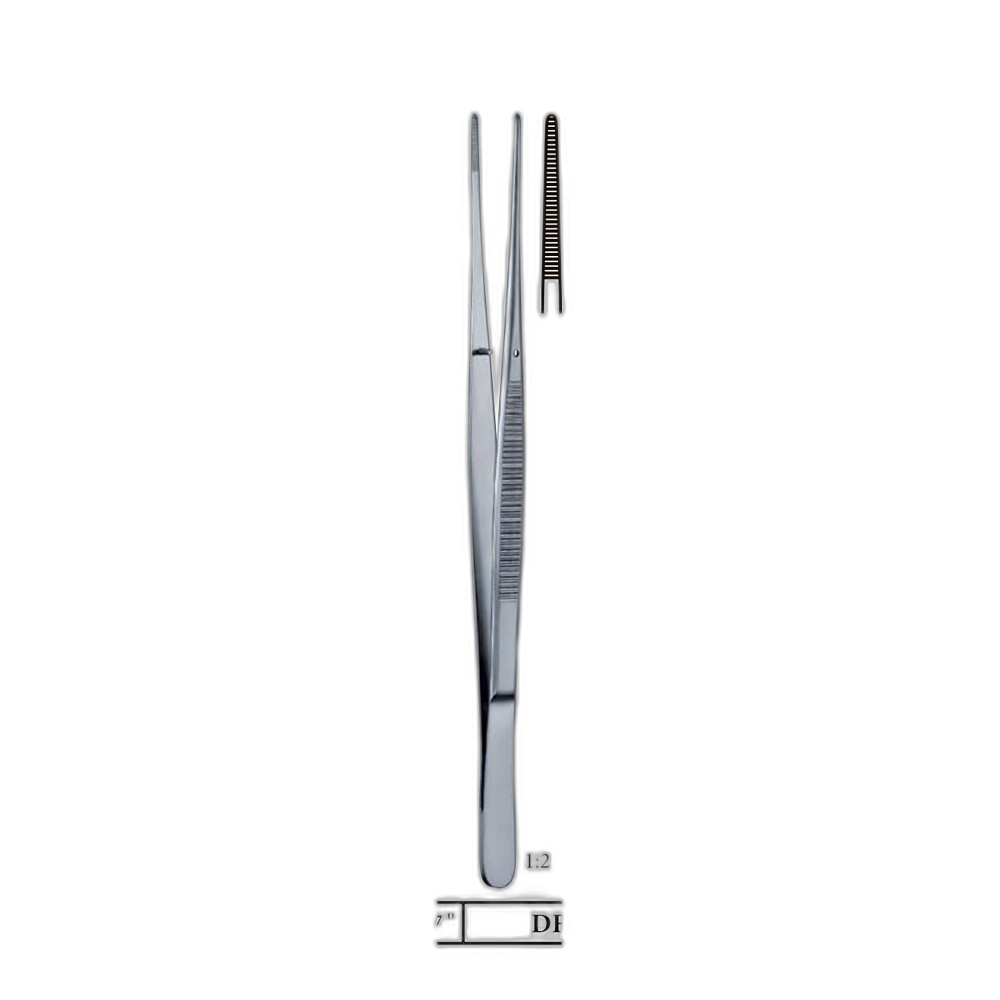
- DeBakey atraumatic forceps to handle vessels and the nerve without crushing.
- Fine nerve hook and a McDonald dissector to identify and trace the recurrent laryngeal nerve.
Ligation is done with fine ties (3-0 and 4-0) on the vessels; bipolar diathermy or an energy device supplements but does not replace careful clamp-and-tie technique near the nerve, where stray thermal spread is dangerous.
Stage 4 — division, delivery and closure
With the vessels controlled and the nerve identified, the lobe is freed from the trachea, dividing the ligament of Berry — a notoriously vascular attachment hugging the nerve. The specimen is delivered, the bed is checked for haemostasis with the patient in slight Valsalva, and a drain may be placed. The strap muscles and platysma are reapproximated with absorbable suture on a Mayo-Hegar or Crile-Wood needle holder, and the skin is closed subcuticularly or with clips. Mayo scissors cut sutures and heavier tissue throughout; the distinction between Mayo and Metzenbaum is worth knowing and we cover it in our Mayo vs Metzenbaum comparison.
Core thyroidectomy instrument set: tray reference
| Instrument | Pattern / size | Stage / role |
|---|---|---|
| Scalpel handle No. 3 + No. 15 blade | Standard | Skin / platysma incision |
| Metzenbaum scissors | 14–18 cm, curved | Flap elevation, fine dissection |
| Mayo scissors | 14–17 cm | Heavier tissue, suture cutting |
| Adson tissue forceps | 1×2 teeth, 12 cm | Skin handling |
| DeBakey forceps | 15–20 cm | Atraumatic vessel/nerve handling |
| Joll’s thyroid retractor | Self-retaining | Hold skin flaps |
| Langenbeck retractor | Small & medium | Strap muscle retraction |
| Lahey goitre tenaculum | 3-prong | Grasp / deliver lobe |
| Mosquito forceps (Halsted) | 12.5 cm, curved & straight | Fine haemostasis (multiple) |
| Crile / Lahey forceps | 14–16 cm | Pedicle haemostasis |
| Mixter right-angle forceps | 18–20 cm | Pass ligatures, superior pole |
| Nerve hook / McDonald dissector | Fine | Identify recurrent laryngeal nerve |
| Mayo-Hegar needle holder | 15–18 cm | Closure |
Clamp-and-tie versus energy devices: what stays in the tray
Energy devices — harmonic scalpels and advanced bipolar sealers — have changed how thyroid vessels are controlled, sealing the superior and inferior pedicles without a single tie. They speed the operation and reduce the haemostat count. But they have not emptied the tray, and any surgeon who treats them as a replacement for instrument technique eventually regrets it.
Energy devices are kept well away from the recurrent laryngeal nerve because lateral thermal spread can injure a nerve the jaws never touched — typically a 2–3 mm safety margin is observed. In the danger zone around the ligament of Berry and the nerve’s entry to the larynx, the work returns to fine mosquito forceps, a nerve hook, and precise clamp-and-tie. So a modern thyroidectomy set carries fewer haemostats than it did a decade ago, but the fine ones that remain are used in exactly the spot where instrument quality matters most. The energy device handles the easy two-thirds; the steel handles the dangerous third.
Hemithyroidectomy versus total: how the tray scales
The same base set serves a diagnostic hemithyroidectomy and a total thyroidectomy for cancer or large multinodular goitre, but the demands scale. A hemithyroidectomy works on one lobe, needs fewer haemostats, and rarely troubles more than one or two parathyroids. A total thyroidectomy doubles the dissection, puts all four parathyroids and both recurrent laryngeal nerves at risk, and may extend into a central neck dissection that adds fine right-angle forceps and a longer specimen-handling burden.
For large retrosternal goitres, the set may need to reach below the manubrium, occasionally calling for sternotomy instruments on standby — a rare but planned-for escalation. The practical lesson for procurement is to specify the total-thyroidectomy configuration as the default tray, because scaling down for a hemithyroidectomy is free, while scaling up mid-case for an unexpectedly difficult gland is not.
Why material quality is non-negotiable in neck surgery
The fine forceps that work next to the recurrent laryngeal nerve must close with perfectly aligned tips — a mosquito forceps with a 0.2 mm tip gap will let a small vessel slip and bleed into the exact field where visibility matters most. That precision comes from forging the working instruments in hardenable martensitic stainless steel (AISI 410/420), heat-treating for hardness, and finishing the tips by hand. DeBakey forceps rely on their fine, atraumatic serration pattern to grip without crushing — a pattern only worth having if the steel holds it.
Fizza Surgical forges thyroid and general surgery instruments to ISO 7153-1, under an ISO 13485 quality management system, CE marked for the EU. You can review the documentation on our certifications page, and the full range sits in the surgical instruments catalogue. The same atraumatic forceps and haemostat families appear in our general and vascular sets, so a hospital standardising on one steel supplier gets consistent tip quality across trays.
Counting, care and the parathyroid problem
A thyroidectomy tray carries a high count of small, easily-misplaced instruments — a dozen or more mosquito forceps, fine ties, a removed specimen, and sometimes a parathyroid gland being checked or auto-transplanted. A disciplined instrument and swab count before closure is a patient-safety essential, not a formality. After surgery, box joints on the haemostats and the serrations on the DeBakeys must be cleaned with the jaws open, ultrasonically processed, lubricated, and function-tested. A DeBakey whose serrations have worn smooth no longer grips atraumatically and should be retired before it forces a surgeon to use a toothed forceps on a vessel.
Frequently Asked Questions
What instruments are unique to a thyroidectomy set?
The instruments most specific to thyroid surgery are the Joll’s self-retaining thyroid retractor, the Lahey goitre tenaculum for grasping the lobe, the Kocher/Lahey thyroid retractor, and the nerve hook used to identify the recurrent laryngeal nerve. The rest of the tray is shared with general neck and soft-tissue sets.
Why are so many mosquito forceps needed in thyroid surgery?
The thyroid bed is densely vascular with many small vessels that are clamped and tied close to the capsule to preserve the parathyroid blood supply. A total thyroidectomy can require a dozen or more fine mosquito (Halsted) forceps working simultaneously, so trays carry them in quantity.
How are the recurrent laryngeal nerve and parathyroids protected during surgery?
By gentle retraction, capsular dissection that ligates vessels close to the gland, atraumatic DeBakey forceps, a fine nerve hook to trace the nerve, and limited use of energy devices near it. Intra-operative nerve monitoring is increasingly used alongside the instrument set.
What is the difference between Mayo and Metzenbaum scissors in this set?
Metzenbaum scissors are lighter with a longer shank-to-blade ratio for delicate dissection such as flap elevation, while Mayo scissors are heavier for cutting tougher tissue and sutures. Both are present in a thyroidectomy tray for different stages of the case.
What steel should thyroidectomy instruments be made from?
Working instruments — haemostats, scissors, needle holders — should be hardenable martensitic stainless steel (AISI 410/420) for edge and tip precision, conforming to ISO 7153-1 and manufactured under an ISO 13485 system with CE marking for EU supply.
Fizza Surgical is an ISO 13485-certified, CE-marked manufacturer of general and specialty surgical instruments in Sialkot, Pakistan, supplying hospitals and distributors worldwide for over 40 years. To configure a thyroidectomy or neck surgery instrument set, contact our team through the surgical instruments catalogue.
Need precision surgical instruments?
Configure complete instrument sets with our team — ISO 13485 certified, CE marked, made in Sialkot since 1980.
Related Guides
View all articles →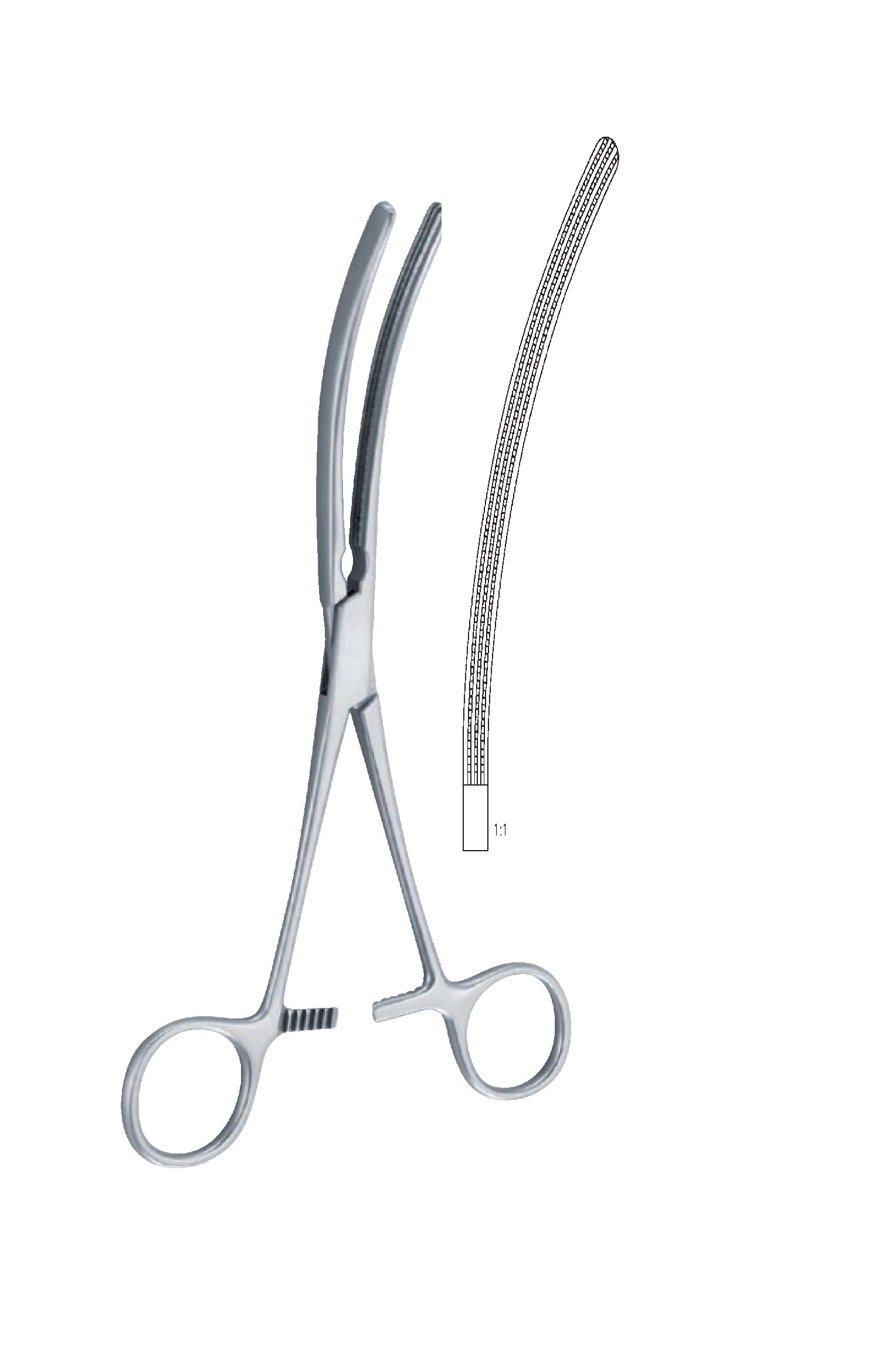

Where We Serve
Fizza Surgical exports to 50+ countries. Browse our country-specific pages with local regulatory guidance and pricing: