Hemorrhoidectomy Instruments: Complete Anorectal Surgery Guide
Hemorrhoidectomy instruments explained: anal retractors, forceps and energy devices for Milligan-Morgan, Ferguson, stapled and Doppler-guided surgery.
 Made in Sialkot · Since 1980
Two operations dominate excisional haemorrhoid surgery, and the instrument tray tells you which one you are walking into before the surgeon says a word.
| Technique | Wound | Region of Practice | Instrument Signature |
|---|---|---|---|
| Milligan-Morgan (open) | Excision left open to heal by secondary intention | UK, Europe | Anal retractor, artery forceps, scissors, diathermy |
| Ferguson (closed) | Excision with the mucosal defect sutured closed | United States | Same base set plus needle holder and continuous suture |
The anorectal set is small compared with a laparotomy tray, but every instrument on it is chosen for one hostile environment: a tight, moist, well-innervated canal where exposure is everything and bleeding is constant. This guide covers the complete set of hemorrhoidectomy instruments for open and closed procedures, plus the stapled and Doppler-guided variants that need dedicated devices.
Diagnosis and Grading Before the Excision
Before a single cushion is excised, the surgeon confirms the grade and position of the disease. That examination has its own short instrument list, and it usually shares the tray.
- Anoscope (proctoscope) — a short tubular scope that presents the anal canal and distal rectum, used to confirm the number and position of the haemorrhoidal columns, classically at 3, 7 and 11 o’clock in the lithotomy position.
- Sigmoidoscope — to exclude a more proximal source of bleeding before attributing it to haemorrhoids.
- Lubricated examining finger and swabs — for the digital rectal examination that precedes any instrumentation.
Skipping this step is a classic error: rectal bleeding blamed on haemorrhoids can mask a proximal tumour, which is why the scope goes in first.
Exposure: The Anal Retractor Decides the Case
You cannot excise a haemorrhoidal cushion you cannot see, and the anal canal collapses the instant you stop holding it open. Retraction is the first and most important choice on the tray.
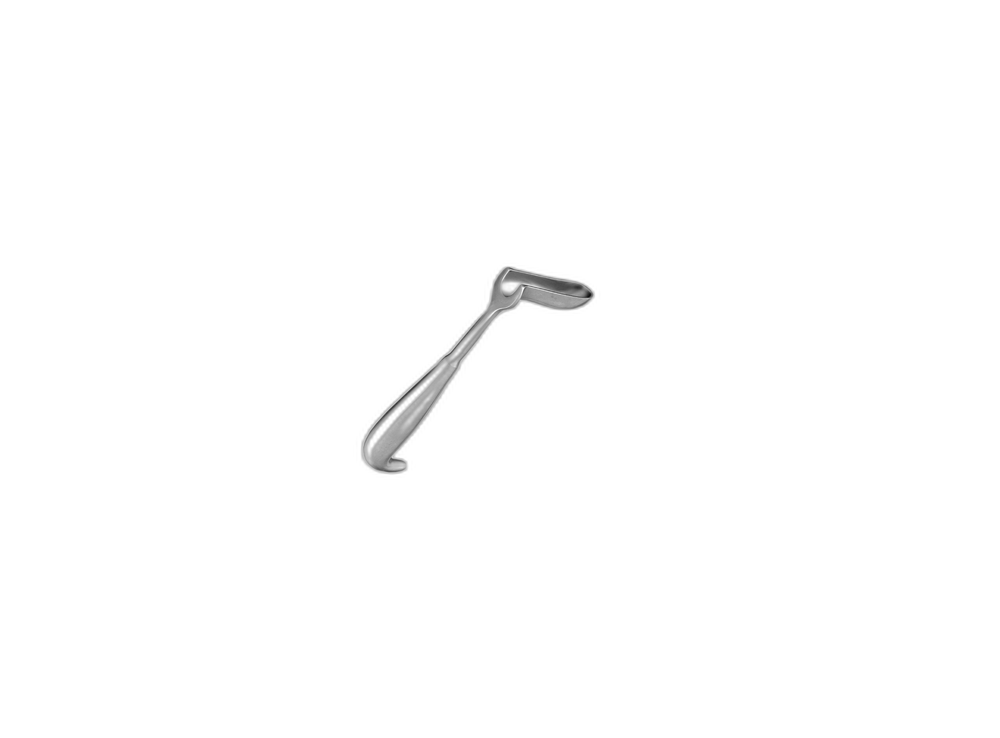
- Parks self-retaining retractor — a bivalve or trivalve retractor that holds the canal open without an assistant, freeing both of the surgeon’s hands. The workhorse for excisional haemorrhoidectomy.
- Hill-Ferguson retractor — a curved, single-blade retractor that presents one haemorrhoidal column at a time while protecting the sphincter. Available in small, medium and large to match the canal.
- Fansler and Sims speculums — tubular and vaginal-pattern retractors used for circumferential exposure in some anorectal work.
- Eisenhammer bivalve retractor — adjustable blades that spread the canal for wider access.
A self-retaining anal retractor works on the same self-holding principle as the Gelpi retractor used in perineal and orthopaedic surgery — the blades lock apart so the field stays open through the whole excision.
Grasping and Clamping
Each haemorrhoidal cushion is grasped, drawn down, and clamped at its base before excision. Precise, secure clamping at the pedicle is what keeps the field dry.
- Kocher (Ochsner) forceps — the toothed tip grips the perianal skin tag or the apex of the cushion firmly for traction.
- Allis tissue forceps — atraumatic grasping of the mucosa and cushion during dissection.
- Curved artery (haemostatic) forceps — a Halsted mosquito or a Crile placed across the vascular pedicle before it is transfixed.
- St Mark’s pattern forceps — dedicated anorectal haemostats used in some UK sets.
Cutting and Dissection
Excision can be sharp, by diathermy, or by an energy device. The tray usually carries all three options.
- Mayo and Metzenbaum scissors — curved Mayo for the tougher perianal skin, Metzenbaum for the finer submucosal dissection that spares the internal sphincter.
- No. 15 scalpel on a No. 3 handle — for the initial skin incision at the base of the external component.
- Monopolar diathermy pencil — increasingly the primary cutting and coagulating tool, reducing intraoperative blood loss.
- Advanced energy devices — LigaSure and Harmonic haemorrhoidectomy seal the pedicle and divide it in one step, a technique associated with less postoperative pain in several trials.
Suturing and Ligation
In the closed Ferguson technique the mucosal wound is sutured; in both techniques the pedicle is transfixed. Rubber band ligation, often combined with excision, needs its own applicator.
- Needle holder — a fine Mayo-Hegar or Crile-Wood for placing 3-0 chromic or polyglactin on the pedicle and mucosal closure.
- Barron or McGivney band ligator — for banding internal haemorrhoids, frequently used alongside excision of the external component.
- Suture scissors and fine tissue forceps — toothed and non-toothed Adson pattern for handling delicate anoderm.
The precise mucosal handling here calls for the same delicate, fine-tipped pickups described in our guide to Adson forceps.
Stapled and Doppler-Guided Variants
Two device-driven procedures sit alongside conventional excision and need purpose-built kit rather than a general set:
- Stapled haemorrhoidopexy (PPH / Longo procedure) — uses a circular stapling device with a purse-string anoscope and threader to resect and lift a ring of rectal mucosa above the dentate line, treating prolapse rather than excising cushions.
- Doppler-guided haemorrhoidal artery ligation (HAL/THD) — uses a specialised proctoscope with an integrated Doppler probe to locate and suture-ligate the feeding arteries.
Both are single-use or device-specific and are not part of a reusable steel tray, but a hospital offering the full range of haemorrhoid surgery keeps them stocked alongside the conventional set.
A Complete Excisional Set at a Glance
| Function | Instruments |
|---|---|
| Diagnosis | Anoscope / proctoscope, sigmoidoscope |
| Exposure | Parks self-retaining retractor, Hill-Ferguson (S/M/L), Eisenhammer |
| Grasping | Kocher forceps, Allis forceps, curved artery forceps |
| Cutting | No. 15 scalpel, Mayo and Metzenbaum scissors, diathermy pencil |
| Haemostasis / energy | Monopolar diathermy, advanced bipolar or ultrasonic sealer |
| Ligation | Needle holder, 3-0 absorbable suture, band ligator |
The distinction that separates one set of hemorrhoidectomy instruments from another is rarely the forceps or scissors — those are shared across general surgery. It is the anal retractor and the energy device that define the case.
Materials and Reprocessing
Reusable anorectal instruments are manufactured from surgical stainless steel — martensitic AISI 410/420 for scissors and clamps, austenitic grades for retractors that need corrosion resistance through frequent cycling. Because anorectal cases are contaminated by definition, point-of-use enzymatic soaking and thorough ultrasonic cleaning are non-negotiable before sterilisation. Retractor blades and box-lock joints trap faecal and blood soil, so instruments are cleaned open, inspected, and steam-sterilised as a wrapped tray. Fizza Surgical manufactures anorectal retractors, forceps and scissors under ISO 13485 with full CE marking.
Frequently Asked Questions
What retractor is used for a haemorrhoidectomy?
The Parks self-retaining retractor and the Hill-Ferguson retractor are the two most common. The Parks holds the canal open hands-free, while the Hill-Ferguson presents one haemorrhoidal column at a time and protects the sphincter. Both come in graded sizes to match the patient’s anal canal.
What is the difference between the Milligan-Morgan and Ferguson instrument sets?
The base instruments are nearly identical — retractor, grasping forceps, scissors and diathermy. The difference is that the closed Ferguson technique adds a needle holder and suture to close the mucosal defect, whereas the open Milligan-Morgan technique leaves the wound open to heal by secondary intention.
Do you need special instruments for stapled haemorrhoidopexy?
Yes. Stapled haemorrhoidopexy (the PPH or Longo procedure) requires a dedicated circular stapler kit that includes the stapling device, a purse-string anoscope, and a suture threader. It is a single-use device set, separate from the reusable steel instruments.
Why is diathermy preferred over scissors in modern haemorrhoidectomy?
Diathermy excision seals small vessels as it cuts, reducing intraoperative blood loss and keeping the field clearer than cold scissor dissection. Many surgeons now use a monopolar pencil or an advanced bipolar energy device as the primary cutting tool, reserving scissors for fine sphincter-sparing dissection.
Sourcing an Anorectal Surgery Set
A well-built haemorrhoidectomy tray comes down to graded anal retractors that hold exposure, secure grasping forceps, and clean-cutting scissors that spare the sphincter. Fizza Surgical supplies the complete proctology and anorectal instrument range — for related diagnostic tools, see our comparison of the anoscope, proctoscope and sigmoidoscope, or browse the full surgical instruments catalogue.
Need precision surgical instruments?
Configure complete instrument sets with our team — ISO 13485 certified, CE marked, made in Sialkot since 1980.
Related Guides
View all articles →

Where We Serve
Fizza Surgical exports to 50+ countries. Browse our country-specific pages with local regulatory guidance and pricing: