Frazier Suction Tube: Neurosurgery & ENT Suction Guide
The Frazier suction tube explained: French sizes, tip angles, thumb-port control and uses in neurosurgery and ENT, plus care and troubleshooting.
 Made in Sialkot · Since 1980
Why does a neurosurgeon reach for a Frazier tip and not a Yankauer? Because in a 15 mm-deep operative corridor next to the dura, a bulky suction tip is not clearing the field — it is blocking the view and threatening the structure you are trying to protect. The Frazier suction tube exists for exactly the surgery the Yankauer cannot enter.
What the Frazier Suction Tube Is
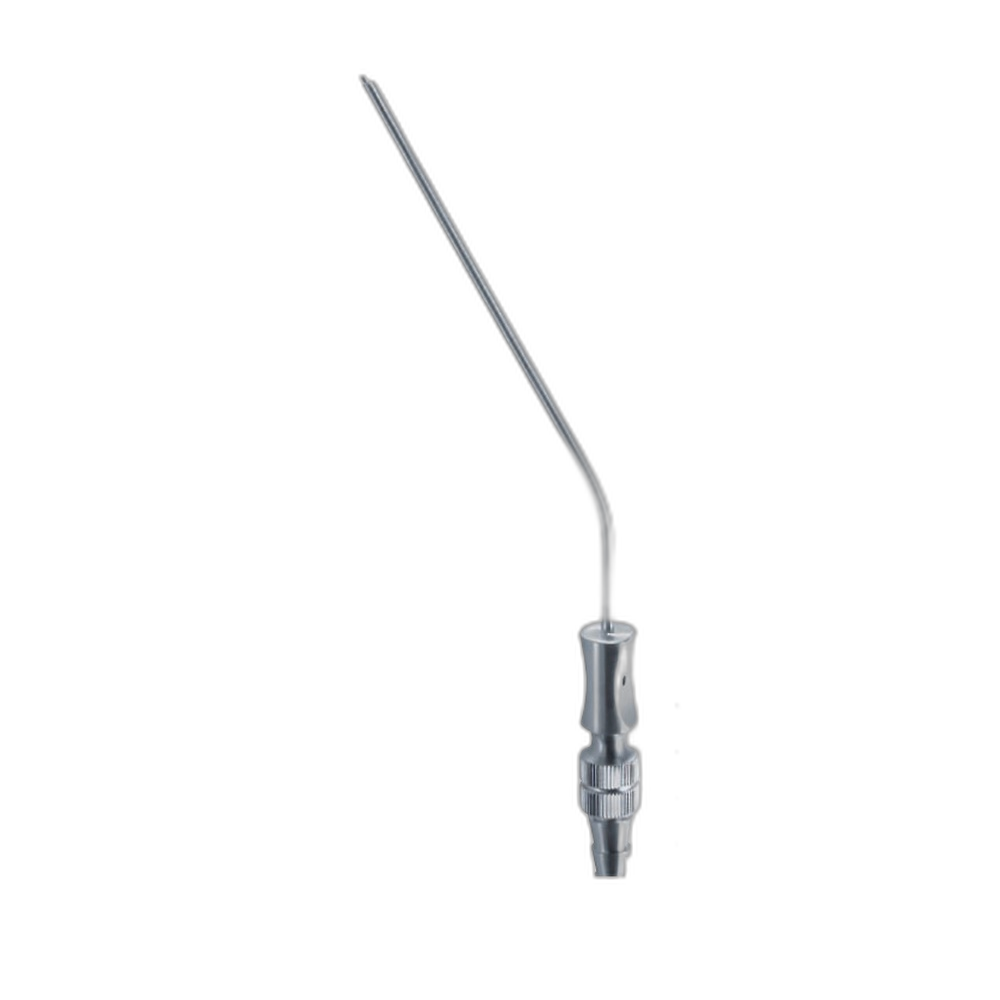
The Frazier is a slender, angled suction tube for delicate, confined-space surgery. Its defining features are a fine calibre, a shaft bent at roughly 30° near the tip, and a thumb-control port drilled into the finger ring. Cover the port with your thumb and full suction reaches the tip; lift it and suction bleeds off — giving graded, precise control without ever looking away from the field.
Ergonomically, the tube is designed to be held like a pen, with the index finger resting naturally over the thumb port despite the name. That grip keeps the surgeon’s hand stable and the wrist neutral through long microsurgical cases, where fatigue and tremor are the enemy. The finger ring also lets the instrument be spun between the fingers to reposition the angled tip without regripping.
A removable stylet runs the length of the lumen. When tissue debris or a clot blocks the narrow bore, you pass the stylet to clear it and keep working, rather than swapping to a fresh tube.
Sizes and the French Gauge
Frazier tips are measured in French gauge (Fr), where the number is three times the external diameter in millimetres. Common sizes:
| French size | Approx. outer diameter | Typical use |
|---|---|---|
| 6 Fr | 2.0 mm | Paediatric, fine neurosurgical dissection |
| 7 Fr | 2.3 mm | Micro-neurosurgery, delicate ENT |
| 9 Fr | 3.0 mm | General ENT, sinus and cervical work |
| 10 Fr | 3.3 mm | Larger ENT fields |
| 12 Fr | 4.0 mm | Robust suction, spine surgery |
| 14 Fr | 4.6 mm | Higher-volume evacuation |
Working lengths are typically short — around 12.5 cm for a straight tube, with 5–7 cm effective reach on the angled patterns — because the whole point is control in a shallow, narrow corridor. Tip angles range from about 30° up to 90° for the deepest recesses.
Where It Earns Its Place
Neurosurgery
Cranial and spinal procedures live in the Frazier’s natural territory. During a laminectomy or a microdiscectomy the surgeon clears bone dust and blood from millimetres away from the dura and nerve roots. The fine tip and thumb-port control let suction be feathered rather than blasted.
ENT and Sinus Surgery
The nasal cavity, ear canal, and paranasal sinuses are among the most confined fields in surgery. A Frazier tube threads into these spaces where a broad-mouthed tip simply will not fit. In endoscopic sinus work it clears the field alongside the scope without crowding the lens.
Frazier vs Yankauer vs Poole
Choosing a suction instrument is really about matching tip size to field volume:
- Frazier — fine, angled, thumb-controlled. Small precise fields: neuro, ENT, spine.
- Yankauer — rigid, larger bore, rounded head. Oropharynx and general open fields.
- Poole — large, multi-perforated shroud. High-volume irrigation and abdominal fluid.
For the abdominal end of that spectrum, see our comparison of the Yankauer vs Poole suction tips.
Straight vs Angled: Which to Reach For
The tip angle is not a cosmetic choice. A near-straight instrument gives the most direct line of suction and the best tactile feedback, ideal when the target sits shallow and in front of you — a superficial ear procedure, for instance. As the angle increases toward 90°, the tip reaches around corners and into recesses the eye and the straight tube cannot follow: the depth of a mastoid cavity, the far wall of a sinus, the underside of a nerve root.
Most surgeons keep two or three angles open on the tray and switch as the dissection moves. A 30° tip covers the majority of neurosurgical and sinus work; steeper angles come out for the deep, hidden corners.
Troubleshooting Weak Suction
When one of these tips stops pulling, the instrument is rarely the culprit. Work through the chain:
- Thumb port not sealing — check the finger is fully covering the hole; a partial seal bleeds off suction.
- Occluded lumen — pass the stylet; dried clot from a previous case is the usual offender.
- Kinked or disconnected tubing — trace the line back to the canister.
- Wall vacuum low — confirm the regulator setting before blaming the instrument.
A tip that pulls weakly straight out of the tray almost always has a retained-debris problem from inadequate reprocessing, not mechanical wear.
Materials, Care, and Longevity
Reusable Frazier tubes are made from surgical stainless steel — usually 304 or 316 grade — chosen for corrosion resistance across repeated autoclave cycles. The narrow lumen is the maintenance challenge: dried blood and protein are hard to reach and, if left, seed corrosion and blockage.
Good practice is to flush the lumen with enzymatic cleaner immediately after use, pass the stylet or a cleaning brush through the full length, then ultrasonically clean before sterilisation. A tube that suctions weakly is usually not worn out — it is partially occluded by retained debris.
Manufacturing should meet ISO 7153-1 for the steel and be produced under an ISO 13485 quality system, with proper passivation so the inner bore resists the pitting that repeated cleaning chemistry would otherwise cause.
Reusable vs Single-Use
Both formats exist, and the choice turns on volume and reprocessing capacity. Reusable stainless tubes have the lower per-case cost over their lifetime and the tactile quality surgeons in fine fields prefer, but they carry a real cleaning burden — that narrow lumen has to be verified clear every cycle, and a Central Sterile department without lumen-cleaning discipline will quietly build up occluded, corroding tubes.
Single-use tips remove the reprocessing risk entirely and guarantee a clear lumen every time, which is why some high-throughput ENT and spine services adopt them. The trade-off is recurring cost and the environmental footprint of disposables. For most departments running a competent CSSD, well-made reusable tubes remain the economical, sustainable default — provided the instruments are built to hold up to hundreds of cycles without pitting.
Frequently Asked Questions
What is a Frazier suction tube used for?
It provides fine, controllable suction in confined operative fields — principally neurosurgery (cranial and spinal), ENT, and sinus surgery — where a larger tip would obstruct the view or endanger delicate structures.
What does the hole in the Frazier suction handle do?
It is a thumb-control port. Covering it with your thumb delivers full suction at the tip; uncovering it bleeds off suction. This lets the surgeon modulate suction precisely without looking away from the field.
What size Frazier suction tube should I use?
Match the French size to the field: 6–7 Fr for paediatric and fine neurosurgical work, 9–10 Fr for general ENT and sinus surgery, and 12–14 Fr where more robust evacuation is needed, such as spine surgery.
Why is there a stylet with the Frazier tube?
The lumen is narrow and blocks easily with clot or tissue debris. The stylet is passed through the bore to clear obstructions during surgery and as part of cleaning, keeping the suction working without swapping instruments.
Explore the full surgical instruments range, including suction and airway tools that pair with our laryngoscopes.
Need precision surgical instruments?
Configure complete instrument sets with our team — ISO 13485 certified, CE marked, made in Sialkot since 1980.
Related Guides
View all articles →
Where We Serve
Fizza Surgical exports to 50+ countries. Browse our country-specific pages with local regulatory guidance and pricing: