Army-Navy Retractor: The Most Versatile Handheld Retractor
The army navy retractor is a double-ended handheld staple. Dimensions, uses, technique, and how it compares to other surgical retractors.
 Made in Sialkot · Since 1980
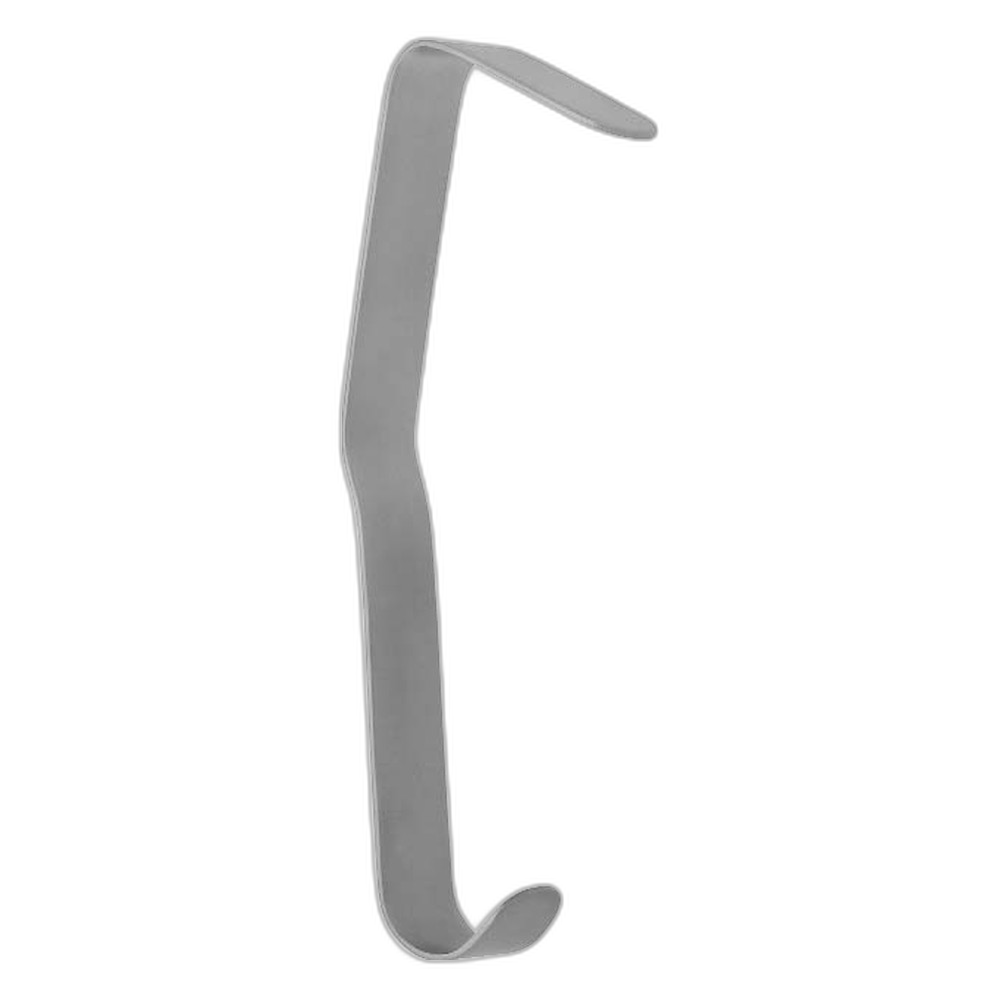
It carries a military name because it was standardised for US military field surgery in the mid-twentieth century, when one instrument that could handle both shallow and deeper retraction saved weight and space in a field kit. The design proved so practical it never left the civilian OR. Today the army navy retractor — sometimes catalogued as the US Army or USA-Pattern retractor — is one of the first instruments laid out on almost any general tray.
It is a handheld, double-ended retractor, and its whole appeal is in those two ends.
The Two-Ended Design
Each end is a flat blade bent at roughly a right angle to the handle, and the two blades are different depths. Flip the instrument and you change how deep you can retract without picking up a second tool. One end gives you a shallow lip for skin and fat; the other reaches further for muscle and deeper layers.
The blades are smooth and atraumatic, with a lip at the tip that catches the wound edge so the blade does not slide out under tension. Because it is handheld, an assistant controls the exact tension and angle moment to moment — the opposite philosophy to a self-retaining instrument like the retractors that lock open on their own.
Dimensions
| Specification | Typical range |
|---|---|
| Overall length | 21–25 cm (8.25–10″) |
| Blade width | 13–25 mm |
| Blade depths (the two ends) | ~26 mm and ~44 mm |
| Weight | 50–100 g |
The 8.25″ double-ended model is the version most hospitals stock, usually in pairs so two assistants can work opposite edges of the same incision.
Where It Earns Its Place
The army navy is a generalist, which is exactly why it is everywhere. Its job is retracting skin, fat, and muscle during minor procedures and the opening and closing stages of larger ones.
- General surgery — exposure while opening through subcutaneous and muscle layers.
- Orthopedics — holding soft tissue clear during fracture and joint work.
- Plastic and reconstructive — gentle handling of flaps and superficial planes.
- Emergency and field surgery — its origin and still a strength, where one versatile tool beats five specialised ones.
For deeper abdominal work it hands off to longer blades; pair it conceptually with the Deaver retractor for deep retraction once the field is open. The army navy gets you in; deeper instruments take over below.
Using It Well
Most retraction problems with this instrument come from technique, not the tool. Hook the blade lip under the wound edge rather than pressing the flat of the blade against tissue — the lip is what converts the assistant’s pull into clean exposure without the blade riding out. Pull along the line the surgeon needs the tissue to move, not straight up; lifting vertically tents the skin and narrows the very window you are trying to open.
In a two-assistant setup, the pair work opposite edges and mirror each other’s tension so the incision opens evenly. If one side pulls harder, the field skews and the surgeon loses the midline. Switching ends mid-case is routine: start with the shallow blade while opening through fat, then flip to the deeper blade as the dissection reaches muscle, all without breaking scrub to find another instrument.
Steady, moderate tension beats brief hard pulls. Sustained even retraction keeps the field predictable and is far kinder to the tissue edge over a long opening or closing.
How It Compares to Other Handhelds
The army navy occupies a specific niche among handheld retractors, and it helps to know its neighbours:
- Army Navy — double-ended, two retraction depths, smooth atraumatic blades; the generalist for superficial-to-mid layers.
- Langenbeck — a single right-angle blade, deeper and narrower; better for a focused deep slot. See our Langenbeck vs Farabeuf comparison.
- Richardson — heavier, with a hooked lip built for the abdominal wall in open laparotomy.
- Deaver — long and curved for deep organ retraction once the cavity is open.
Where the army navy beats all of them is versatility per instrument: two depths, no moving parts, light in the hand, and equally at home in a tertiary OR or a field kit.
None of those neighbours makes it obsolete, and it makes none of them obsolete either. The army navy is the instrument you open with and close with on case after case, while the specialised blades come and go as the depth and shape of the wound demand. That is why it is rarely the most expensive retractor on the tray and almost always the most used.
Why It Stays on Every Tray
Three things keep this retractor universal. It is cheap to stock in pairs, so equipping a general tray costs little. It has nothing to break — no hinge, ratchet, or fine tip to dull — so it survives heavy rotation through the CSSD with minimal attrition. And the double-ended design means one instrument covers the work two single-ended retractors would otherwise occupy. For a procurement team building out general trays at scale, that combination of low cost, durability, and versatility is hard to beat. It is the kind of unglamorous instrument that earns its place by simply always being there and always working.
Material and Care
Standard versions are forged from AISI 410 or 420 surgical stainless per ISO 7153-1, with titanium and insulated (for electrosurgery) options available. Titanium runs roughly 40% lighter for the same stiffness, which matters when an assistant holds the instrument for an extended closing; insulated patterns carry a non-conductive coating so the blade can sit safely next to an active electrode.
There is no hinge or ratchet, which makes it one of the lowest-maintenance instruments on the tray — clean the blade and the lip, inspect for bends, and sterilize. The only real failure mode is a bent blade or a flattened tip lip that stops catching the wound edge; both come from prying or dropping rather than normal use. A retractor that has been used as a lever to crack open a tight fascial plane is the one you will find bent at the next count.
What to Check Before You Buy
Run a thumbnail along the blade edge — it should be smooth, with no burr that could nick a glove or abrade tissue. Sight down the blade to confirm it is flat and unbent, and press the lip against a firm surface to confirm it holds its shape. Finally, weigh it in the hand: a quality army navy balances comfortably and does not feel blade-heavy. Because these are usually bought in volume for general trays, consistency across a batch is worth checking on a sample before accepting a large order.
Frequently Asked Questions
Why is it called an army navy retractor?
The double-ended pattern was standardised for US military field surgery, where a single instrument covering two retraction depths saved space in a field kit. The name stuck as it moved into civilian operating rooms.
What are the two ends for?
Each end is a blade of a different depth bent at a right angle to the handle. Flipping the instrument switches between shallow retraction (skin and fat) and deeper retraction (muscle) without reaching for another tool.
Is it self-retaining?
No. It is handheld, so an assistant controls tension and angle directly. For hands-free retraction you would use a self-retaining type such as a Gelpi or Weitlaner.
What size should a hospital stock?
The 8.25″ (21 cm) double-ended model in pairs covers most general cases, letting two assistants retract opposite wound edges.
Sourcing from Fizza Surgical
Fizza Surgical manufactures army navy retractors in Sialkot from ISO 7153-1 stainless, in standard, titanium, and insulated patterns, supplied individually or in pairs. Every instrument is CE marked under ISO 13485:2016. Browse the surgical instruments range or view our certifications for OEM and bulk orders.
Need precision surgical instruments?
Configure complete instrument sets with our team — ISO 13485 certified, CE marked, made in Sialkot since 1980.
Related Guides
View all articles →
Where We Serve
Fizza Surgical exports to 50+ countries. Browse our country-specific pages with local regulatory guidance and pricing: