Deaver Retractor: Deep Abdominal Retraction Guide for Surgeons
Deaver retractor guide: curved-blade design, blade widths 25-75 mm, uses in cholecystectomy, and Deaver vs Harrington vs Richardson.
 Made in Sialkot · Since 1980
The abdomen is open, the gallbladder fossa is the target, and the problem is the liver. Its broad right lobe sits squarely over the operative field, draped across exactly the structures the surgeon needs to see. An assistant slides a curved blade beneath the lobe, lifts gently toward the costal margin, and the field opens. The cystic duct, the cystic artery, the triangle of Calot, all of it now visible. That blade is a Deaver retractor, and in deep open abdominal and pelvic work it is one of the most relied-upon hand-held instruments on the tray.
This guide covers the design, sizing, materials, and clinical handling of the Deaver retractor from a manufacturer’s bench. We have produced these instruments in Sialkot for over four decades, and the details below reflect what actually matters when a surgeon picks one up.
Curved-Blade Design: Why the Deaver Holds Deep Tissue
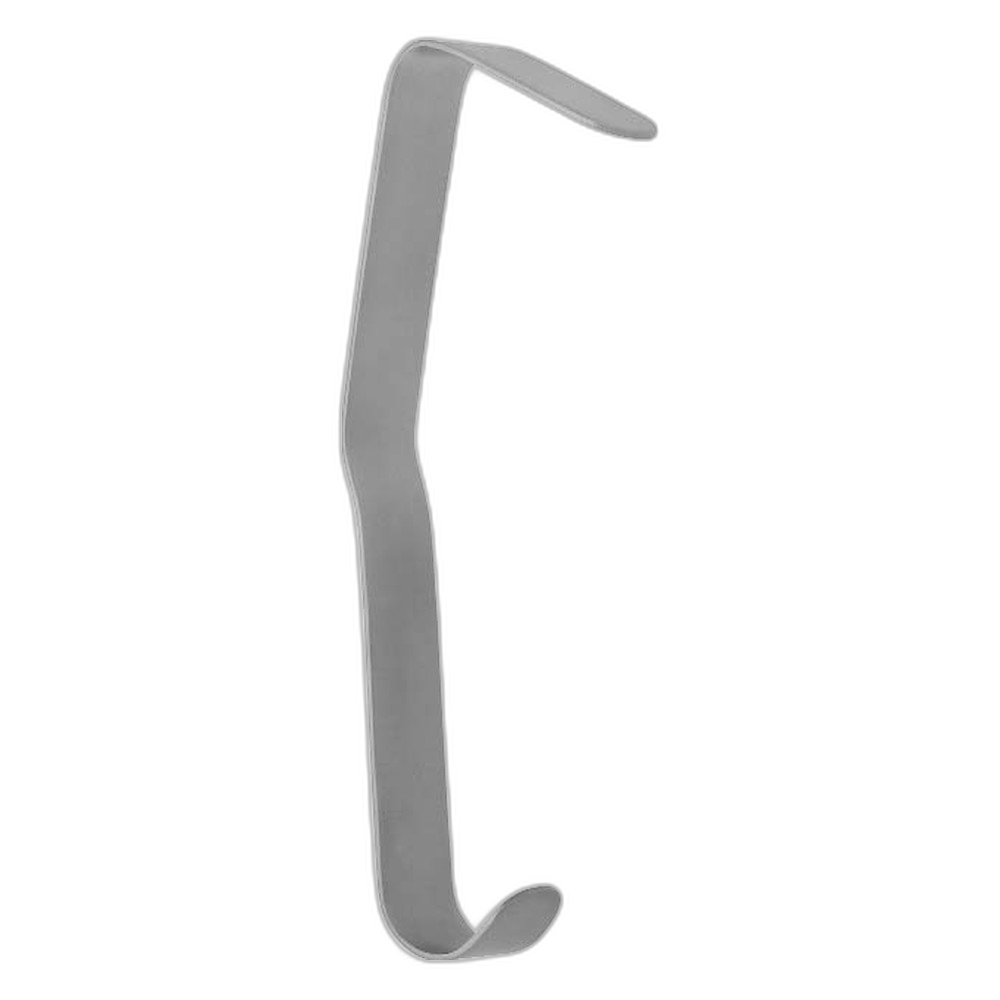
The Deaver retractor is a single hand-held instrument with one long, gently curved blade and a solid handle. The defining feature is the curvature. The blade sweeps in a smooth C-shape, often described as a question-mark or hook profile, so the working end reaches down into a cavity and then curves back to cradle whatever is being held.
The blade itself is thin, flexible, and concave on its inner face. The edges are rounded and the surface is smooth, with no teeth, lip, or sharp margin. That matters when you are retracting liver, bowel, or bladder for an extended period. A blunt concave blade distributes pressure across a wide contact area and slides under tissue without catching it.
Flexibility is deliberate. Unlike a rigid Richardson blade, the Deaver gives slightly under load. The surgeon can seat it against the curve of an organ and let it conform rather than dig in.
One blade, one handle, one assistant. The Deaver is not self-retaining. It is held in position for as long as exposure is needed, which makes blade choice and padding important considerations we return to below.
Blade Widths and Lengths: Reading the Numbers
Deaver blades come in a graded range of widths, and choosing correctly is most of the skill in using one well. Common widths run from 25 mm (1 inch) through 38 mm (1.5 inch) up to 50 mm (2 inch), with wider blades to 75 mm available for the broadest exposure.
Width controls how much tissue the blade holds and how much of the wound it occupies. A narrow 25 mm blade slips into a tight pelvic corner or a pediatric field without crowding the surgeon’s hands. A 50 mm blade sweeps a whole lobe of liver aside in one motion but takes up real estate in the incision.
Overall instrument length typically sits around 305 to 315 mm, roughly 30 to 32 cm, with longer 38 cm patterns made for very deep cavities. The length is what lets the curved blade reach the floor of a deep abdomen while the handle stays clear of the field and the assistant’s grip stays out of the surgeon’s line of sight.
The curve depth varies with the pattern. A shallow-curve Deaver is suited to broad, near-surface retraction of the abdominal wall, while a deeper-curve blade is built to hook well under viscera and lift them out of a deep field.
Specifications Table
| Blade width | Blade length | Curve depth | Typical use |
|---|---|---|---|
| 25 mm (1″) | ~305 mm overall | Shallow | Pediatric fields, pelvic corners, narrow incisions |
| 38 mm (1.5″) | ~305–315 mm overall | Medium | General-purpose abdominal and pelvic retraction |
| 50 mm (2″) | ~315 mm overall | Deep | Liver lobe retraction, deep cavity exposure |
| 63–75 mm (2.5–3″) | ~315–380 mm overall | Deep | Broad viscera retraction, large laparotomy fields |
Widths and lengths are made to order in graded sets. The figures above represent the common working range rather than fixed catalogue limits.
Materials and Finish
We manufacture Deaver retractors from surgical-grade martensitic stainless steel, AISI 410 and 420. These grades take a hardening heat treatment that gives the blade the springy resilience a Deaver needs, holding a flexible curve without taking a permanent set under repeated retraction load.
The standard finish is satin, a low-glare matte surface. Surgeons working under bright theatre lights generally prefer satin over mirror polish because it does not throw reflections back into the field during long retraction. The finish is even and passivated, which supports corrosion resistance through repeated autoclave cycles.
Our retractors are made to the ISO 7153-1 standard for surgical instrument stainless steels, manufactured under an ISO 13485 quality system, and CE marked. Dimensional consistency across a graded set matters here. When a scrub team reaches for a 38 mm Deaver, every 38 mm Deaver in the set should feel identical in the hand.
Clinical Uses Across Abdominal, Pelvic, and Thoracic Surgery
The Deaver earns its place in deep, open procedures where an organ has to be held clear of the working field for sustained periods.
In open cholecystectomy, the classic application is retracting the right lobe of the liver upward to expose the gallbladder bed and the structures of Calot’s triangle. In truncal vagotomy the blade is used the other way, holding the left lobe of the liver aside to reach the lower oesophagus.
In abdominal and pelvic surgery, the Deaver retracts viscera and the abdominal wall during laparotomy, and in gynaecological work such as open hysterectomy it holds the bladder and bowel back from the deep pelvis so the surgeon can work safely around the uterus and adnexa. Bowel, stomach, and spleen are all retracted with the same instrument in the appropriate size.
The Deaver also appears in thoracic work, where the curved blade holds lung or mediastinal structures aside in a deep chest field. Across all of these, the common thread is deep retraction of a soft organ that needs a broad, atraumatic blade rather than a toothed grip.
Note what the Deaver is not for. It is a poor choice for holding the wound edges open at the surface, where a self-retaining frame or a lipped Richardson does the job better and frees the assistant. The Deaver earns its keep below the surface, where reach and a smooth cradling blade matter more than a locking grip.
For a wider view of where the Deaver sits among hand-held and self-retaining instruments, see our guide to surgical retractor types.
Deaver vs Harrington vs Richardson
These three deep retractors are often on the same tray, and they are not interchangeable. The differences come down to blade shape.
| Retractor | Blade shape | Best at |
|---|---|---|
| Deaver | Long, thin, gently curved C-shaped blade | Reaching deep and cradling a soft organ such as the liver across a broad contact area |
| Harrington (“sweetheart”) | Heart-shaped, spoon-like shovel at the tip | Deep retraction of the liver and other organs without disturbing superficial structures |
| Richardson | Right-angled blade with a lipped concave tip | Holding back multiple layers of the abdominal wall in narrower, less deep cavities |
In practice, a surgeon might use a Richardson to hold the wound edges and a Deaver or Harrington to lift the liver out of the deep field. The Deaver’s slim flexible blade reaches further into a cavity than the Richardson’s angled blade, while the Harrington’s broad spoon spreads load over a single large organ. Choosing between them is about depth and what you are holding.
The same principle of matching blade geometry to the anatomy applies to specialist patterns such as the Goelet retractor and the obstetric DeLee retractor.
Handling, Padding, and Choosing the Right Width
Because the Deaver is held by an assistant rather than locked in place, technique affects both exposure and patient safety. The assistant maintains steady, even traction along the line the surgeon sets, without levering against the wound edge. Sustained point pressure from a blade held at a sharp angle is the main avoidable risk, particularly over a long case.
For prolonged liver or bowel retraction, a moist laparotomy pad placed between the blade and the organ spreads the contact pressure further and reduces the chance of a serosal injury or a capsular tear. The blade is repositioned periodically rather than held in one spot for the whole procedure.
Choosing width is a balance. The rule of thumb: use the narrowest blade that still holds the tissue you need held. A blade that is too wide crowds the incision and the surgeon’s instruments; a blade that is too narrow lets tissue slip past its edges and forces the assistant to apply more force to compensate. For a deep pelvis, start narrow. For a broad liver lobe, go to 50 mm. Keep a graded set within reach so the team can step up or down as the dissection changes depth.
Sterilization and Care
Deaver retractors are routinely steam sterilized. Standard practice is autoclaving at 134°C for a full cycle after thorough cleaning. The instrument should be cleaned promptly after use, with attention to the junction between blade and handle where tissue and fluid can lodge.
Dry the instrument fully before storage. Martensitic 410 and 420 steels are corrosion resistant rather than corrosion proof, and water left standing in a tray is the most common cause of staining and pitting over time. Inspect the blade edge and curve for any bending or surface damage before each use; a Deaver that has lost its true curve will not seat correctly against an organ.
Avoid mixing instruments of different steel grades in the same ultrasonic bath or tray, since galvanic contact can accelerate surface corrosion on the more reactive instrument. Lubricate any hinged instruments separately; the Deaver itself has no moving parts, which is one reason it is among the longer-lived items on the tray.
With correct cleaning, drying, and storage, a quality Deaver retractor gives many years of reliable service across hundreds of sterilization cycles.
Sourcing Deaver Retractors
As a manufacturer, we supply Deaver retractors in single sizes and as graded sets, in the full range of blade widths and curve depths covered above. Every instrument is produced from AISI 410/420 stainless to ISO 7153-1, under our ISO 13485 quality system, and CE marked. Browse our surgical instruments range or contact our team to discuss specifications, custom widths, or OEM requirements.
Frequently Asked Questions
What is a Deaver retractor used for?
A Deaver retractor is a hand-held instrument used for deep retraction in open abdominal, pelvic, and thoracic surgery. Its curved, smooth blade holds organs such as the liver, bowel, or bladder clear of the operative field. The classic use is retracting the right lobe of the liver during open cholecystectomy.
What sizes does a Deaver retractor come in?
Blade widths commonly range from 25 mm (1 inch) through 38 mm (1.5 inch) to 50 mm (2 inch), with wider patterns up to 75 mm. Overall length is typically around 305 to 315 mm, with deeper-cavity versions up to 38 cm. Curve depth varies from shallow to deep depending on the pattern.
What is the difference between a Deaver and a Harrington retractor?
The Deaver has a long, thin, gently curved C-shaped blade that reaches deep and cradles an organ across a broad contact area. The Harrington, or “sweetheart” retractor, has a heart-shaped spoon-like tip suited to deep liver retraction without disturbing superficial structures. Both are used in cholecystectomy, often interchangeably depending on surgeon preference.
How is a Deaver retractor sterilized?
Deaver retractors are steam sterilized, typically by autoclaving at 134°C after thorough cleaning. The instrument should be cleaned promptly, dried completely before storage to prevent staining, and inspected for any loss of blade curvature before reuse.
How do I choose the right Deaver blade width?
Use the narrowest blade that still holds the tissue you need held. Narrow blades (25 mm) suit pelvic corners and pediatric fields, while wider blades (50 mm and up) suit broad liver and viscera retraction. Keep a graded set on the tray so the team can change width as the dissection deepens.
Need precision surgical instruments?
Configure complete instrument sets with our team — ISO 13485 certified, CE marked, made in Sialkot since 1980.
Related Guides
View all articles →
Where We Serve
Fizza Surgical exports to 50+ countries. Browse our country-specific pages with local regulatory guidance and pricing: