Stainless Steel Grades in Surgery: 410 vs 420 vs 440 Explained
Surgical steel grades explained: 410 vs 420 vs 440 martensitic stainless, their hardness, corrosion resistance and best instrument uses.
 Made in Sialkot · Since 1980
Why does one scalpel hold its edge through 200 procedures while another dulls in a month? Why does a hemostat spring back crisply after years of autoclaving while a cheaper one goes soft at the box lock? The answer almost always comes down to a two- or three-digit number stamped into the steel — 410, 420, or 440 — and how that steel was heat treated after forging.
These three are the martensitic stainless steels, the family that dominates surgical instrument manufacturing. When people talk about surgical steel grades, this trio is almost always what they mean. They are cousins, not identical twins. Each trades corrosion resistance, hardness, and toughness in a different ratio, and matching the grade to the instrument’s job is the first decision a serious manufacturer makes.
What “Martensitic” Means for an Instrument
Martensitic stainless steels share one defining trait: they can be hardened by heat treatment, the way carbon tool steels are. Heat the steel to its austenitising temperature, quench it rapidly, then temper it, and the crystal structure locks into a hard body-centred tetragonal arrangement. That is what lets a scalpel take a razor edge or a needle holder grip a fine suture needle without deforming.
Two levers control everything. Carbon sets how hard the steel can get — more carbon, more achievable hardness. Chromium sets corrosion resistance — you need at least ~10.5% for the steel to count as stainless, and the free chromium forms the passive oxide film that fights rust. The catch is that carbon and chromium fight each other: carbon likes to tie up chromium as carbides, pulling it out of corrosion duty. The whole art of these grades is balancing the two.
Grade 410: The Tough Generalist
410 carries the lowest carbon of the three, around 0.15% maximum, with roughly 11.5–13.5% chromium. Lower carbon means it cannot reach the extreme hardness of 440, but it gains toughness and ductility in exchange. It resists cracking and shrugs off impact.
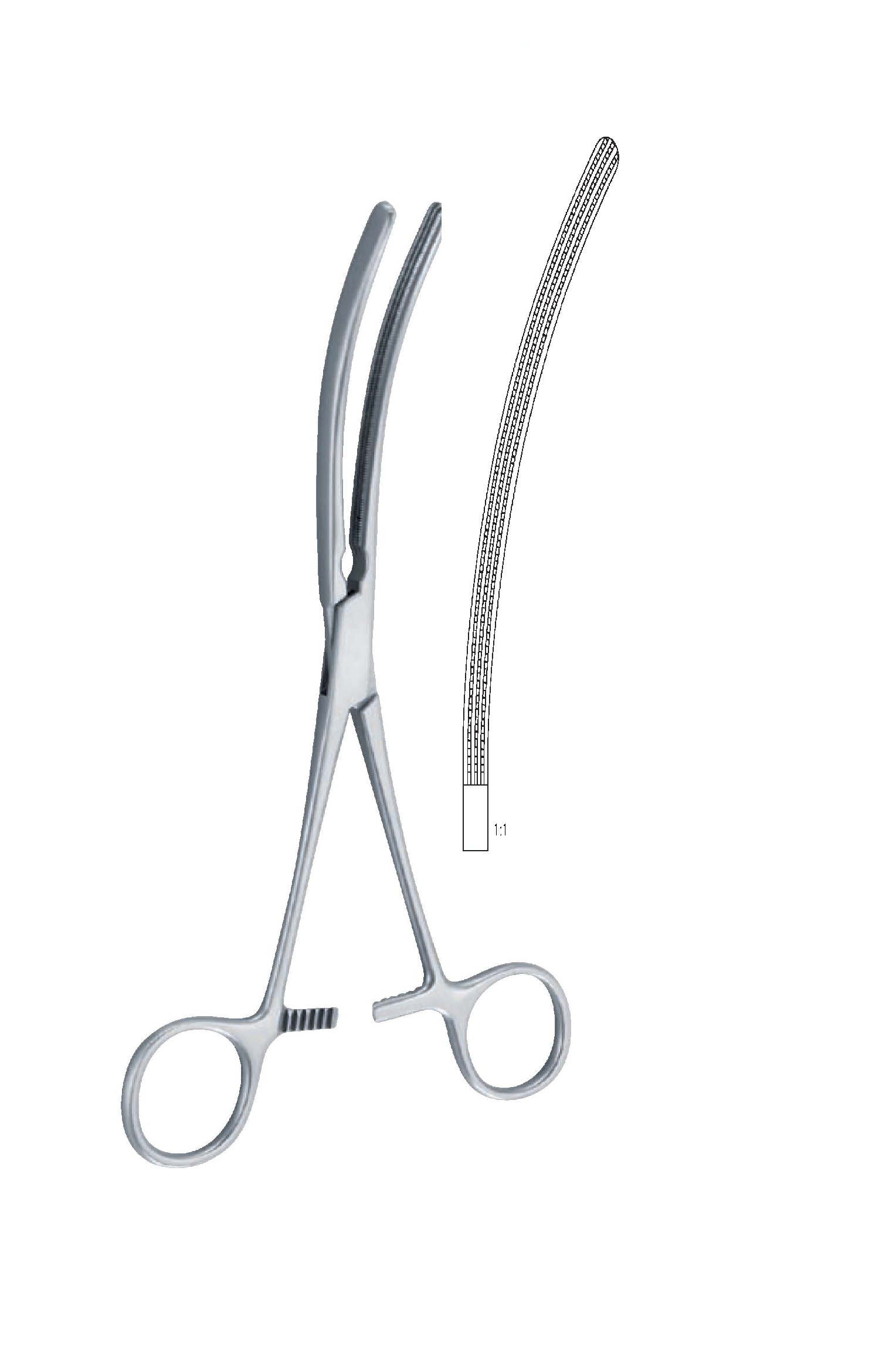
That profile makes 410 the grade of choice for instruments that flex, twist, and take load rather than cut: hemostatic forceps, needle holders, retractor bodies, and the shanks of ring-handled instruments. A Crile or Kelly forceps needs springy resilience at the joint far more than it needs a keen edge — 410 delivers exactly that. Our comparison of the Crile-Wood and Mayo-Hegar needle holders shows how this toughness plays out in a working suturing instrument.
Grade 420: The Surgical Workhorse
420 bumps carbon up to roughly 0.15–0.40% (and its higher-carbon variant, 420HC, higher still), keeping chromium around 12–14%. That extra carbon unlocks meaningfully higher hardness after heat treatment — typically 50–52 HRC for instrument work — while retaining enough chromium for repeated steam sterilisation.
This is why 420 is the default steel for the bulk of surgical instruments worldwide. Scalpel handles, surgical and dissecting scissors, curettes, chisels, rongeur jaws, dental instruments, and elevators are commonly 420 or 420-modified. It holds a working edge, tolerates the autoclave, and forges cleanly. When you read “surgical stainless steel” without a grade, 420 is usually what is meant.
The compromise is deliberate: 420 sacrifices a little of 410’s toughness and a little of 440’s ultimate edge hardness to sit in the middle where most instruments actually need to be.
Grade 440: The Edge Specialist
440 — usually 440A or 440C in medical use — pushes carbon highest of all, up to around 0.60–0.75% in 440C, with chromium raised to 16–18% to compensate. The result is the hardest and most wear-resistant of the three, capable of 58–60 HRC. It takes and holds the finest, longest-lasting edge.
That makes 440 the grade for premium cutting instruments where edge retention is the whole point: fine iris and micro scissors, high-end scalpel blades, and specialist cutting tools. The trade-off is brittleness. A 440C edge is harder to grind without micro-chipping, and the material is less forgiving of shock. You would not want a heavy bone-cutting forceps in 440C — it might chip where a 420 jaw would simply dull and resharpen.
Side-by-Side: 410 vs 420 vs 440
| Property | 410 | 420 | 440 (440C) |
|---|---|---|---|
| Carbon content | ~0.15% max | ~0.15–0.40% | ~0.60–0.75% |
| Chromium content | 11.5–13.5% | 12–14% | 16–18% |
| Typical hardness (HRC) | 40–45 | 50–52 | 58–60 |
| Toughness | Highest | Moderate | Lowest (brittle) |
| Edge retention | Modest | Good | Excellent |
| Corrosion resistance | Good | Good | Best of the three |
| Best-suited instruments | Forceps, needle holders, retractors | Scissors, scalpels, curettes, chisels | Fine cutting, micro scissors |
Why the Grade Alone Doesn’t Guarantee Quality
Here is the detail cheaper suppliers gloss over: the grade is necessary but not sufficient. Two instruments both stamped 420 can perform completely differently depending on three post-forging steps.
Heat treatment. Under-hardened 420 goes soft and dulls fast; over-hardened 420 becomes brittle at the tip. The tempering window is narrow and has to be controlled per instrument geometry.
Passivation. After machining, the surface holds free iron and contaminants that seed rust. A proper nitric or citric acid passivation strips them and thickens the chromium-oxide layer. Skip it, and even a good 420 instrument will spot and pit in the autoclave — which is why we treat passivation as a mandatory, documented step rather than an optional finish.
Finishing. A polished or satin surface has fewer micro-crevices for corrosion and biofilm to start in than a rough one. Surface finish is a corrosion-resistance decision, not just a cosmetic one.
This is the same material discipline that underpins every instrument in our surgical instrument range, and it is documented under our ISO 13485 system.
Beyond the Big Three
Two other materials show up in an instrument catalogue. Grade 17-4 PH (a precipitation-hardening stainless) appears in some specialist and endoscopic components needing strength plus corrosion resistance. Titanium alloy (Ti-6Al-4V) is chosen where light weight, MRI compatibility, or non-magnetism matter — microsurgical and neurosurgical instruments especially. Titanium is not harder than hardened 440; it is chosen for different reasons entirely. For a working feel of titanium in practice, see our guide to the Castroviejo micro needle holder.
Frequently Asked Questions
Which stainless steel is best for surgical instruments?
There is no single best grade — it depends on the instrument’s job. 420 suits most cutting and general instruments, 410 is better for forceps and needle holders that need springy toughness, and 440C is reserved for fine cutting instruments where maximum edge retention justifies its brittleness.
Is 440 steel better than 420 for surgical instruments?
Not universally. 440C is harder and holds an edge longer, which is ideal for fine scissors, but it is more brittle and prone to chipping. For scalpels, general scissors, and curettes, 420 offers a better balance of hardness, toughness, and resharpenability.
Why do surgical instruments rust if they are stainless steel?
Stainless resists corrosion but is not corrosion-proof. Rust and staining usually trace to skipped passivation, chloride exposure from certain detergents or saline, or trapped free iron from cross-contamination with lower-grade steel. Proper passivation and reprocessing prevent nearly all of it.
What does the hardness rating (HRC) mean?
HRC is the Rockwell C hardness scale. Higher numbers mean a harder, more wear-resistant surface. Instrument-grade 420 typically sits at 50–52 HRC and 440C at 58–60 HRC — harder edges last longer but are less forgiving of shock.
How can I tell what grade an instrument is made from?
Reputable manufacturers provide material certificates traceable to the steel batch, and the grade can be confirmed by spectrometry. Do not rely on appearance alone — grade, heat treatment, and passivation together determine performance, and only documentation confirms them.
The Takeaway for Buyers
When you evaluate a supplier, the grade stamped on the instrument is the start of the conversation, not the end. Ask what heat-treatment hardness the cutting instruments reach, whether passivation is documented, and whether material certificates are traceable. Fizza Surgical forges to AISI 410, 420, and 440 as each instrument demands, hardens to instrument-appropriate HRC, and passivates every piece under a CE-marked, ISO 13485 quality system — because the number in the steel only matters if everything after forging is done right.
Need precision surgical instruments?
Configure complete instrument sets with our team — ISO 13485 certified, CE marked, made in Sialkot since 1980.
Related Guides
View all articles →

Where We Serve
Fizza Surgical exports to 50+ countries. Browse our country-specific pages with local regulatory guidance and pricing: