Gigli Saw: Wire Saw for Bone Surgery & Craniotomy Guide
The Gigli saw explained: how the wire saw works, wire sizes, amputation and craniotomy uses, technique and safety, plus materials and care.
 Made in Sialkot · Since 1980
In 1892, an Italian obstetrician named Leonardo Gigli was trying to solve a problem in obstructed labour: how to divide the pubic bone safely and from the inside out. Working in Breslau with the instrument maker H. Härtel, he twisted several flexible wires into a single cutting cord and called it the Drahtsäge — the wire saw. Five years later a surgeon in Kraków borrowed it for craniotomy, and the Gigli saw quietly became one of the most versatile bone-cutting tools in surgery.
More than a century on, despite powered craniotomes and oscillating saws, the wire saw is still in neurosurgical and orthopaedic sets. Its virtue is simple: a cutting instrument that is essentially a length of wire can go where a rigid blade cannot.
How the Gigli Saw Works
The saw is made of multiple flexible wire strands twisted together so the helical surface presents dozens of small cutting edges. A loop is formed at each end, and a handle clips into each loop. The surgeon draws the wire back and forth in long strokes; the twisted profile grips and abrades bone on both directions of travel.
Because the wire is flexible, it can be passed around or beneath a bone through a small opening, then drawn taut and cut from the deep surface outward — the opposite of how a rigid saw approaches. That “inside-out” capability is the whole reason the instrument survives.
Wire Types and Sizes
| Specification | Options | Notes |
|---|---|---|
| Length | 30 cm (12″), 50 cm (20″), 70 cm (28″) | Longer wires for limb amputation; shorter for cranial work |
| Wire construction | Single, double-twisted, triple-twisted | More strands = more aggressive, coarser cut |
| Handles | Detachable, locking | Must grip the loop without slipping under tension |
| Accessory | Wire guide / conductor | Passes the wire safely beneath the bone |
A single-strand wire gives a finer, slower cut; triple-twisted wire removes bone faster but leaves a rougher kerf. The choice depends on whether you are dividing a delicate cranial suture or amputating through a femur.
Clinical Applications
Amputation
This is the classic use. In limb amputation the bone must be divided cleanly and squarely at the chosen level. The flexible wire lets the surgeon complete the cut with a smooth stroke and minimal soft-tissue footprint, which is why the longer 50–70 cm wires are amputation instruments.
Craniotomy
Before powered craniotomes, the saw connected adjacent burr holes to lift a bone flap. Small burr holes are drilled, a guide is passed beneath the skull between two holes, the wire is drawn through on the guide, and the bone between the holes is divided from beneath. It remains a reliable backup — and in some resource-limited or specific reconstructive settings, a primary technique.
Orthopaedic and Specialty Uses
The saw still appears in osteotomies and, in a modern echo of its origins, in minimal-access procedures — a 2021 report described Gigli-saw sagittal suturectomy for craniosynostosis in infants, using the wire’s flexibility to work through small incisions.
Obstetric Origins
It is worth remembering that the instrument was never designed for bone flaps at all. Leonardo Gigli built it to perform lateral pubiotomy — dividing the pubic bone to widen the pelvis in obstructed labour — as a gentler alternative to the symphysiotomy of the era. The flexibility that made it safe to pass around the pubic ramus from within is the same property that later made it valuable in cranial and limb surgery. The tool outlived its original indication because the underlying idea — a bone cutter you can route around anatomy rather than through a straight-line approach — turned out to be broadly useful.
Technique Points That Matter
- Maintain tension. A slack wire kinks, and a kinked Gigli wire snaps. Keep it taut between the handles throughout the stroke.
- Use long, full strokes. Short sawing generates heat and frays the wire; long passes distribute wear and cut cooler.
- Protect the soft tissue. Passing the wire beneath bone risks the structures on the far side — a conductor or guide keeps the wire in a controlled path.
- Treat the wire as consumable. Fraying strands are a failure warning. A partly broken Gigli wire cutting at speed is a safety hazard.
Gigli Saw vs Powered Bone Saw
The Gigli wire is not trying to replace the oscillating saw — the two solve different problems. Powered saws are faster and more controllable for straight, accessible cuts; the Gigli wins on flexibility, cost, portability, and the inside-out cut. For a broader comparison of cutting instruments, see our guide on bone drill vs bone saw.
Passing the Wire Safely: The Guide and Conductor
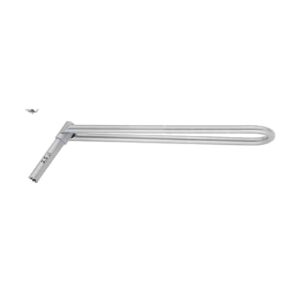
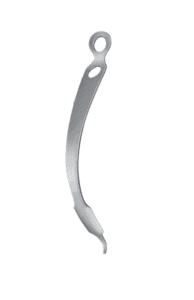
The single most dangerous moment is passing the flexible wire beneath the bone, blind, to the far side where vessels, nerves, or brain sit. A guide (or conductor) — a slim, curved malleable instrument — is threaded under the bone first, the wire loop is attached, and the guide is withdrawn to carry the wire safely into position along a controlled path. Skipping the conductor and pushing a bare wire under a bone is how far-side structures get injured.
Once the wire is through, handles clip to both loops with a locking mechanism that must not slip under tension. Only then does cutting begin, with the operator’s hands moving in long opposing strokes.
Inspection and Service Life
A wire saw is a consumable that happens to be reusable. Every cutting cycle dulls the helical edges and fatigues the strands, and the loops at each end concentrate stress. Before every case the wire should be run through the fingers (with care) and inspected for frayed strands, flattened cutting surface, and deformed loops. Any of these signs retires the wire.
The economics still favour it: even replaced regularly, a wire costs a fraction of a powered blade and needs no power source — which is precisely why it endures in field, military, and resource-limited settings alongside high-end theatres.
Materials and Manufacture
Gigli wire is made from high-quality stainless steel drawn and twisted to hold an edge while staying flexible. The handles are hardened stainless that must lock into the wire loops without slipping under load. Both should be produced to ISO 7153-1 material standards under an ISO 13485 quality system, and passivated for corrosion resistance across repeated sterilisation.
Reusable wires do have a service life — the cutting surfaces dull and strands fatigue — so inspection before every case is part of responsible use. Explore the full range in our bone surgery instruments catalogue.
Frequently Asked Questions
What is a Gigli saw used for?
It is a flexible wire saw used mainly for limb amputation, where bone must be divided cleanly, and historically for craniotomy to connect burr holes and lift a bone flap. It is also used in some osteotomies and minimal-access procedures.
Who invented the Gigli saw?
Leonardo Gigli, an Italian obstetrician, developed it in 1892 in Breslau with instrument maker H. Härtel, originally to perform lateral pubiotomy in obstructed labour. It was adapted for craniotomy in 1897.
What lengths does Gigli saw wire come in?
Common lengths are 30 cm (12″), 50 cm (20″), and 70 cm (28″), in single, double-twisted, and triple-twisted constructions. Longer wires suit amputation; shorter wires suit cranial work.
Is the Gigli saw still used today?
Yes. Although powered craniotomes and oscillating saws have replaced it for many routine cuts, the Gigli saw remains in neurosurgical and orthopaedic sets for its flexibility, low cost, portability, and ability to cut bone from the deep surface outward.
Review our full instrument standards on the certifications page.
Need precision surgical instruments?
Configure complete instrument sets with our team — ISO 13485 certified, CE marked, made in Sialkot since 1980.
Related Guides
View all articles →
Where We Serve
Fizza Surgical exports to 50+ countries. Browse our country-specific pages with local regulatory guidance and pricing: