Suction Irrigation Cannula: Laparoscopic & Open Surgery Guide
Suction irrigation cannula guide: 5mm vs 10mm flow, trumpet valves, fenestrated tips, hydrodissection and lumen reprocessing rules.
 Made in Sialkot · Since 1980
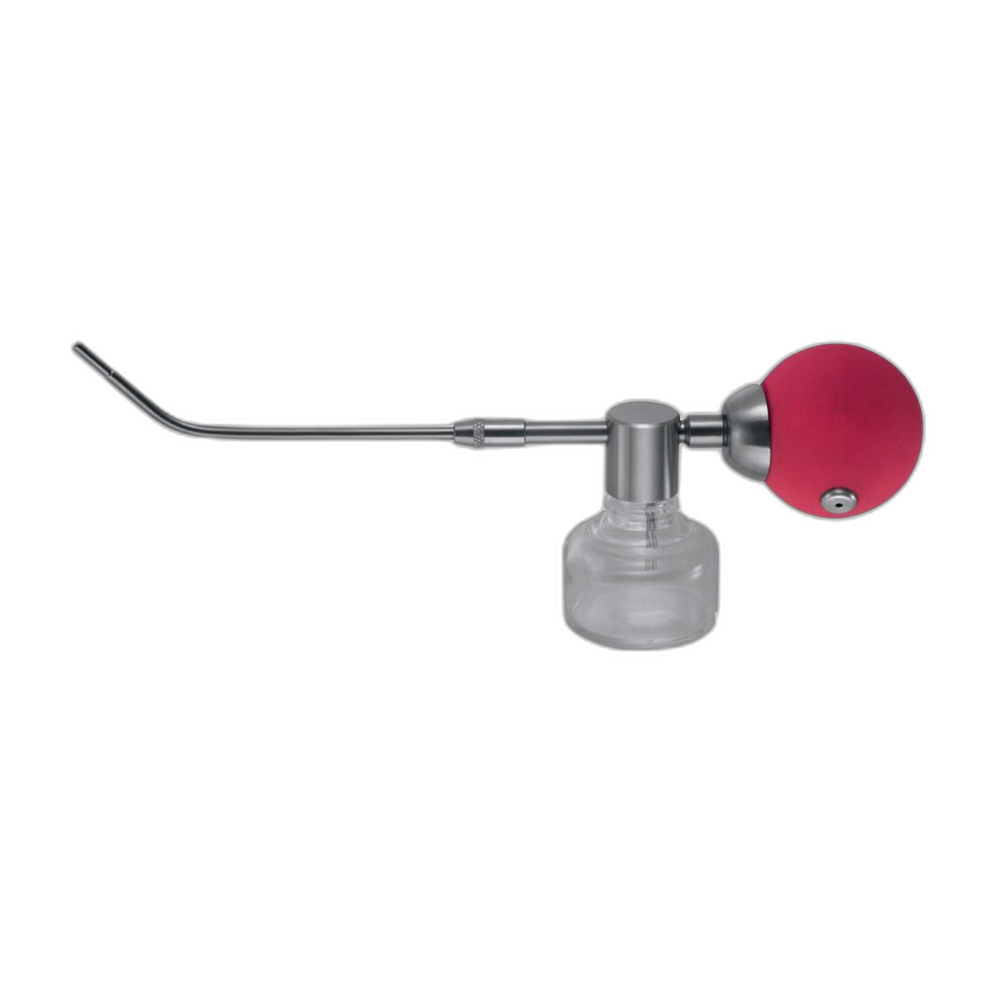
Outer diameter: 5 mm and 10 mm. Working length: 330 mm standard, 450 mm bariatric. Material: AISI 304 / 316L. Valve: dual trumpet, or pistol trigger. Autoclavable: 134°C, disassembled.
That is the entire specification of an instrument that does not appear on most tray photographs, gets ordered as an afterthought, and is the reason the surgeon can see anything at all forty minutes into a bloody cholecystectomy.
Two Jobs, One Shaft
A suction irrigation cannula is a tube with two independently controlled fluid paths sharing a single lumen.
Press one valve and pressurised saline runs out of the tip. Press the other and the lumen goes to wall suction. The two are never open at once — which sounds obvious, but a worn valve seat that lets suction leak while you are irrigating means you are washing saline straight into the canister and not into the patient.
The dual-trumpet handle puts two spring-loaded buttons side by side under the index and middle fingers. It is the older design and still the most common in reusable form, because there is almost nothing in it to fail: two pistons, two springs, two seats. The pistol-grip trigger design puts irrigation on a trigger and suction on a thumb button, which some surgeons prefer for one-handed control during a long lavage.
Why It Earns Its Place
Visibility. Laparoscopic optics are unforgiving. A few millilitres of blood in the subhepatic space turns the monitor into a red fog, and there is no swab to reach in with. Irrigate, suck, and the field returns. This is the instrument’s main job and it does it continuously.
Blunt dissection. Underrated. A jet of saline at moderate pressure separates loose areolar tissue without cutting anything — hydrodissection. In an inflamed Calot’s triangle, where the planes are oedematous and the cystic artery is somewhere in the mess, a directed jet opens the plane more safely than a hook. The tip itself also works as a blunt probe and a retractor.
Smoke evacuation. Every monopolar activation produces plume. Open the suction briefly and the field clears. Do it with the valve cracked rather than fully open, or you will dump the pneumoperitoneum and the abdomen will collapse around you.
Lavage. In perforated appendicitis or a contaminated abdomen, litres of warm saline go in and come out. This is where a 10 mm cannula stops being a luxury — a 5 mm lumen clogs on fibrin and particulate within seconds, and you spend the case unblocking it.
Finding the bleeder. The most useful trick in the instrument. Blood pools and obscures its own source. Suction the pool dry and watch: the first thing to well up is the vessel. Clearing the field is a diagnostic manoeuvre, not just housekeeping.
Choosing the Diameter
| 5 mm | 10 mm | |
|---|---|---|
| Port required | 5 mm working port | 10 mm port or reducer |
| Flow rate | Modest | Roughly 4× the 5 mm lumen |
| Clogging risk | High with clot or debris | Low |
| Best for | Routine cholecystectomy, gynae, appendicectomy | Contaminated abdomen, heavy bleeding, bariatric |
Flow scales with the fourth power of the radius, which is why the difference is so lopsided. Doubling the diameter does not double the flow — it multiplies it by roughly sixteen in theory, and by around four in practice once valve and tubing restriction are accounted for. Either way, a 10 mm cannula is not marginally better at lavage. It is in a different category.
Many sets ship as a 10–5 mm combination: a 10 mm outer tube with a 5 mm inner tube that slides inside it, so one handle serves both. Useful, and genuinely convenient — but the inner tube is a part that gets left in the washer, and a 10–5 set missing its inner tube is just a 10 mm cannula.
Tip Configurations
- Open end — maximum flow, but the tip grabs omentum and bowel the moment it touches them. Fine for lavage in an empty field.
- Multi-fenestrated — a ring of side holes near the tip. If one hole occludes against tissue the others keep flowing, so suction continues and the tissue releases. The safer default and what most surgeons should be using.
- Blunt/atraumatic tip — rounded end for use as a probe and retractor.
- Angled or curved — reaches the subphrenic and pelvic recesses where a straight shaft cannot point.
The trap with open-ended tips is that a firm suction application onto bowel serosa can injure it. The mucosa gets drawn into the lumen, and a serosal tear you did not notice becomes a leak on day three. Fenestrated tips make this much harder to do.
Open Surgery Has Its Own Family
The laparoscopic cannula is not the whole story. In open surgery the equivalents are separate instruments with distinct designs — the Poole for wide abdominal lavage, the Yankauer for the pharynx and general field, the Frazier for fine work in ENT and neurosurgery. Each is optimised for a lumen size and a tissue-guarding geometry rather than for passing down a port. We cover the trade-offs between them in our comparison of operating theatre suction instruments.
What Fails, and Why
Two failure modes account for nearly everything.
Blocked lumen. Fibrin, clot, and fat dry inside a 5 mm tube and set. Once dry they are extremely difficult to remove, and a cannula that will not pass a cleaning brush cannot be verified as clean — which makes it a reprocessing failure, not just an inconvenience. Flush the lumen with water immediately at the end of the case, before it goes to CSSD. This one habit prevents most of the problem.
Leaking valves. The trumpet pistons run on O-rings that harden with repeated steam exposure. A leaking valve wastes suction, drops the pneumoperitoneum, and lets irrigation dribble when you are not asking for it. O-rings are consumables — schedule them.
Reprocessing rules for these are stricter than for solid instruments, because you cannot see inside:
- Disassemble completely. The handle comes apart; a cannula run through a washer assembled has not been cleaned inside.
- Brush the full length of every lumen with a correctly sized channel brush. Not an approximate size — a brush that does not contact the wall does nothing.
- Flush with enzymatic solution, then ultrasonic with a lumen adapter that forces fluid through the channel rather than around it.
- Dry the lumen with medical air. Retained moisture is where biofilm establishes.
- Sterilise disassembled, so steam reaches every surface.
Our suction irrigation cannulae are machined from AISI 304 and 316L in 5 mm and 10 mm, 330 mm and 450 mm working lengths, with dual-trumpet handles, fenestrated and open tip options, and replaceable O-ring and seal sets. Supplied under ISO 13485:2016 with CE marking, alongside the rest of our general surgical instrument range. Full material and certification documentation is available on request.
Frequently Asked Questions
Can a 5 mm cannula be used through a 10 mm port?
Yes, with a reducer — without one the port will leak CO₂ around the shaft continuously. The more useful question is whether you should: if you are anticipating lavage of a contaminated abdomen, put the 10 mm cannula through the 10 mm port and avoid the clogging entirely.
Why does suction collapse my pneumoperitoneum?
Because you are evacuating CO₂ along with the fluid — the instrument cannot tell them apart. Use short bursts, crack the valve rather than opening it fully when you are only clearing smoke, and let the insufflator catch up. If it collapses instantly on a small application, check for a leaking valve or a port seal that has failed.
What irrigation pressure is appropriate?
Gravity or a pressure bag at around 150–300 mmHg covers routine lavage and gives enough of a jet for hydrodissection. Higher pressures are not better — a hard jet drives contamination into tissue planes and, in a contaminated abdomen, spreads exactly what you are trying to remove. Warm the saline; litres of cold irrigation into an open abdomen drops core temperature measurably.
Reusable or disposable?
Reusable is substantially cheaper per case and the metal lasts for years, but it depends entirely on your CSSD being able to brush and verify a long narrow lumen reliably. If that capability is not there, a reusable cannula is a cleaning failure waiting to be found on an audit, and disposable is the honest choice. The instrument is only as good as the channel brushing behind it.
Need precision surgical instruments?
Configure complete instrument sets with our team — ISO 13485 certified, CE marked, made in Sialkot since 1980.
Related Guides
View all articles →
Where We Serve
Fizza Surgical exports to 50+ countries. Browse our country-specific pages with local regulatory guidance and pricing: