Walsham and Asch Forceps: Nasal Fracture Reduction Guide
Walsham forceps reduce nasal bones, Asch forceps reduce the septum. Blade design, sizes, tray contents and the timing window for closed reduction.
William Walsham was a London surgeon writing in the 1890s. Morris Asch was a New York laryngologist of roughly the same era. Neither man ever saw the other’s instrument in use, and both patterns have survived essentially unchanged for well over a century — which tells you something about how well they solved the problem they were built for.
That problem is the displaced nasal fracture. The nose is the most frequently fractured bone in the face, the reduction window is short, and closed reduction under local or general anaesthetic remains the standard first-line treatment. Two instruments do the work, and they are not interchangeable.
What Each Instrument Reduces
The distinction is simple and it is the single most useful thing to know about this pair:
- Walsham forceps reduce the nasal bones. One blade goes inside the nasal cavity, the other stays outside on the skin. The bone is grasped between them and disimpacted, elevated, and moved laterally or medially as required.
- Asch forceps reduce the septum. Both blades go inside — one in each nostril — and the septum is grasped between them, elevated out of the vomerine groove if it has dislocated, and straightened back to the midline on the maxillary crest.
Get that backwards and neither manoeuvre works. Using a Walsham on the septum crushes rather than aligns it; using an Asch on the nasal bones gives no external counter-pressure, so the bone rotates instead of reducing.
Walsham Forceps in Detail
The Walsham pattern is an angled, hinged forceps with markedly asymmetric blades. The inner blade is narrow and smooth, sized to sit in the nasal cavity against the undersurface of the nasal bone and the frontal process of the maxilla. The outer blade is broader and, critically, is supplied with a soft rubber or silicone sleeve. That sleeve is not optional decoration — it distributes the external grip across the skin and prevents the linear pressure bruise that a bare metal blade leaves along the dorsum.
Standard length is 21–23 cm. Sets are supplied as left and right pairs, angled to suit each side of the nose, and it is worth confirming on receipt that you have actually been sent a matched pair rather than two of the same hand — a surprisingly common shipping error with this pattern.
The reduction manoeuvre with Walsham forceps is short and firm rather than sustained. The impacted nasal bone is first disimpacted with a deliberate elevating movement, then repositioned. Prolonged squeezing achieves nothing except soft-tissue injury, because the bone either mobilises in the first second or it is fixed by callus and needs an osteotome.
Asch Forceps in Detail
The Asch pattern is a hinged forceps with two symmetrical, elongated, slightly flared blades that taper toward the tip. Standard length is 21–22 cm. There are no serrations and no teeth: the blades are smooth, because the object is to straighten cartilage and thin bone, not to hold it.
The two-inner-blade design gives the instrument a second function beyond straightening. Once each blade is in a nasal cavity, gentle opening lifts the entire septum and dorsum upward — a manoeuvre used to elevate a depressed nasal dorsum at the same time as the septum is being aligned. Some surgeons perform the whole closed reduction with an Asch alone for that reason, adding the Walsham only when a laterally displaced nasal bone will not follow.
| Walsham forceps | Asch forceps | |
|---|---|---|
| Target structure | Nasal bones / frontal process of maxilla | Nasal septum, dorsum elevation |
| Blade placement | One inside, one outside | Both inside (one per nostril) |
| Blade symmetry | Asymmetric — narrow inner, broad outer | Symmetric |
| Protective sleeve | Yes, on outer blade | No |
| Supplied as | Left / right pair | Single instrument |
| Typical length | 21 – 23 cm | 21 – 22 cm |
| Blade surface | Smooth | Smooth |
The Closed Reduction Tray
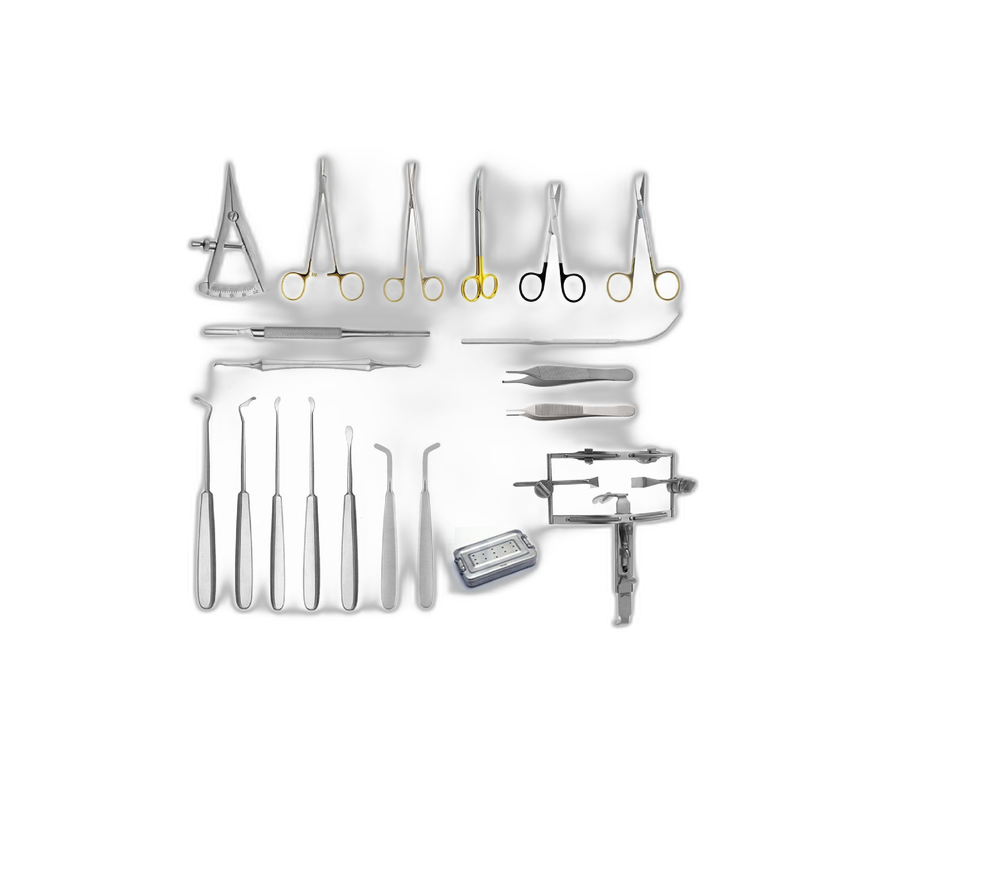
A nasal fracture reduction set is small. Beyond the two forceps above, a standard tray carries:
- Nasal speculum — Killian for the deeper examination, Thudichum for quick anterior work; the pattern choice is covered in our nasal speculum comparison
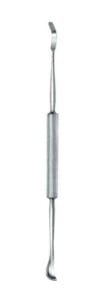
- Boies or Goldman elevator — a flat, blunt elevator used to push a depressed nasal bone outward from within the nasal cavity
- Bayonet dressing forceps — for packing placement without obscuring the line of sight
- Freer elevator — septal mucoperichondrial elevation where the septum needs formal exposure
- Frazier suction, 8 or 10 Fr
- Nasal packing and an external splint
The Boies elevator deserves a mention because it competes directly with the Walsham for the depressed-bone indication. An elevator applies force from inside only, with the surgeon’s opposite thumb providing external counter-pressure. That is entirely adequate for a simple inward depression. The Walsham earns its place when the bone is impacted and needs to be actively gripped and disimpacted, or when a laterally displaced fragment has to be moved across the midline — situations where thumb counter-pressure cannot generate a controlled enough vector.
Timing, and Why It Governs Instrument Choice
Closed reduction works within a window: roughly 5 to 10 days after injury in adults, shorter in children, measured from the point the initial swelling settles enough to assess the deformity. Inside that window the fracture is mobile and the instruments above will reduce it.
Past about three weeks, early callus fixes the fragments. At that point Walsham and Asch forceps will not move the bone no matter how much force is applied, and continuing to try converts a closed procedure into soft-tissue trauma. The correct next step is a formal osteotomy — a different tray entirely, drawing on the same instrument families used in septoplasty and nasal surgery sets.
Materials and Care
Both patterns are forged from martensitic stainless steel, typically AISI 420, hardened and tempered, then passivated. They are box-joint or screw-joint hinged instruments with no ratchet, which makes them mechanically simple and long-lived.
The one maintenance item specific to the Walsham is the sleeve on the outer blade. Rubber sleeves degrade with repeated steam cycles — they harden, then crack, then split. A cracked sleeve is worse than no sleeve, because the split edge concentrates pressure exactly where the sleeve was meant to spread it. Silicone sleeves survive autoclaving considerably better than natural rubber, and replacement sleeves should be a stock line item rather than something ordered when they fail. Inspect them at every reprocessing cycle and replace on the first sign of surface crazing.
Everything else is routine: clean hinges with the instrument open, lubricate the joint after cleaning and before sterilization, and autoclave at 134 °C. Fizza Surgical manufactures both patterns under ISO 13485:2016 with CE marking as part of the ENT range within our surgical instrument catalogue.
Frequently Asked Questions
What is the difference between Walsham forceps and Asch forceps?
Walsham forceps reduce the nasal bones using one blade inside the nose and one outside the skin. Asch forceps reduce the septum using two blades, one in each nostril. They address different structures and are not interchangeable.
Why does one blade of the Walsham forceps have a rubber sleeve?
The outer blade rests on the skin of the nasal dorsum. The sleeve spreads the grip pressure and prevents a linear bruise or pressure injury. Silicone sleeves tolerate repeated autoclaving better than natural rubber and should be replaced at the first sign of cracking.
How long after a nasal fracture can closed reduction still be done?
Generally 5 to 10 days after injury in adults once swelling has settled, and sooner in children. Beyond roughly three weeks the fragments are fixed by callus and formal osteotomy is required instead.
Are Walsham forceps sold as a pair?
Yes. They are supplied as angled left and right instruments to suit each side of the nose. Check on receipt that a genuine matched pair has been shipped rather than two of the same hand.
For quotations on nasal fracture reduction instruments, replacement Walsham blade sleeves, or a complete ENT closed-reduction tray, contact Fizza Surgical with your required configuration.
Need precision surgical instruments?
Configure complete instrument sets with our team — ISO 13485 certified, CE marked, made in Sialkot since 1980.
Related Guides
View all articles →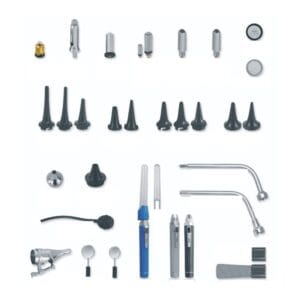
Where We Serve
Fizza Surgical exports to 50+ countries. Browse our country-specific pages with local regulatory guidance and pricing: