Bakes Bile Duct Dilators and Desjardins Gallstone Forceps
Bakes bile duct dilators sizes 1-13mm and Desjardins gallstone forceps jaw profiles: selection, materials and inspection for open biliary surgery.
The choledochotomy is open. Bile is welling up around the stay sutures, the cystic duct stump is ligated, and the intraoperative cholangiogram has shown a filling defect sitting just proximal to the ampulla. What comes off the tray next decides whether this becomes a clean ductal clearance or a twenty-minute wrestle that ends in a T-tube and a plan to come back endoscopically.
Two instrument families do most of that work: the graduated malleable probes used to calibrate and open the duct, and the long, fenestrated forceps used to grasp and withdraw the stone itself. Both are old designs. Both are still on the tray in 2026, because laparoscopic and endoscopic clearance handles most stones but not all of them, and the open bailout has to be stocked.
Bakes Dilators: What They Actually Do
The Bakes pattern is a malleable stem terminating in a smooth, ovoid, olive-shaped tip. It is not a cutting instrument and it is not, despite the name, primarily a dilating instrument in the way a cervical or urethral dilator is. In common bile duct work it does three jobs, roughly in this order:
- Calibration. Passing successively larger olives down the duct tells you the functional diameter of the distal choledochus and whether the sphincter of Oddi admits a reasonable instrument. A duct that takes a 3 mm olive freely but stops a 4 mm one at a fixed point is telling you something about that point.
- Patency confirmation. The classic manoeuvre is to pass the olive through the ampulla into the duodenum and palpate the tip through the duodenal wall. That single tactile confirmation is worth a great deal when the cholangiogram is equivocal.
- Gentle dilation. Where a distal stricture is soft and fibrotic rather than malignant, serial passage of increasing sizes will open it enough to allow stone extraction or a drainage procedure.
The malleable stem is the design’s whole point. The common bile duct does not run in a straight line from the choledochotomy to the ampulla — it curves posteriorly and to the right behind the first part of the duodenum. A rigid probe fights that curve and transmits force to the duct wall. A malleable stem is pre-bent by the surgeon to approximate the retroduodenal course, so the olive follows the lumen instead of tenting it.
Size Range and Set Configuration
Bakes bile duct dilators are supplied as graduated sets. The common configurations are:
| Set | Tip diameters | Increment | Typical working length |
|---|---|---|---|
| 13-piece full set | 1.0 – 13.0 mm | 1.0 mm | 28 – 32 cm |
| 9-piece clinical set | 3.0 – 11.0 mm | 1.0 mm | 30 cm |
| 5-piece short set | 3.0 – 7.0 mm | 1.0 mm | 28 cm |
| Individual replacements | 5.0 / 6.0 / 7.0 mm | — | 32 cm |
The 3–7 mm range is where almost all the clinical work happens. A normal common duct is 4–6 mm; anything obstructed for a while will be dilated well beyond that. The very small olives (1–2 mm) are useful in paediatric biliary work and in hepaticojejunostomy anastomotic assessment, and the large end of the range (11–13 mm) is mostly used for grossly dilated ducts and for reconstructive procedures rather than routine exploration.
Practical note on ordering: hospitals reordering individual pieces almost always burn through the 5, 6 and 7 mm sizes first, because those are the ones that get bent hardest and re-straightened most often. If you are specifying a tray for a unit that does regular open biliary work, order the mid-range sizes in duplicate rather than buying a second full set.
Why the Tip Geometry Matters
The olive is not a sphere. It is an elongated ovoid with a tapered leading shoulder, and the transition from stem to olive is a smooth radius rather than a step. That profile matters for a specific reason: a step or a sharp shoulder catches on the mucosal folds of the distal duct and on the ampullary papilla, and the natural response to that resistance is to push harder. Pushing harder against a caught shoulder is how you get a false passage through the posterior duct wall into the pancreatic head.
When inspecting a set on receipt, run each olive between finger and thumb along the stem junction. Any palpable ridge, any flat spot from a dropped instrument, any polishing burr — reject it. This is a blunt instrument whose entire safety margin comes from surface finish.
Desjardins Gallstone Forceps
Where the dilators calibrate, the Desjardins forceps extract. The pattern is a long-shanked, ring-handled forceps with a ratchet and a pair of fenestrated, spoon-shaped jaws that are curved on the flat. Standard length is 23 cm (9 inches), with 25 cm and 27 cm variants for deep or obese fields.
The design solves a specific problem. A gallstone in the common duct is smooth, wet, and usually harder than the tissue around it. Grasp it with a conventional toothed forceps and it squirts out of the jaws; grasp it hard enough not to squirt and you crush it into fragments that then have to be flushed and fished individually. The Desjardins fenestration lets the jaws close around the curvature of the stone rather than clamping across its diameter, and the ratchet holds a light, constant grip during withdrawal instead of requiring sustained hand pressure through a 20 cm reach.
Jaw Profiles
| Jaw profile | Fenestration | Best for |
|---|---|---|
| Small / narrow | Single oval window | Stones under 8 mm; intrahepatic and cystic duct work; narrow ducts |
| Large / broad | Wide oval window, deeper spoon | Stones 8 – 20 mm; gallbladder fundus stones; retained ductal stones |
| Curved on flat | Either | Following the retroduodenal curve of the distal duct |
| Straight | Either | Supraduodenal duct, gallbladder, transcystic approach |
Most units stock a straight small, a curved small and a curved large. The curved large is the workhorse for retained stones; the small profiles come out for the intrahepatic ducts and for the occasional gynaecological use the pattern also sees — the same forceps appears in some units for retrieving retained products and endometrial polyps, which is why it turns up in catalogue sections outside general surgery.
A Note on Grip Force
The ratchet on a Desjardins forceps typically has three teeth. On a stone, the first tooth is usually enough. Going to the third tooth on a pigment stone will fragment it, and fragments in a duct are worse than a single stone because they distribute themselves past the point where you can see or reach them. If the stone will not come at the first ratchet position, the answer is a different instrument or a different approach, not more force.
The Rest of the Biliary Sub-Tray
Bakes dilators and Desjardins forceps do not work alone. A complete open biliary exploration sub-tray, over and above the standard laparotomy set, usually contains:
- Desjardins gall stone probe and scoop — the double-ended probe/scoop used to dislodge impacted stones and to sweep debris toward the choledochotomy before formal grasping
- Randall stone forceps, full curve set — originally a renal pelvis instrument, widely used for biliary stones where the angle of approach suits the curve better than a Desjardins; see our Randall stone forceps curve guide for selecting between the four standard curves
- Biliary Fogarty-type balloon catheter (disposable) — for retrograde sweeping of the distal duct
- Ductal irrigation cannula, malleable, 3–5 mm
- Kehr T-tube in a range of sizes, plus the scissors to trim it
- Cholangiogram catheter and clamp
- Potts-Smith or fine Metzenbaum scissors for the choledochotomy extension
That sub-tray sits alongside the standard open gallbladder instruments; the base tray is covered in our cholecystectomy instrument set guide.
Material and Manufacturing Considerations
Bakes dilators are a genuinely unusual manufacturing problem, because the design requires two contradictory properties in one piece: the stem must be malleable enough to take and hold a hand-formed bend, and the olive must be hard enough to resist deformation and hold a mirror polish.
The stem is therefore made from an austenitic grade — AISI 316L or 304 — in a soft, annealed condition. Austenitic stainless does not harden by heat treatment, so the malleability is stable over the instrument’s life; it will bend, hold the bend, and bend back without work-hardening to the point of cracking for a very large number of cycles. The trade-off is that it is a softer material overall and will scratch more easily than a martensitic instrument.
The Desjardins forceps, by contrast, is a conventional hinged instrument and is forged from martensitic AISI 420 and hardened, because the jaws, box joint and ratchet all need wear resistance.
Both undergo passivation after final polishing to build the chromium oxide layer that carries the corrosion resistance. This matters more than usual for biliary instruments: bile is aggressive, it is retained in fenestrations and around ratchets, and an instrument that goes back to CSSD with dried bile in the jaw window is a corrosion problem waiting to happen. Fenestrated jaws should be brushed, not just soaked.
| Property | Bakes dilator | Desjardins forceps |
|---|---|---|
| Steel grade | AISI 316L / 304, annealed | AISI 420, hardened |
| Condition | Soft / malleable | Hardened & tempered |
| Finish | Mirror polish, passivated | Satin or mirror, passivated |
| Sterilization | Steam autoclave 134 °C | Steam autoclave 134 °C |
| Standards | ISO 7153-1 materials; manufactured under ISO 13485:2016, CE marked | |
Inspection Checklist Before a Set Goes Into Service
- Lay all olives out in ascending order and confirm the graduation is continuous with no missing size — a gap in the sequence defeats the calibration purpose entirely.
- Check each stem bends smoothly by hand and holds its shape without springing back.
- Straighten each stem fully and sight down it; a stem with a permanent kink from repeated bending at one point is nearing end of life.
- Inspect every olive under magnification for pitting, flats, or a step at the stem junction.
- On the forceps: close to the first ratchet and hold the jaws to the light. The fenestration edges should meet evenly with no daylight at the tips and no lateral offset at the box joint.
- Cycle the ratchet ten times. It should engage crisply and release without needing to be forced sideways.
The general principles behind that inspection routine apply to any incoming shipment, and are set out in more detail in our instrument inspection and QC checklist.
Where These Instruments Still Earn Their Place
ERCP with sphincterotomy handles the majority of common duct stones, and laparoscopic transcystic and transcholedochal clearance handles a large share of the rest. So it is fair to ask whether a full biliary sub-tray is still worth stocking.
It is, for three reasons. Endoscopic clearance fails in a meaningful minority of cases — impacted stones, altered anatomy after gastric surgery, periampullary diverticula. Second, a proportion of hospitals worldwide have no ERCP service at all, which makes open exploration the primary rather than the bailout technique. Third, the instruments are cheap relative to the consequence of not having them: a set of bile duct dilators and a pair of Desjardins forceps cost a fraction of a single unplanned second procedure.
Fizza Surgical manufactures both patterns as part of the general surgical instrument range, under ISO 13485:2016 with CE marking. Full details of our quality certification are on the certifications page.
Frequently Asked Questions
What sizes do Bakes bile duct dilators come in?
Standard graduated sets run from 1.0 mm to 13.0 mm in 1.0 mm increments, usually supplied as a 13-piece full set or a 9-piece clinical set covering 3–11 mm. Working length is typically 28–32 cm. The 3–7 mm sizes see the most clinical use.
Why is the shaft of a Bakes dilator malleable?
The distal common bile duct curves posteriorly behind the duodenum. A malleable AISI 316L shaft can be pre-bent by the surgeon to follow that curve, so the olive tip tracks the lumen rather than tenting the duct wall and risking a false passage.
What is the difference between Desjardins and Randall stone forceps?
Desjardins forceps have fenestrated spoon jaws curved on the flat and were designed for gallstones; Randall forceps come in a set of four fixed curves and were designed for renal pelvis stones. Both are used in biliary work — the choice usually comes down to which curve matches the angle of approach.
Can Bakes dilators be used laparoscopically?
Not the standard pattern. Their 28–32 cm malleable stems and ring-free design suit an open choledochotomy. Laparoscopic common duct exploration uses dedicated long, rigid or flexible instrumentation passed through ports, plus balloon catheters and choledochoscopes.
How should fenestrated biliary forceps be cleaned?
Brush the jaw fenestrations mechanically rather than relying on soak and ultrasonic alone. Bile dries in the window and around the ratchet, and residue left under a passivated surface is a common cause of pitting corrosion on biliary instruments.
To request a quotation for graduated bile duct dilator sets, Desjardins forceps or a complete open biliary exploration sub-tray, contact Fizza Surgical with your required sizes and jaw profiles.
Need precision surgical instruments?
Configure complete instrument sets with our team — ISO 13485 certified, CE marked, made in Sialkot since 1980.
Related Guides
View all articles →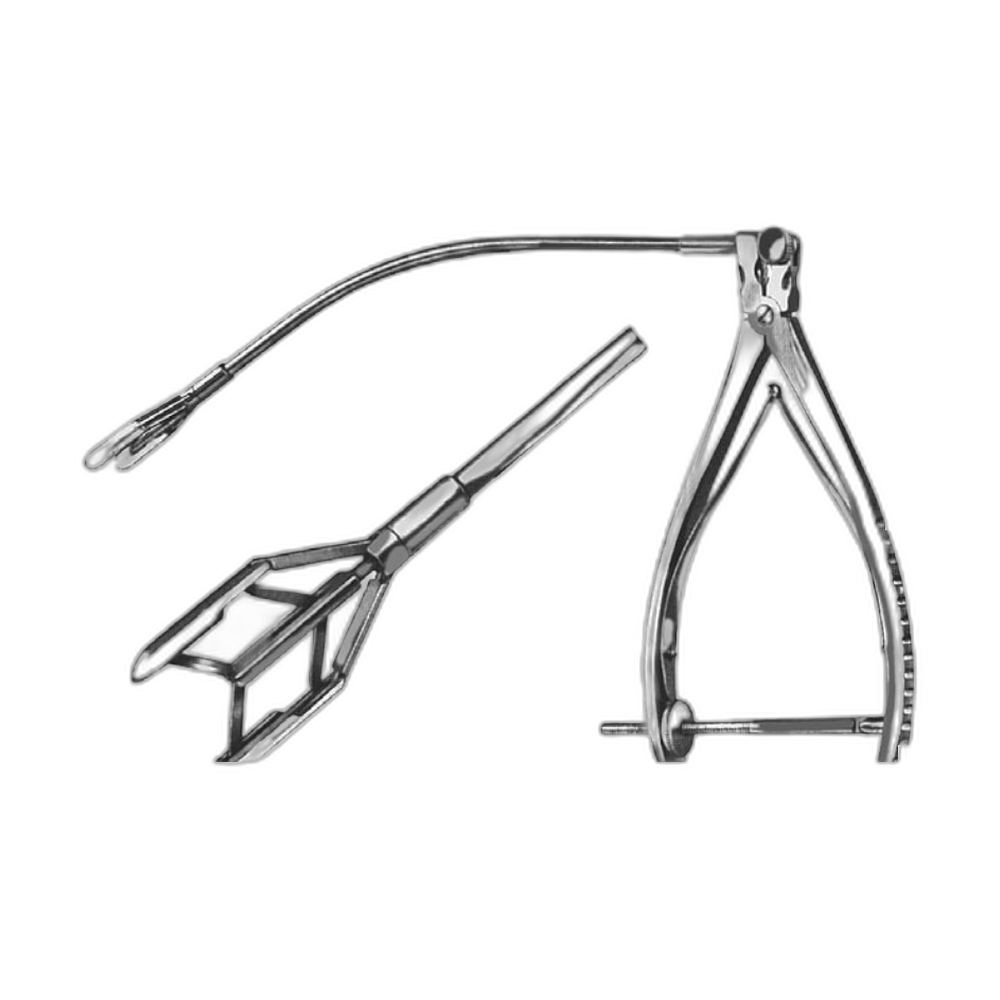
Where We Serve
Fizza Surgical exports to 50+ countries. Browse our country-specific pages with local regulatory guidance and pricing: