Randall Stone Forceps: Curve Selection for Stone Retrieval
Randall stone forceps curves: Fig. 1-4 quarter to full curve, lengths, why there is no ratchet, and how to choose figures for urology or biliary sets.
Four curves. That is very nearly the whole purchasing decision on this instrument, and it is the one detail most requisitions get wrong — usually by ordering a single figure number and assuming it will cover every case.
| Figure | Curve | Typical length | Reaches |
|---|---|---|---|
| Fig. 1 | Quarter curve | ~23.5 cm (9¼”) | Renal pelvis, straight-line access |
| Fig. 2 | Half curve | ~21.5 cm (8½”) | Upper and mid calyces |
| Fig. 3 | Three-quarter curve | ~19.5 cm (7¾”) | Lower pole calyces |
| Fig. 4 | Full curve | ~19 cm (7½”) | Sharply angled inferior calyces |
Note the inverse relationship: the more curved the jaw, the shorter the instrument. That is not arbitrary. A tightly curved jaw sweeps a wide arc as it opens, so the shaft has to be shorter to keep the whole assembly manageable inside the kidney. Ordering a full curve expecting the reach of a quarter curve is a specification error, not a manufacturing one.
What the Instrument Is Doing
Randall stone forceps are ring-handled grasping forceps with blunt, fenestrated, curved jaws and inward-angled shanks, designed to reach into the collecting system and extract calculi intact.
Three design decisions define the instrument, and each solves a specific problem.
The jaws are blunt. They are working inside the renal pelvis and calyces, against thin urothelium over a highly vascular collecting system. Any sharpened or toothed profile would perforate. The grip comes from geometry and surface texture, not from teeth.
The jaws are fenestrated. The open window through each jaw does two things: it lets irrigation fluid and small fragments pass rather than damming behind the instrument, and it gives the stone somewhere to seat so that the grip is a three-point capture rather than a two-point squeeze.
There is no ratchet. This is the feature that surprises people used to hemostats, and it is deliberate. A ratchet locks at a fixed jaw separation regardless of what is between the jaws. Applied to a friable calculus, that means the surgeon commits to a grip force before knowing whether the stone will tolerate it. Without a ratchet, grip is continuously modulated by hand, and the instant the stone starts to give the surgeon feels it and backs off.
Fragmenting a stone during extraction is the failure mode this instrument is built to avoid. A whole calculus comes out through the pyelotomy in one pass. A fragmented one leaves residual pieces scattered through the calyces, which is how a completed case becomes a recurrence.
Clinical Applications
The primary use is open stone surgery — pyelolithotomy and nephrolithotomy — where the instrument is passed through the pyelotomy incision and the appropriate curve is selected to match the calyx being cleared.
Beyond that:
- Common bile duct exploration. The same instrument, and often the same figure numbers, is used to retrieve ductal gallstones during open choledochotomy. The atraumatic fenestrated jaw suits the duct wall as well as it suits the urothelium.
- Percutaneous nephrolithotomy. Smaller patterns assist fragment retrieval where a nephroscope basket is not the best tool for the job.
- Bladder stone removal during open cystolithotomy.
- Polyp and foreign body retrieval, where a blunt fenestrated grasp is preferable to a toothed one.
It would be dishonest not to acknowledge that flexible ureteroscopy and laser lithotripsy have taken over much of the caseload that once belonged to open stone surgery in well-resourced centres. But the instrument has not disappeared, for three reasons: large staghorn calculi still come out open in many units; open common bile duct exploration remains routine in a great many hospitals; and stone disease is heavily concentrated in regions where flexible endoscopy and laser capability are not universally available. Departments equipping for field and resource-limited settings order these steadily.
Selecting Curves for a Set
The pragmatic answer for a urology department: stock all four figures. They are inexpensive relative to the rest of the tray, and the whole point of the family is that anatomy varies.
If the budget forces a partial set, the reasoning goes like this. Lower pole calyces are the hardest to reach and the most common site for residual fragments, which argues for the three-quarter and full curves. The quarter curve is the one most easily substituted by a standard long grasping forceps already on the tray. So a two-instrument compromise is usually Fig. 2 and Fig. 3.
For general surgery departments buying these purely for biliary work, a half curve and a three-quarter curve cover the great majority of ductal stone retrieval. These are commonly added to a cholecystectomy instrument set where open common bile duct exploration is part of the unit’s practice.
Construction Points That Matter
Stone forceps take a specific kind of abuse: repeated moderate load on a long, curved, unsupported jaw. That produces three characteristic failure modes, and each maps to a manufacturing detail.
Jaw alignment. Hold the instrument closed against a light source. The fenestrations should overlay precisely and the tips should meet without crossover or gap. Misaligned jaws grip on one side only, which is exactly how a stone gets crushed instead of held.
Box joint quality. A ring-handled instrument used with rotational load will develop play at the joint before it develops anything else. A well-machined box joint with a properly fitted pin resists this; a loose one progressively loses jaw alignment and cannot be repaired economically. We covered the wider question of joint construction in our comparison of box joint versus screw joint instruments.
Fenestration edge finish. The window edges must be fully deburred and radiused. A sharp fenestration edge on an instrument specifically designed to be atraumatic defeats the entire purpose, and it is a finishing step that gets skipped when a manufacturer is competing on price alone.
Materials fall under ISO 7153-1, with martensitic stainless in the 410/420 family the standard choice for the jaw and joint. Fizza Surgical manufactures these in Sialkot under CE marking and an ISO 13485 quality system maintained since 1980, with jaw alignment gauged individually at final inspection rather than sampled by batch.
Frequently Asked Questions
Why do Randall stone forceps have no ratchet?
To let the surgeon modulate grip force continuously. A ratchet locks at a fixed jaw separation, committing to a grip before the surgeon knows how friable the calculus is. Without one, any hint that the stone is starting to fragment is felt immediately and the grip can be eased — which is the difference between extracting a stone whole and leaving fragments in the calyces.
Which figure number should I order?
Fig. 1 is quarter curve, Fig. 2 half, Fig. 3 three-quarter, and Fig. 4 full curve. If ordering a partial set, Fig. 2 and Fig. 3 cover the widest range of practical anatomy, since lower pole calyces need the greater curvature and straight-line pelvic access can often be managed with instruments already on the tray.
Can they be used for gallstones as well as kidney stones?
Yes — retrieval of ductal calculi during open common bile duct exploration is a well-established second application, and the blunt fenestrated jaw suits the duct wall for the same reasons it suits the collecting system. Many general surgery departments buy them for biliary work exclusively.
Is this instrument obsolete now that laser lithotripsy exists?
No, though its share of the caseload has fallen in centres with full flexible endoscopy capability. Large staghorn calculi are still managed openly in many units, open biliary exploration remains routine in a great many hospitals, and stone disease is common in regions where laser and flexible scope capability is not universally available.
Ordering
Specify figure number, length, and jaw pattern, and confirm the fenestration is present — some suppliers list a solid-jaw stone forceps under the same family name, and it is not the same instrument. The wider urology range, including instruments for nephrectomy and prostatectomy, sits within our surgical instruments catalogue.
Need precision surgical instruments?
Configure complete instrument sets with our team — ISO 13485 certified, CE marked, made in Sialkot since 1980.
Related Guides
View all articles →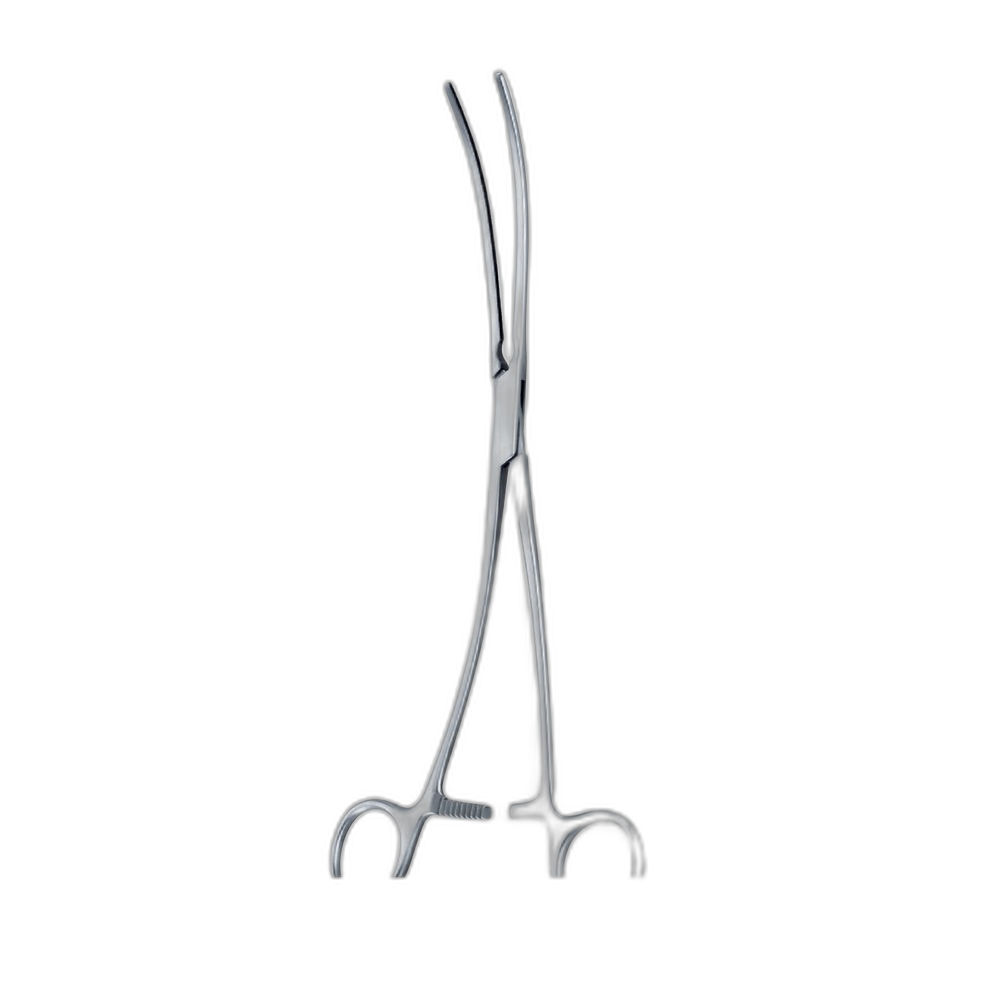
Where We Serve
Fizza Surgical exports to 50+ countries. Browse our country-specific pages with local regulatory guidance and pricing: