Lister Sinus Forceps and Probes: Tract Exploration Tools
Lister sinus forceps explained: no-ratchet spring design, sizes 125-180 mm, Hilton method, probes and grooved directors, plus care and cleaning.
An axillary abscess drained through a 1 cm stab incision rarely gives up everything on the first pass. Pus sits behind fibrinous septa in loculated pockets, and a scalpel pushed any deeper is working blind next to the axillary vein and the intercostobrachial nerve. That is the moment a specific instrument earns its place on the tray — one that goes in closed and comes out open.
The Lister sinus forceps has barely changed since the antiseptic era, for the simple reason that nothing has improved on it. It is a spring forceps with slim, blunt, transversely serrated jaws and — critically — no ratchet. Everything useful about it follows from that missing catch.
Why the Missing Ratchet Is the Whole Design
Put a Spencer Wells artery forceps into an abscess cavity and it locks shut. You can grip with it, but you cannot open it against resistance in a controlled way, because the box joint and the catch are engineered to hold a vessel closed against arterial pressure.
Sinus forceps do the opposite job. The two limbs are sprung so that the resting state is open. The surgeon squeezes to close the jaws, advances the closed tip along the track, then releases finger pressure and lets the spring push the blades apart inside the cavity. The septum tears along its weakest plane. Vessels and nerves, which are tougher and more elastic than fibrin, slide aside rather than dividing.
The jaw tips are rounded and blunt for the same reason. There is no cutting edge anywhere on the instrument. A sharp tip would find a plane the surgeon did not intend.
Transverse serrations run along the inner face of both blades. They are shallow — deep enough to hold a slipping fragment of granulation tissue or a retained suture knot, shallow enough that they do not shred what they grip.
Sizes and Pattern Variations
Most theatre trays carry two lengths: a short pattern for superficial collections and a longer one for deep tracks in the perineum, groin or gluteal region.
| Pattern | Length | Jaw profile | Typical use |
|---|---|---|---|
| Lister, straight | 125 mm | Slim, blunt, serrated | Superficial abscess, digital collections, minor ops set |
| Lister, straight | 140 mm | Slim, blunt, serrated | General ward and casualty drainage |
| Lister, straight | 160 mm | Slim, blunt, serrated | Breast abscess, axillary and groin collections |
| Lister, straight | 180 mm | Slim, blunt, serrated | Deep perianal and pilonidal tracks, ischiorectal fossa |
| Lister, curved | 140–180 mm | Gently curved on flat | Following an angled track around the anal verge |
The curved pattern is less common but worth having in an anorectal set, where a track that starts posteriorly often sweeps laterally before it reaches the internal opening.
Hilton’s Method — The Technique the Instrument Was Built For
John Hilton described the approach in the 1860s and it is still the safest way to open a deep collection in an anatomically crowded space.
The skin and superficial fascia are incised along the line of least tension. Deep fascia is opened just enough to admit the closed forceps. From that point the scalpel is put down. The closed blades advance into the cavity, are opened by releasing spring tension, and are withdrawn open. The manoeuvre is repeated in several directions — anterior, posterior, medial, lateral — until the loculations have been broken and the cavity is a single space that a finger can sweep.
Two practical points decide whether this works cleanly:
- Advance closed, withdraw open. Opening on the way in pushes tissue ahead of the tip and can create a false passage. Opening on the way out tears septa along planes that already exist.
- Do not force a direction. If the blades will not separate, that plane is not fibrin — it is fascia or a vessel sheath. Reposition and try another axis.
The same forceps then places the drain or the corrugated strip, gripping the end of the drain and carrying it to the depth of the cavity in one pass.
Probes and Directors: The Other Half of the Set
Sinus forceps map a cavity. Probes map a track. In a fistula-in-ano or a chronic discharging sinus, the probe goes first.
Malleable silver or stainless probes come in 125–200 mm lengths with an olive or bulbous tip and a shank soft enough to be bent by hand to match the suspected curve of the track. The bulbous tip is not decoration — it stops the probe from tunnelling through the wall of the track and creating a false internal opening, which is the classic way a simple fistula is converted into a complicated one.
Grooved directors are flat, 130–150 mm, with a channel milled along the upper surface and a leaf or forked terminal. Once the director is seated in the track, a scalpel blade run along the groove lays the track open along exactly the line the director occupies, with the tissue on either side protected by the shoulders of the groove. It converts a blind cut into a guided one.
Probe-pointed scissors and knives serve the same purpose with a bulb on the leading blade, and appear in most anorectal sets alongside a standard No. 3 scalpel handle.
Material, Finish and the Joint
Sinus forceps are non-cutting instruments, so they do not need the hardness of a blade. Manufacture is normally from martensitic stainless conforming to ISO 7153-1 — typically AISI 420 grade — hardened to a level that keeps the spring temper without making the limbs brittle. The temper matters more than the hardness figure. A limb that has been over-hardened will take a permanent set the first time it is sprung hard against a fibrous septum, and the jaws will no longer meet.
A satin or matt finish is preferable to mirror polish here. These instruments work in cavities lit by a single overhead lamp, and a mirror surface throws glare straight back at the surgeon.
Check the jaw meeting on any new instrument by holding it to a light source with the blades squeezed shut. Light visible between the serrated faces means the instrument will let a small fragment of granulation tissue slip every time. Fizza Surgical inspects jaw closure on every unit of this pattern before packing, and the same check takes a supervisor five seconds during goods-in at the receiving hospital. Our full range of general instruments is listed under surgical instruments.
Cleaning an Instrument That Lives in Infected Cavities
These forceps come out of every case loaded with pus, granulation debris and sometimes bone dust. The serrations and the spring limb junction are the two places debris hides.
Immediate wet transport prevents proteinaceous soil from drying into the serrations. Enzymatic pre-soak, then ultrasonic cleaning with the instrument in the open, unsprung position so cavitation reaches both faces of the jaw. Manual brushing along the serration axis, not across it.
Autoclave at 134 °C for the standard 3-minute holding time. Do not lubricate the spring — instrument milk on a spring joint attracts lint and does nothing useful, since there is no box joint to protect. The related routine for hinged instruments is covered in our note on rongeur jaw maintenance.
Retire the instrument when the blades no longer spring fully open under their own tension. A fatigued limb is a safety issue, not a cosmetic one: it converts a blunt-dissecting forceps into a gripping forceps, and the surgeon will not notice until it fails to open inside a cavity.
Frequently Asked Questions
Do Lister sinus forceps have a ratchet or catch?
No. The absence of a ratchet is deliberate. The limbs are sprung open at rest so the surgeon can close them to advance into a track and release them to open blunt planes inside the cavity. A ratcheted forceps cannot perform Hilton’s method.
What length should a general theatre stock?
Two lengths cover most work: 140 mm for superficial and ward-level drainage, and 180 mm for deep perianal, ischiorectal and gluteal collections. Add a 160 mm for breast and axillary abscesses if the caseload justifies a third.
Can artery forceps be used instead?
They are frequently substituted and it is a poor substitution. A locking artery forceps opens against tissue only as far as the surgeon’s grip allows, has sharper jaw tips, and cannot be released open inside a cavity. Use it if nothing else is available, but do not build a set around it.
Why is a bulbous tip important on a sinus probe?
It prevents the probe from perforating the wall of the track. A pointed probe pushed along a chronic fistula will make its own passage through granulation tissue and create a false internal opening, which changes both the operation and the recurrence risk.
Are these instruments reusable or single-use?
Reusable. A correctly tempered stainless pattern will survive several hundred autoclave cycles. Replace on loss of spring, not on appearance — surface staining from repeated exposure to purulent material is cosmetic, while a limb that no longer springs fully open is functionally dead.
Need precision surgical instruments?
Configure complete instrument sets with our team — ISO 13485 certified, CE marked, made in Sialkot since 1980.
Related Guides
View all articles →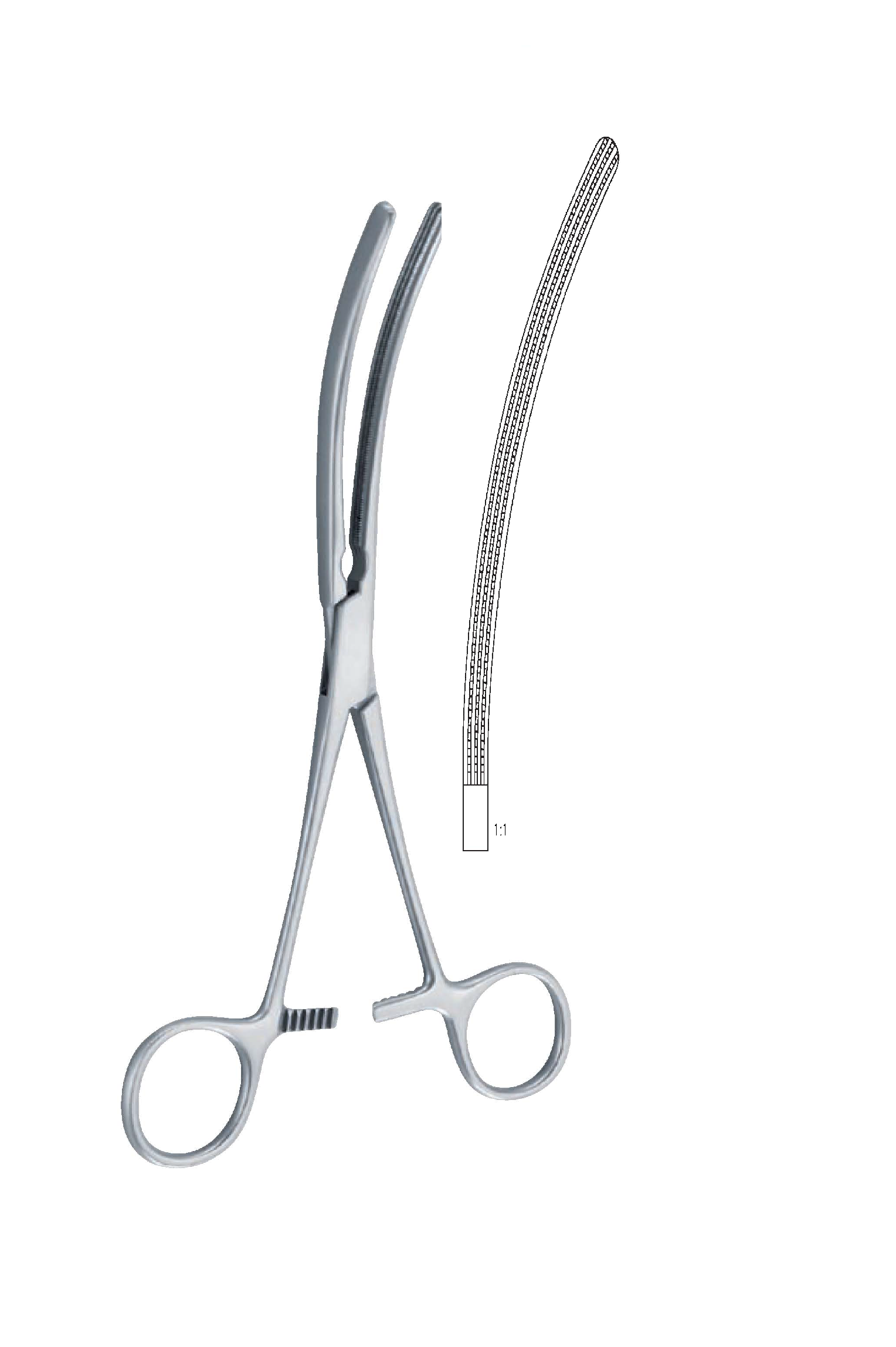
Where We Serve
Fizza Surgical exports to 50+ countries. Browse our country-specific pages with local regulatory guidance and pricing: