Amputation Instrument Set: Contents and Blade Selection
What belongs in an amputation instrument set: Liston and Catlin knives, blade length by level, bow vs Gigli saw, rasps, retraction and care.
A district hospital amputation tray usually runs to somewhere between 22 and 35 pieces. The number varies less than you would expect between a trauma unit in Europe and a rural surgical centre in West Africa, because the operation itself has not changed: control the vessels, divide the muscle at the level you intend to close at, cut the bone cleanly, and finish with a stump that will tolerate a prosthesis.
What does vary — and what decides whether the stump heals — is blade selection and the condition of the saw. Those two items get less attention in procurement than they deserve.
What Actually Goes in the Tray
A working amputation instrument set breaks into six functional groups. The count below reflects a mid-thigh or below-knee case in an open tray, not a modular power-tool system.
| Group | Instruments | Typical quantity |
|---|---|---|
| Soft-tissue division | Liston amputating knives (2 lengths), Catlin double-edged knife, No. 4 scalpel handle with No. 22 blades, Mayo scissors curved and straight | 6–8 |
| Bone division | Bow saw (Satterlee or Charrière pattern) with spare blades, Gigli wire saw with two handles and a saw guide | 4–6 |
| Bone finishing | Bone rasp/file, Liston bone-cutting forceps, single- and double-action rongeurs, periosteal elevator | 4–5 |
| Retraction | Langenbeck retractors, Volkmann rake retractors (blunt 4-prong), linen three-tailed amputation retractor | 4–6 |
| Haemostasis and closure | Artery forceps curved and straight, Adson and toothed dissecting forceps, Mayo-Hegar needle holders, ligature reels | 10–14 |
| Limb control | Esmarch bandage, pneumatic or Samway tourniquet, bone-holding forceps | 2–3 |
Amputation Knives: Liston, Catlin and Blade Length
The Liston knife is the workhorse — a single-edged, straight-backed blade with a long taper and a fully round or octagonal handle so the surgeon can rotate it freely in the palm during a circular or fish-mouth incision. Blade lengths run 150, 180, 200 and 250 mm.
Length is not a matter of preference. The rule that has survived is that the blade must be long enough to complete the sweep around the limb circumference in a single continuous stroke, without sawing. A sawing motion leaves a ragged, terraced muscle edge that will not appose neatly at closure.
| Amputation level | Approximate limb circumference | Liston blade length |
|---|---|---|
| Digits, transmetatarsal | < 15 cm | 150 mm or scalpel only |
| Below elbow, below knee | 25–35 cm | 180 mm |
| Above knee, mid-thigh | 40–55 cm | 200 mm |
| Hip disarticulation, obese thigh | > 55 cm | 250 mm |
The Catlin knife is double-edged and tapers to a point. Its job is the interosseous space — the membrane and deep muscle between radius and ulna, or tibia and fibula. It is passed through the space and drawn distally, cutting on both edges. A single-edged knife cannot do this without repeated repositioning, and each repositioning costs tourniquet time.
Keep the Catlin off the general soft-tissue work. Its point is fine and it is easily damaged against bone.
Guillotine Versus Definitive Amputation — Two Different Trays
A common procurement mistake is buying one tray and expecting it to cover both operations. They are not the same procedure and they do not need the same steel.
A guillotine amputation is a damage-control operation for uncontrolled sepsis or gas gangrene. Skin, muscle and bone are divided at the same level in one plane, the wound is left open, and the patient returns for revision once the infection is controlled. The tray is short: knives, a saw, artery forceps, and retraction. There is no flap planning, no bone bevelling and no closure, so needle holders and fine dissecting forceps sit largely unused.
A definitive amputation is a reconstructive operation. Myoplasty or myodesis anchors opposing muscle groups over the bone end; the posterior flap in a below-knee case has to be raised at a specific length and thickness. That work needs the full complement — periosteal elevators, bone-holding forceps, a drill for myodesis holes if the technique is used, fine forceps for nerve handling, and enough needle holders that two surgeons can close simultaneously.
Hospitals that receive trauma and diabetic foot sepsis in volume are better served by two trays than by one oversized one. The guillotine set turns around faster, and it keeps the fine instruments out of a grossly contaminated case.
Flap Planning and the Instruments It Demands
Flap length is measured, not estimated. The long posterior flap in a below-knee amputation is conventionally cut at one-third of the limb circumference at the level of the bone cut, plus 1 cm — which means the tray needs a sterile ruler or a marked flexible measure, an item routinely forgotten and routinely improvised with a suture packet.
The skin incision is made with a No. 22 blade on a No. 4 handle, not with the amputation knife. The knife takes over once the deep fascia is opened and the circumferential muscle division begins. Keeping the two separate protects the amputation knife edge from the abrasive contact of skin prep and dermis.
Muscle is divided at a level 2 to 3 cm distal to the intended bone cut in most techniques, so that it can be brought over the bone end without tension. Sharp division with a long blade in a single sweep gives an edge that holds a suture; a crushed or diathermy-charred muscle edge does not, and myoplasty breakdown is a slow, expensive complication.
Saws: Bow Saw Versus Gigli Wire
Both belong in a complete set, and they fail in different ways.
The bow saw — Satterlee or Charrière pattern — holds a replaceable straight blade under tension in a rigid frame. Tooth pitch matters: a coarse blade around 14 teeth per 25 mm clears cancellous bone and marrow debris without clogging, while a fine blade around 22 teeth per 25 mm gives a smoother cut on cortical bone but loads up faster in a wide femoral cut. Most sets carry both.
The Gigli saw is a twisted multi-strand wire with a loop at each end for the T-handles. It cuts from the far side of the bone outwards, which is exactly what you want when the soft tissue behind the bone must not be touched. It is passed around the bone with a saw guide, then worked with long strokes at a shallow angle — 30 to 45 degrees between the two hands. Steep, short strokes generate heat, snap the wire and burn the bone end. Our separate guide on the Gigli wire saw covers passing technique in detail.
Two practical notes on saws in a resource-limited theatre. First, wire saws are consumables — budget three to five per set per year, not one. A wire that has been used and re-sterilised twice will break mid-cut. Second, bow saw blades corrode at the pin holes where they sit in the frame, and the frame itself traps bone dust at the tensioning screw. Both need to be broken down for cleaning after every case.
Finishing the Bone End
A stump fails at the bone end more often than at the skin. The saw leaves a sharp cortical rim and, at a below-knee level, an anterior tibial crest that will press on the skin flap under prosthetic load.
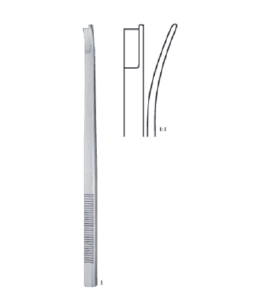
The tibial crest is bevelled at roughly 45 degrees — traditionally with an osteotome or with a second, angled saw cut before the transverse cut is completed. See our overview of the osteotome and chisel set for pattern and width selection.
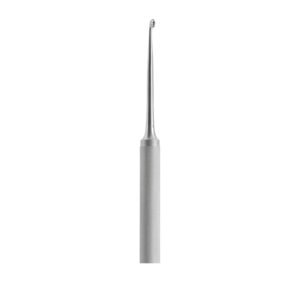
The remaining rim is taken down with a bone rasp. A half-round rasp with medium cut on one face and fine on the other is enough; a coarse wood-style file leaves grooves that harbour debris. Liston bone-cutting forceps handle the fibula, which is divided 1 to 2 cm proximal to the tibial cut so that it does not become a pressure point of its own.
Rongeurs then clear any loose fragments from the marrow cavity and the periosteal edge.
Haemostasis and Limb Control
The Esmarch bandage exsanguinates the limb from distal to proximal before the tourniquet is inflated — except in sepsis or suspected malignancy, where elevation alone is used instead of compression. Tourniquet time is the operating clock: most units work to a 90-minute ceiling for the lower limb and 60 minutes for the upper. Our comparison of pneumatic and Esmarch tourniquets sets out pressure selection by limb and systolic reading.
Major vessels are dissected out, doubly ligated and divided separately from the muscle mass. The main nerve trunks — sciatic, tibial, median — are drawn down under gentle traction, divided sharply with a fresh blade, and allowed to retract into the muscle. A crushed or torn nerve end is the origin of a symptomatic neuroma, so the tray should carry a scalpel handle that is not the one used for skin.
Artery forceps count matters more here than in most sets. A mid-thigh amputation with a poorly controlled femoral profunda can consume a dozen clips in ninety seconds. Twelve curved and six straight is a realistic minimum for a thigh-level tray, and a set that carries eight total will run out at the worst possible moment.
One more item earns its place: a second set of ligature reels or pre-cut ties, loaded before the tourniquet goes on. Once the profunda is bleeding, nobody has a spare hand to load a reel.
Retraction and the Three-Tailed Retractor
The linen or gauze three-tailed amputation retractor is one of the few instruments in surgery that is neither steel nor disposable in the modern sense. Three tails of woven linen are drawn between the bones and around the divided muscle to hold everything proximally while the saw works. In a two-bone segment the middle tail passes through the interosseous space.
It costs almost nothing and it prevents the commonest intraoperative injury during amputation: the assistant’s retractor slipping and the saw blade catching soft tissue. Steel retractors — Langenbeck for the skin flaps, blunt Volkmann rakes for muscle — supplement it but do not replace it.
Steel Grade and Heat Treatment
Amputation knives and saw blades are cutting instruments and are made from hardenable martensitic stainless steel to ISO 7153-1, most commonly AISI 420 in the higher-carbon variant, hardened to roughly 52–56 HRC at the edge. Below about 50 HRC the edge rolls on the first pass through fascia. Above about 58 HRC it chips against bone.
Non-cutting components — retractors, bone-holding forceps, the saw frame — use AISI 410 or austenitic 316L where corrosion resistance matters more than edge retention.
Fizza Surgical has manufactured to this specification in Sialkot since 1980 and holds ISO 13485 certification with CE marking; our bone surgery instrument range covers the saws, rasps and cutting forceps described here, and certification detail is on our certifications page.
Building the Set for a Field or District Hospital
Where sterile turnaround is slow and cases arrive unpredictably, the set needs to be self-sufficient rather than minimal.
- Duplicate the knives. One Liston knife per case is one damaged edge away from an incomplete operation.
- Carry both saw types. Power fails; the Gigli does not need it.
- Pack a spare wire saw and a full sleeve of bow saw blades inside the tray, not in a separate store.
- Include a hand drill and wire for bone traction if delayed closure is likely.
- Specify a perforated stainless sterilising case sized so the tray does not need repacking — instruments loose in a wrap get lost and get damaged.
Care After a Contaminated Case
Amputation for gas gangrene or diabetic sepsis leaves the tray heavily soiled with necrotic tissue and marrow fat. Marrow fat is the problem: it is not water-soluble and it sets in the saw frame and the rongeur box joint.
Break the saw down completely, remove the blade, and pre-soak in an enzymatic solution warm enough to mobilise lipid — most manufacturers specify 40 to 45 °C. Ultrasonic clean with hinged instruments open. Inspect knife edges under magnification before repacking; a nicked amputation knife should be sent for regrinding, not returned to the tray.
Dry fully before autoclaving. Water trapped in a bow saw frame is the commonest source of the brown staining that gets reported as rust on an otherwise sound set.
Frequently Asked Questions
How many instruments should an amputation instrument set contain?
Between 22 and 35 pieces for a general lower-limb tray. The count is less important than coverage of all six functional groups — soft-tissue division, bone division, bone finishing, retraction, haemostasis and limb control. A 30-piece set missing a wire saw is worse than a 22-piece set that has one.
What blade length is right for a below-knee amputation?
A 180 mm Liston knife suits most below-knee levels, where limb circumference falls between 25 and 35 cm. The blade should complete the circumferential sweep in one stroke; if you find yourself sawing, the blade is too short.
Is a Gigli saw better than a bow saw for amputation?
They solve different problems. The Gigli cuts from behind the bone outwards and protects the soft tissue on the far side, which suits a tight surgical field. A bow saw is faster and more controllable in an open field with good exposure. A complete set carries both.
Why is the tibial crest bevelled?
An unbevelled anterior tibial crest concentrates load on the skin flap once the patient is fitted with a prosthesis, causing pressure necrosis at the stump end. A 45-degree bevel and a rasped edge distribute that load across a broader surface.
Can amputation knives be resharpened?
Yes, and they should be. A Liston knife in AISI 420 at 52–56 HRC will take several regrinds over its service life before the blade profile is compromised. Send it for professional regrinding — hand stoning by theatre staff changes the bevel angle and shortens the interval to the next sharpening.
What is the three-tailed retractor for?
It holds divided muscle and skin proximally while the bone is cut, keeping soft tissue out of the saw path. In two-bone segments such as the forearm or leg, the middle tail passes through the interosseous space so both bones are cleared simultaneously.
Need precision surgical instruments?
Configure complete instrument sets with our team — ISO 13485 certified, CE marked, made in Sialkot since 1980.
Related Guides
View all articles →
Where We Serve
Fizza Surgical exports to 50+ countries. Browse our country-specific pages with local regulatory guidance and pricing: