Kirschner Wire Instruments: Drivers, Benders and Cutters
Kirschner wire instruments explained: K-wire sizes 0.6-4.0mm, chucks, benders, TC cutters, ring-fixator tensioners and traction bows.
A 1.6 mm trocar-tip wire, 150 mm long, driven at 400 rpm through the metaphysis of a distal radius. That is the whole of the fixation in a large share of paediatric and low-demand adult fractures, and it costs a fraction of a plate. The wire is the cheap part. What determines whether the construct holds is the set of instruments around it.
Martin Kirschner introduced the technique in 1909 as a means of skeletal traction. More than a century later the wire itself has barely changed, while the handling instruments have quietly split into four distinct families — drivers, benders, cutters and tensioners — each of which fails in its own characteristic way.
Wire sizes and what each diameter is for
Diameter drives everything downstream. A cutter rated for 1.2 mm will deform on a 2.5 mm wire, and a driver chuck sized for fine wires will slip on a heavy one.
| Diameter | Typical length range | Common application |
|---|---|---|
| 0.6 – 0.9 mm | 70 – 150 mm | Hand and finger phalanges, paediatric metacarpals, small-animal orthopaedics |
| 1.0 – 1.25 mm | 100 – 150 mm | Metacarpal and metatarsal fixation, tension-band constructs in small bone |
| 1.4 – 1.6 mm | 150 – 200 mm | Distal radius, olecranon and patella tension bands, paediatric supracondylar humerus |
| 1.8 – 2.0 mm | 150 – 250 mm | Adult distal radius, ankle, provisional fixation before plating, skeletal traction |
| 2.5 – 3.0 mm | 200 – 300 mm | Heavy traction, guide wires for cannulated screws, large-fragment provisional fixation |
| 3.5 – 4.0 mm | 250 – 300 mm | Ring fixator transosseous wires, femoral and tibial traction pins |
Tip geometry matters as much as diameter. A trocar tip — three ground facets — cuts cortex cleanly and wanders less on a curved surface, which is why it is the default for percutaneous work. A diamond tip has four facets and drills faster through cancellous bone but skates more readily on a sloped cortex. Bayonet or double-ended trocar wires give you a second sharp end when the first blunts mid-case. Blunt-ended wires exist specifically so that a wire left protruding under skin does not migrate through soft tissue.
Material is almost always AISI 316L austenitic stainless for implantable wires, chosen for corrosion resistance in vivo rather than hardness. Note the distinction from the instruments that handle them: cutters and benders are martensitic 420 or 440 grades, hardened so they can cut and shape a 316L wire without deforming.
Drivers and chucks
The driver is where most theatre frustration originates, because a chuck that will not hold is a chuck that spins on the wire and polishes it into a surface it can never grip again.
Three arrangements are in routine use. The Jacobs chuck with T-handle is the manual standard — three jaws, keyed or keyless, gripping anywhere along the wire so you can advance in stages without repositioning. Slow, but it gives unmatched tactile feedback when you are feeling for the far cortex. The power driver chuck, mounted on a battery or air drill, is faster and generates less heat per unit of advance precisely because it is faster — but it removes that tactile signal entirely. The quick-release cannulated chuck lets a wire pass through the handle, which matters when you are driving a 250 mm wire through a limb and cannot afford to keep re-gripping.
Two failure modes to know. Jaw wear is the common one: the hardened jaw faces round over and stop biting, and the tell is a wire that turns in the chuck under load. The other is thermal — a blunt wire on a power driver at high rpm generates enough heat at the tip to cause ring sequestrum around the pin track, and the operative sign is smoke or a wire that suddenly advances easily after resisting. Change the wire, do not push through.
Benders
Almost every wire that stays in gets bent. A protruding straight end is a skin perforation waiting to happen; a bent end resists migration and gives a purchase point for later removal.
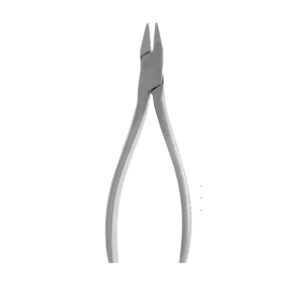
A dedicated K-wire bender is a plier-form instrument with a slotted or grooved jaw that captures the wire at a defined distance from the skin and levers a controlled bend without kinking. The distinction from an ordinary plier is the groove: pinch a wire between flat jaws and you flatten its cross-section at the bend, creating a stress riser that is where the wire will subsequently fatigue and break. Broken wire ends buried in bone are one of the more tedious problems in trauma surgery.
Bend geometry is the surgeon’s call, but the mechanics are not subtle. A 90-degree bend resists migration well and sits proudly under skin; a 180-degree hook resists migration better still and is standard where the wire will be in for six weeks or more. Bending closer than about 5 mm to the skin makes later removal awkward; leaving more than about 15 mm invites the end to tent the dressing.
Some benders carry a combination cutting notch. Convenient, but a combination jaw is a compromise on both functions, and on wires above 2.0 mm the dedicated instrument is worth the extra tray space.
Cutters
This is where specification is least forgiving. Cutting a hardened wire is a shear operation against a very small contact area, and an under-specified cutter does not fail gracefully — it crushes the wire, work-hardens the cut zone, and leaves a burr that will not pass back through the pin track on removal.
Three configurations, distinguished by where the cutting edge sits relative to the handle axis:
- End-cutting (front-cutting) — jaws at the tip, cutting perpendicular to the handles. Lets you cut flush against skin or against bone in a deep wound, which is exactly what you want when trimming a wire in situ.
- Side-cutting — cutting edge along the side of the jaw. More mechanical advantage for the same hand force, better for cutting wire to length on the back table before it goes in.
- Double-action — a compound linkage that roughly doubles the force delivered at the jaw for a given grip. Essential above about 2.5 mm; a single-action cutter on a 3.0 mm wire is a two-handed struggle that ends in a crushed end.
Tungsten carbide inserts are the meaningful upgrade. A TC-insert cutter holds its edge across hundreds of cuts where a plain hardened-steel jaw develops a visible notch after a few dozen on heavy wire, and a notched jaw crushes rather than shears. On the reprocessing side, TC inserts are brazed in and do not tolerate aggressive alkaline detergents — pH-neutral enzymatic cleaning only, or the braze corrodes and the insert loosens.
Tensioners and traction bows
Two applications need the wire held under measured tension rather than simply driven.
In ring fixator work, fine transosseous wires of 1.5 to 1.8 mm provide stability only when tensioned — typically in the region of 90 to 130 kgf depending on wire diameter and ring size — because an untensioned fine wire has essentially no bending stiffness. A wire tensioner clamps the wire against the ring and applies a calibrated pull, and the calibration is the whole point. Tensioners drift out of specification with use, and a set of rings tensioned by a drifted device is a construct that is not what the surgeon believes it is.
In skeletal traction, a transfixing wire of 1.8 to 2.5 mm through the proximal tibia or calcaneus is held in a Kirschner traction bow — a semicircular frame with a tensioning screw at one or both ends. The bow tensions the wire so it does not bow under load and provides the attachment point for the traction cord. The traditional Kirschner bow tensions from one end; Böhler-pattern bows tension centrally. Either way, check the tension daily on a patient in traction, because a slackening wire will cut through cancellous bone.
Reprocessing and what wears out first
Kirschner wire instruments live in a hostile part of the tray. Cutters and benders are box-joint or double-action instruments with hinges that trap bone debris, and they take a hammering in use.
The wear sequence is predictable. Cutter jaws notch first — inspect the cutting edge under magnification against a light and retire the instrument when a notch is visible, because a notched cutter crushes. Bender grooves round over next, at which point the instrument starts flattening wires instead of bending them. Chuck jaws round last but most insidiously, because a chuck that slips slightly still looks fine.
Hinged instruments in this group need lubrication after every cycle — a water-soluble instrument milk applied to the box joint before autoclaving, never a mineral oil, which will not steam-penetrate. Our note on instrument lubrication covers the reasoning. For the wider orthopaedic tray these instruments sit in, see our guides to distal radius fixation instruments and the external fixator set.
Frequently Asked Questions
What Kirschner wire instruments does a basic trauma tray need?
Four items cover routine percutaneous pinning: a T-handle Jacobs chuck, a double-action end-cutting wire cutter with tungsten carbide inserts, a grooved K-wire bender, and a wire-length gauge. Add a tensioner only if you run ring fixators, and a traction bow only if you place skeletal traction.
Can ordinary pliers or bone cutters be used on K-wires?
No, and the reason is metallurgical rather than procedural. A general-purpose plier has flat jaws that flatten the wire cross-section and create a stress riser at the bend. A bone cutter is ground for a much softer material and will notch on hardened wire. Both leave you with a wire that fractures in situ, which is a far larger problem than the instrument saved.
Why does a wire bind and heat during insertion?
Almost always a blunt tip. A trocar point that has been driven through cortex once, or reused after a failed pass, no longer cuts — it burnishes, and the friction generates enough heat to cause thermal necrosis in a ring around the pin track. If a wire suddenly needs more pressure, or if you see smoke, change the wire rather than pushing harder. Low rpm with irrigation also helps on dense cortex.
How much tension does a fine ring-fixator wire need?
Typically 90 to 130 kgf depending on wire diameter and ring diameter, applied with a calibrated tensioner and set per the fixator manufacturer’s protocol. The number matters because a fine wire below its intended tension contributes almost nothing to construct stiffness. Have tensioners checked against a reference periodically — they drift.
What steel grades are used for the wires and the instruments?
Different grades for different jobs. Implantable wires are normally AISI 316L austenitic stainless, selected for corrosion resistance in vivo. The cutters and benders that handle them are martensitic 420 or 440 grades, hardened and tempered so the instrument is substantially harder than the wire it works on. A cutter made from the same grade as the wire would notch on the first cut.
Sourcing
Kirschner wire instruments are supplied individually or as a pinning module — T-handle chucks, double-action TC cutters in end- and side-cutting patterns, grooved benders, wire gauges, tensioners and Kirschner traction bows. Manufactured in Sialkot to ISO 13485 with CE marking. See the full bone surgery instruments range or contact us for a set built to your trauma tray list.
Need precision surgical instruments?
Configure complete instrument sets with our team — ISO 13485 certified, CE marked, made in Sialkot since 1980.
Related Guides
View all articles →

Where We Serve
Fizza Surgical exports to 50+ countries. Browse our country-specific pages with local regulatory guidance and pricing: