Instrument Comparisons

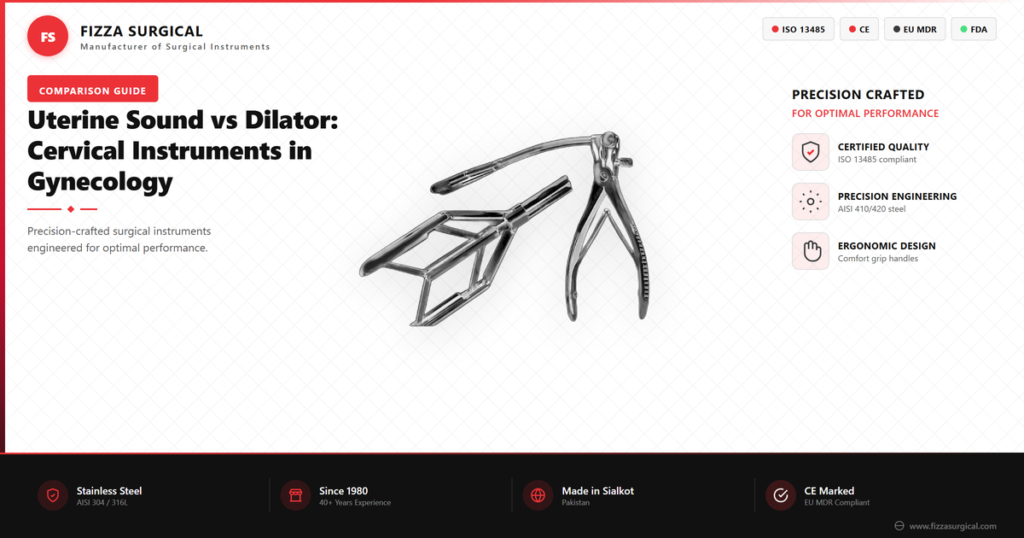
uterine sound vs dilator cervical instruments banner

Uterine Sound vs Dilator: Cervical Instruments in Gynecology

Two instruments sit at the start of almost every transcervical gynaecological procedure, and they are routinely confused. A uterine sound measures. A dilator opens. One is designed to slip gently through the cervical canal and tell you how deep and in what direction the uterine cavity lies; the other is designed to apply controlled force

Uterine Sound vs Dilator: Cervical Instruments in Gynecology Read More »

anoscope vs proctoscope sigmoidoscope comparison banner

Anoscope vs Proctoscope vs Sigmoidoscope: Rectal Exam Tools

Anoscope Proctoscope Rigid sigmoidoscope Working length 7–9 cm 13–15 cm 25–35 cm Diameter 19–23 mm 19–22 mm 15–20 mm Reaches Anal canal, distal rectum Rectum to rectosigmoid junction Rectum + sigmoid colon Bowel prep None Usually none / single enema Enema required Typical use Hemorrhoids, fissures, banding Rectal biopsy, proctitis, foreign body Rectosigmoid lesions, volvulus

Anoscope vs Proctoscope vs Sigmoidoscope: Rectal Exam Tools Read More »

bone drill vs bone saw orthopedic banner

Bone Drill vs Bone Saw: When to Use Each in Orthopedic Surgery

Both cut bone. That is where the similarity ends. A surgical drill makes holes — controlled cylindrical channels for screws, pins, wires, and guide instrumentation. A bone saw makes cuts — linear or curved divisions of bone for osteotomies, resections, and amputations. The bone drill vs bone saw question is rarely a real dilemma to

Bone Drill vs Bone Saw: When to Use Each in Orthopedic Surgery Read More »

Serving 50+ countries in 7 languages View Global Markets
WhatsApp
Fizza Surgical
Fizza Surgical ● Online — typically replies instantly