Jorgenson Scissors vs Curved Mayo: Which to Use
Jorgenson scissors vs curved Mayo: how the blade curves differ, why they are not interchangeable, and which to use at each stage of a hysterectomy.
 Made in Sialkot · Since 1980
Both instruments land on the hysterectomy tray, and both cut heavy tissue with a curved blade — so surgical techs new to gynecology often treat them as interchangeable. They are not. Reach for a curved Mayo when the surgeon asks for the Jorgenson at the cervical amputation, and you will hand over a blade that cannot make the cut cleanly.
| Feature | Jorgenson scissors | Curved Mayo scissors |
|---|---|---|
| Blade curve | Acute, sharply hooked near the tip | Gentle, uniform curve |
| Body | Heavy, rigid, robust | Heavy but more general-purpose |
| Tip | Rounded, narrow, tapered | Semi-blunt, rounded |
| Length | Typically 22–23 cm (9 in) | 15–23 cm range |
| Signature job | Amputating the cervix off the vaginal cuff | Cutting fascia, dense tissue, sutures |
| Versatility | Specialized — one main role | Broad — used across many procedures |
The Jorgenson: built for one difficult cut
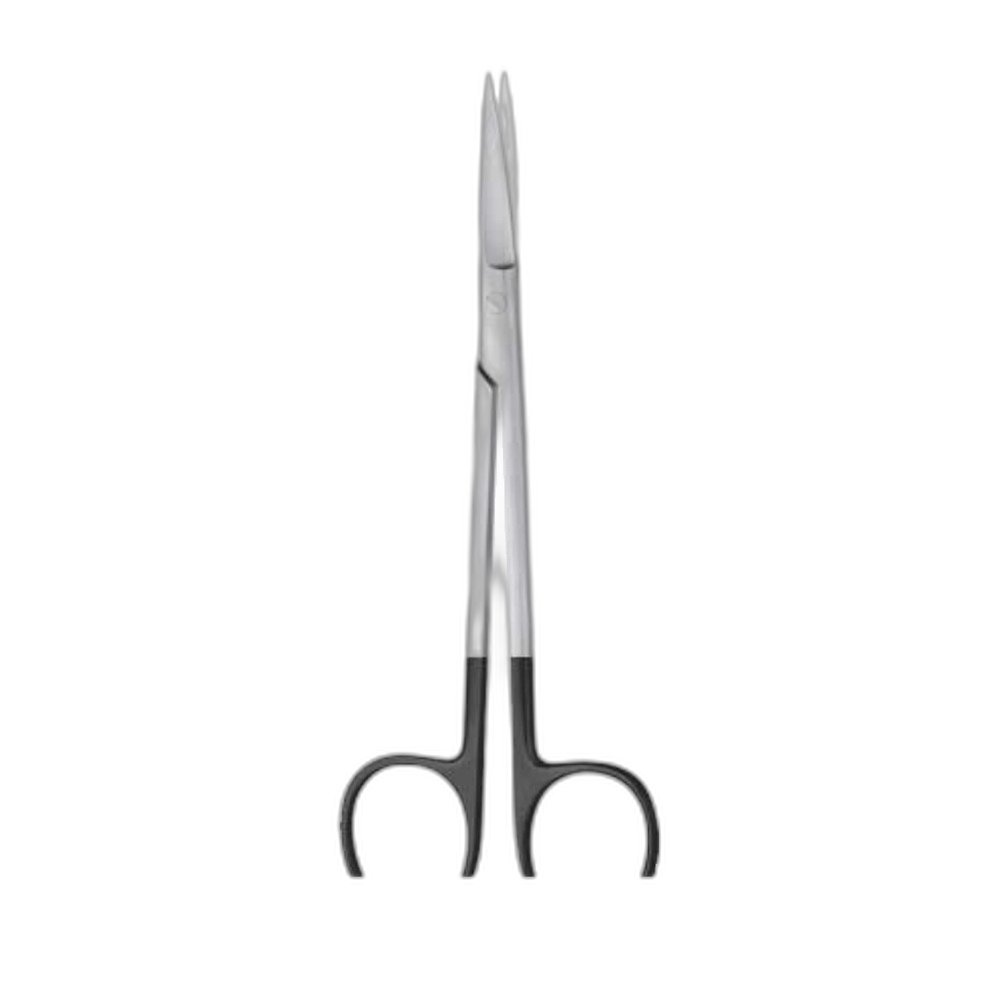
The Jorgenson is a heavy scissor with an aggressively hooked curve near the tip. That sharp bend is not decorative — during an abdominal or vaginal hysterectomy, the surgeon needs to cut the cervix free from the vaginal cuff deep in the pelvis, working around the curve of the vaginal fornix. The acute blade angle reaches under and around the cervix in a way a gently curved blade cannot, and the rigid body transmits the force needed to divide that dense, vascular tissue in a controlled arc.
Its narrow tapered tip lets it work in the confined space at the top of the vagina. Everything about the design is optimized for that single moment of the operation, which is why the Jorgenson has a fixed place on gynecologic trays despite being a one-job instrument.
The curved Mayo: the pelvic workhorse
Curved Mayo scissors are the general heavy-tissue scissors of the abdomen and pelvis. The uniform curve lets the surgeon reach around structures and cut in recessed spaces without cranking the wrist into an awkward angle. Through a hysterectomy they divide the round ligaments, cut fascia, take down adhesions, and trim suture — the constant background cutting that fills most of the case.
The blades are heavier and semi-blunt, made to cut tough fascia and connective tissue rather than delicate planes. Where fine tissue dissection is needed, the team switches to curved Metzenbaum scissors; the Mayo is deliberately the sturdier, blunter option. For the full lineage of Mayo patterns and their sizes, our guide to Mayo scissors breaks down straight versus curved and the tissue each suits.
Why they are not interchangeable
The temptation to substitute comes from surface similarity — both are heavy, both curved, both cut dense tissue. The difference is the degree and placement of the curve. A curved Mayo’s gentle arc simply cannot hook under the cervix at the vaginal cuff; the surgeon would be sawing at a bad angle against a vascular structure. Conversely, using a Jorgenson for routine fascial cutting is clumsy — the acute hook gets in the way when a straight-through cut is all that is needed.
This is why standard hysterectomy equipment lists specify both, along with straight and curved Mayo uterine scissors. They are complementary, each covering a stage of the operation the other handles poorly.
Reading the request at each stage of a hysterectomy
The two instruments hand off to each other as the operation moves deeper. Early in an abdominal hysterectomy, the curved Mayo does the bulk work — dividing the round and broad ligaments, opening the fascia, taking down filmy adhesions. It stays in the surgeon’s hand through most of the exposure because the cutting is repetitive and the tissue is tough but accessible.
The Jorgenson comes into play at the bottom of the procedure, at the vaginal cuff. Once the bladder is reflected and the uterine vessels are secured, the cervix has to be amputated from the vaginal fornix — a cut made blind by feel, around a curve, against vascular tissue. That is the Jorgenson’s moment, and handing over anything else slows the surgeon at the most delicate stage. In a vaginal hysterectomy the sequence compresses but the logic holds: Mayo for the accessible cutting, Jorgenson for the deep hooked cut.
So the Jorgenson scissors vs Mayo choice is really a question of when, not which is better. A scrub tech who anticipates the handoff — Mayo up front, Jorgenson passed as the surgeon reaches the cuff — keeps the case moving. Reading the stage of the operation is as useful as knowing the instruments themselves.
Choosing and caring for both
When selecting either instrument, three things matter: blade edge quality, box-joint smoothness, and tip finish. Both are heavy scissors that will see hundreds of cycles, so edge retention is the priority — a Mayo that crushes fascia rather than cutting it slows the whole case, and a dull Jorgenson turns cervical amputation into a struggle.
- Steel: Both are forged from hardened martensitic stainless (AISI 420 grade is typical) for edge retention. Tungsten-carbide-insert versions of curved Mayo scissors, marked with gold rings, hold their edge far longer.
- Inspection: Test the cut on gauze — it should shear cleanly to the tip, not fold the material.
- Box joint: Clean and lubricate it; stiffness there is the first sign of retained debris or corrosion.
- Sterilization: Autoclave open at 134°C, and protect the tips in the tray so the Jorgenson’s narrow point is not bent.
On lifecycle cost, the tungsten-carbide-insert curved Mayo is usually the better buy for a busy gynecology service: the higher purchase price is offset by years of extra edge life before re-sharpening. The Jorgenson, used for a single cut per case, sees far fewer cutting cycles, so a well-made hardened-stainless pair serves reliably without the carbide premium. Buy to match how hard each instrument actually works.
For a service building or replacing a gynecology tray, both belong on the list — not one or the other. Fizza Surgical manufactures Jorgenson scissors, curved and straight Mayo scissors, and the full gynecologic instrument range in hardened and tungsten-carbide patterns under ISO 13485 and CE marking. Browse our surgical instruments range and see our certifications for the standards behind each instrument.
Frequently Asked Questions
What is the main difference between Jorgenson and curved Mayo scissors?
Jorgenson scissors have an acute, sharply hooked curve near the tip and are specialized for amputating the cervix off the vaginal cuff during hysterectomy. Curved Mayo scissors have a gentle, uniform curve and are general-purpose heavy-tissue scissors used for fascia, dense tissue, and suture cutting.
Can I use curved Mayo scissors instead of Jorgenson scissors?
Not for cervical amputation. A curved Mayo’s gentle arc cannot hook under the cervix at the vaginal fornix the way a Jorgenson’s acute curve can. Standard hysterectomy trays list both because each handles a stage of the operation the other does poorly.
What are Jorgenson scissors used for besides hysterectomy?
Their primary role is cutting thick, heavy tissue in deep pelvic spaces, most notably freeing the cervix during hysterectomy. The acute curve and rigid body make them useful wherever a hooked, forceful cut is needed in a confined deep field.
Are curved Mayo scissors used for delicate tissue?
No. Curved Mayo scissors are heavier and semi-blunt, made for tough fascia and connective tissue. For delicate tissue dissection, surgeons switch to curved Metzenbaum scissors, which have finer, thinner blades.
What steel are these hysterectomy scissors made from?
Both are forged from hardened martensitic stainless steel, commonly AISI 420, for edge retention under repeated use and sterilization. Tungsten-carbide-insert versions, identified by gold-ringed handles, hold their cutting edge significantly longer.
Need precision surgical instruments?
Configure complete instrument sets with our team — ISO 13485 certified, CE marked, made in Sialkot since 1980.
Related Guides
View all articles →
Where We Serve
Fizza Surgical exports to 50+ countries. Browse our country-specific pages with local regulatory guidance and pricing: