Laparoscopic Instrument Set: Complete MIS Guide
What belongs in a laparoscopic instrument set: core list, sizes, insulation failure testing and lumen reprocessing.
 Made in Sialkot · Since 1980
What actually belongs in a laparoscopic instrument set?
Ask three surgeons and you will get three answers, because the honest answer is that there is no single set. There is a core that every abdominal case uses, and then there are procedure-specific additions. Most procurement mistakes come from buying somebody else’s “complete” list rather than building around the core.
This guide covers the core, the variations, and the two areas hospitals consistently underestimate: insulation integrity and lumen reprocessing.
How a modular laparoscopic instrument is built
Before the list, the anatomy of the tools themselves — because it determines cleaning, cost, and failure modes.
A modular instrument separates into three parts:
- Handle — ring, axial, or pistol grip, with or without a ratchet. This is the part surgeons have strong opinions about.
- Outer tube (sheath) — 5 mm or 10 mm diameter, 330 mm working length as standard, 450 mm for bariatric. Carries the insulation on monopolar instruments.
- Insert — the working element: jaws, scissor blades, dissector tip.
Modular design costs more upfront and repays it twice: worn inserts are replaced without discarding the handle, and all three parts can be brushed and flushed individually. Non-modular (unitary) instruments are cheaper and marginally more rigid, but a lumen you cannot open is a lumen you cannot verify as clean. For any unit doing volume laparoscopy, modular is the defensible choice.
Standard dimensions worth memorising: 5 mm and 10 mm shaft diameters, 330 mm standard length, 450 mm extended, and a 4 mm luer lock flushing port on every monopolar instrument for channel irrigation.
Access instruments
Veress needle and trocars
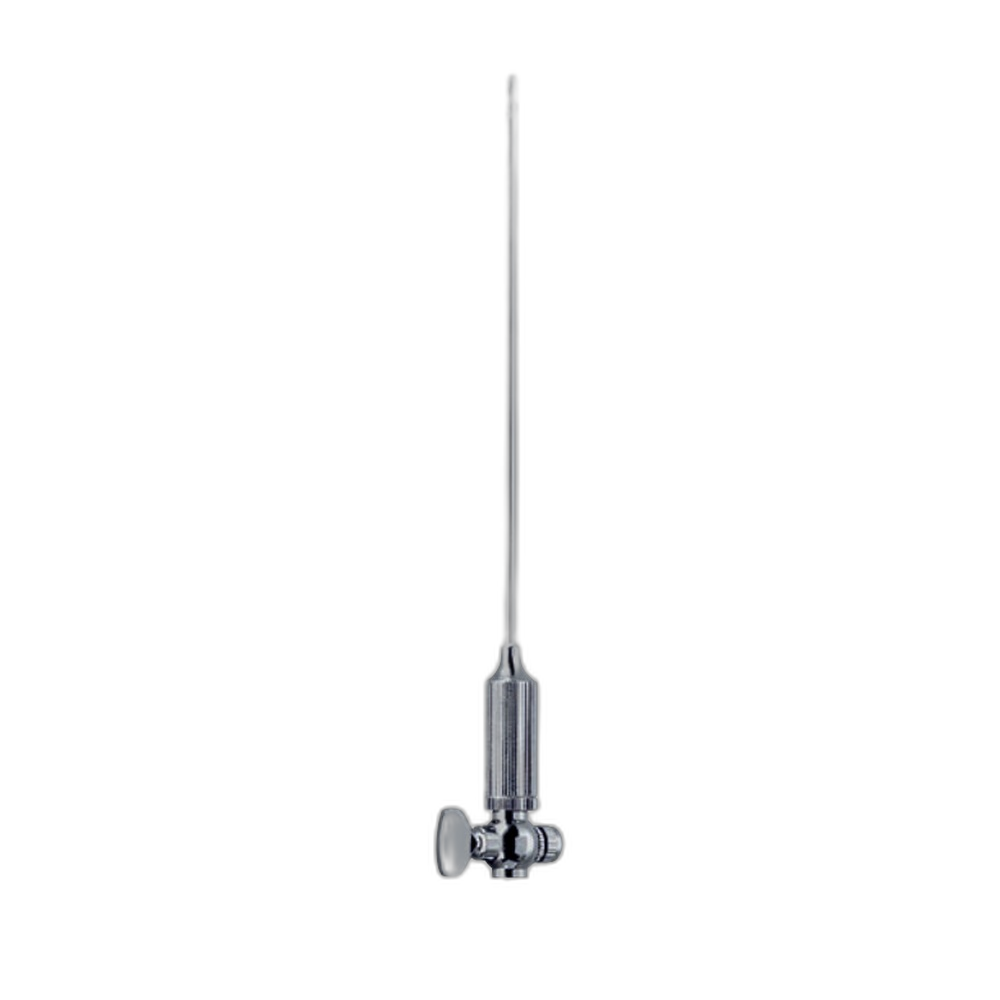
Entry is where laparoscopic complications cluster. A spring-loaded Veress needle (120 mm or 150 mm) is used for closed entry; open Hasson entry uses an S-retractor pair, two Kocher clamps, and a blunt Hasson cannula with a cone and fascial stay sutures.
Trocar counts follow the case. A four-port cholecystectomy needs one 10 mm umbilical, one 10 mm epigastric, and two 5 mm laterals. Bladed, bladeless, and optical designs all have their advocates — we cover the differences in our guide to laparoscopic trocar types.
Reducers matter and are routinely forgotten. Without a 10-to-5 mm reducer, a 5 mm instrument in a 10 mm port leaks pneumoperitoneum continuously, and the surgeon spends the case fighting a collapsing working space.
Insufflation and optics
A CO2 insufflation tubing set with a hydrophobic filter, the light guide cable, and the telescope itself. Telescopes come in 0° and 30° in both 5 mm and 10 mm. The 30° is the more useful scope in the upper abdomen and the harder one to learn.
Grasping and dissecting instruments
This is the bulk of the set, and where naming gets confusing because manufacturers use different eponyms for near-identical jaws.
Atraumatic graspers
Bowel grasper (Hunter, Glassman, or Dorsey pattern) — long fenestrated jaws, fine horizontal serrations, wide contact area to spread pressure across the bowel wall. Never use a toothed grasper on bowel; the tissue damage will not be visible until it perforates.
Fenestrated grasper — the general-purpose atraumatic tool, used for the gallbladder fundus, omentum, and tissue that needs holding rather than pulling.
Traumatic graspers
Claw grasper — heavy interdigitating teeth for specimen retrieval and tissue that is going to be removed anyway.
Babcock — a laparoscopic version of the open instrument, broad and relatively gentle, useful for appendix and bowel where a bit more purchase is needed.
Dissectors
Maryland dissector — curved, fine-tipped, the single most-used instrument in laparoscopic surgery. It dissects, grasps, and with monopolar attachment, coagulates. Calot’s triangle is dissected with a Maryland.
Right-angle dissector — for passing behind ductal and vascular structures before clipping.
Hook electrode (L-hook or J-hook) — monopolar dissection, particularly gallbladder off the liver bed. The most common single source of stray energy injury, for reasons covered below.
Scissors
Curved Metzenbaum-pattern for tissue, straight for suture, and hook scissors for cutting a structure held under tension. Laparoscopic scissors are consumable in a way open scissors are not — the blades cannot be sharpened in situ and dull inserts get used far longer than they should because nobody tests them. A simple gauze-cut test at reassembly catches this.
Haemostasis, suction, and closure
Clip appliers — 5 mm and 10 mm, single-load reusable or multi-fire disposable. Reusable appliers need jaw alignment checked at every reprocessing; a misaligned jaw drops the clip into the abdomen.
Bipolar forceps — safer than monopolar because current travels only between the two jaws. For the monopolar-versus-bipolar decision, see our comparison of electrosurgical instruments.
Suction-irrigation cannula — 5 mm or 10 mm, with a trumpet or piston valve. The valve is the hardest part of the whole set to clean properly; more detail in our suction irrigation cannula guide.
Needle holders — straight or curved jaw, tungsten carbide insert, usually with an axial handle. Intracorporeal suturing is a skill built on the instrument; a needle holder with any jaw play is unusable for it.
Knot pusher and extracorporeal knot instruments, specimen retrieval bags, and a fascial closure device for 10 mm port sites, which must be closed to prevent port-site herniation.
Core set reference
| Instrument | Diameter | Length | Typical quantity |
|---|---|---|---|
| Veress needle | 2 mm | 120 / 150 mm | 1 |
| Trocar with cannula | 5 mm | 100 mm | 2–3 |
| Trocar with cannula | 10 mm | 100 mm | 2 |
| Reducer 10→5 mm | — | — | 2 |
| Maryland dissector | 5 mm | 330 mm | 2 |
| Fenestrated grasper | 5 mm | 330 mm | 2 |
| Bowel grasper, atraumatic | 5 mm | 330 mm | 2 |
| Claw grasper | 10 mm | 330 mm | 1 |
| Curved scissors | 5 mm | 330 mm | 1 |
| Hook electrode | 5 mm | 330 mm | 1 |
| Bipolar forceps | 5 mm | 330 mm | 1 |
| Clip applier | 10 mm | 330 mm | 1 |
| Suction-irrigation cannula | 5 / 10 mm | 330 mm | 1 |
| Needle holder | 5 mm | 330 mm | 2 |
| Telescope 0° / 30° | 10 mm | — | 1 each |
Procedure-specific additions
Cholecystectomy — cholangiogram catheter and clamp if intraoperative cholangiography is performed. Our cholecystectomy instrument set guide covers the full list including the open conversion tray that must be immediately available.
Appendicectomy — endoloop applicator, retrieval bag, and a 5 mm clip applier.
Hernia (TEP/TAPP) — balloon dissector for the preperitoneal space, mesh fixation tacker, and mesh-positioning graspers.
Colorectal — 450 mm extended-length instruments, bowel graspers in multiples, energy sealing device, and an endoscopic linear stapler.
Bariatric — 450 mm instruments throughout, liver retractor (Nathanson or fan), long trocars for thick abdominal walls, and bougie.
Gynaecology — uterine manipulator, myoma screw, morcellator where policy permits.
Insulation failure: the part most sets ignore
Every monopolar laparoscopic instrument is a metal shaft carrying several thousand volts, wrapped in a thin polymer coat. When that coat develops a defect, current exits wherever the defect is — potentially against bowel, well outside the surgeon’s field of view on the monitor.
Two facts make this worse than it sounds. The defects are frequently microscopic and invisible to naked-eye inspection. And because only about a sixth of the abdomen is visible on screen at any moment, an out-of-view burn is typically discovered days later as a delayed perforation.
The reported prevalence of insulation defects in circulating monopolar laparoscopic instruments is high — studies examining reprocessed instruments have repeatedly found defects in a substantial fraction of the inventory. Related mechanisms include capacitive coupling, where current transfers through intact insulation to an adjacent conductor such as a metal trocar, and direct coupling, where an activated electrode touches another instrument.
What a hospital should actually do:
- Test insulation, do not inspect it. A high-voltage insulation tester sweeps the shaft and detects pinholes visually invisible. Test at every reprocessing cycle for monopolar instruments.
- Use all-metal trocars or all-plastic trocars, not hybrids. A metal cannula with a plastic anchoring sleeve is the classic capacitive coupling trap — the sleeve insulates the cannula from the abdominal wall, so induced current has nowhere to discharge except into tissue at the tip.
- Keep generator power at the lowest effective setting and prefer cut over coag waveform where clinically appropriate; the high peak voltages of coag drive insulation breakdown.
- Never activate an electrode that is not in contact with target tissue and not fully in view.
- Retire instruments on defect, not on age. A failed insulation test is a removal criterion, full stop.
This is the single highest-value safety intervention available in laparoscopic instrument management, and it costs less than one litigated bowel injury.
Handle selection and surgeon fatigue
Handle choice is treated as personal preference. It is partly an occupational health question.
Laparoscopic surgery imposes a fixed wrist and repetitive thumb loading through a fulcrum at the abdominal wall, and the reported prevalence of hand and shoulder symptoms among high-volume laparoscopic surgeons is substantial. Handle geometry is one of the few variables a hospital actually controls.
The three families:
Ring handle (scissor-style). Familiar from open surgery, precise, and the ratchet is easy to engage. The drawback is thumb loading — the thumb ring concentrates force on a single digit, and in long cases that produces the numbness surgeons describe over the thumb pad. Best for procedures needing frequent fine open-close control.
Axial handle (in-line). The shaft runs through the palm, so grip force spreads across the whole hand and the instrument rotates naturally with forearm pronation. Preferred for needle holders and intracorporeal suturing, where rotation matters more than jaw force.
Pistol grip. Highest mechanical advantage, most comfortable for sustained heavy grasping like bowel retraction. Least precise for fine work, and it fixes wrist angle, which some surgeons find limiting.
Most departments end up with a mix and should specify one deliberately: axial for needle holders, ring for dissectors and scissors, pistol for retracting graspers. Buying a whole set in one handle style is convenient for procurement and wrong for the people using it.
One more detail worth specifying: a rotation wheel on the outer tube, allowing 360° jaw rotation independent of the handle. Without it the surgeon rotates the whole forearm to angle a jaw. It is a small cost increment and the single most appreciated feature on a modern instrument.
Reusable, disposable, or hybrid
The economics rarely favour a pure strategy.
Fully reusable has the lowest per-case consumable cost and the highest reprocessing burden. It only works where the CSSD genuinely has the capacity, the testing equipment, and the discipline to verify lumens and insulation. Where those are absent, reusable instruments are not cheaper — they are just a risk that has not been priced.
Fully disposable guarantees a sharp, intact, insulation-verified instrument every case and removes reprocessing entirely. Per-case cost is high and waste volume is significant.
Hybrid is what most high-volume units converge on: reusable metal instruments for graspers, dissectors, and retractors, where sharpness is not the issue and reprocessing is straightforward; disposable or single-use-sterile for scissors, clip appliers, and staplers, where blade sharpness or mechanism reliability drives outcomes.
A defensible calculation includes purchase price, reprocessing labour and consumables, repair and insert replacement, the cost of instrument-related delays, and the amortised risk of a stray-energy injury. Purchase price alone reliably gives the wrong answer. Our single-use versus reusable cost analysis works through the full model.
Reprocessing lumened instruments
Laparoscopic instruments are the hardest items in a CSSD because the soil is inside a 2–3 mm channel 330 mm long, where you cannot see it.
The sequence that works:
- Point-of-use treatment. Flush the channel with water in theatre before the soil dries. Dried protein in a narrow lumen is effectively unremovable later.
- Disassemble fully. Handle, sheath, insert — separately.
- Enzymatic soak with the lumen filled, not just the exterior submerged. Air locks are common; inject the channel.
- Brush every channel with a correctly sized flexible brush. Brush diameter must exceed lumen diameter or it passes through without contact.
- Ultrasonic with lumen irrigation connectors. A standard ultrasonic bath does very little for a long narrow channel unless it is actively irrigated.
- Thermal disinfection, dry thoroughly — retained moisture in a lumen prevents steam sterilisation and causes corrosion.
- Lubricate hinges and ratchets with a water-soluble instrument milk.
- Test: insulation, jaw alignment, ratchet function, insert sharpness.
Our ultrasonic cleaning guide and enzymatic cleaning solution guide go further into detergent selection and cycle parameters.
Buying considerations
Four questions determine whether a laparoscopic instrument set will still be usable in five years.
Is it modular? Repairability is the difference between replacing a worn jaw insert and discarding an entire instrument.
What is the insulation material and how is it applied? Heat-shrink sleeves are cheaper and delaminate. Bonded or fused coatings survive reprocessing far better.
Are jaw inserts available as spares, and for how long? Ask for a written availability commitment. A discontinued pattern turns the whole set into scrap.
Is the handle ratchet serviceable? Ratchets wear. A design that allows spring replacement lasts; a sealed one does not.
Fizza Surgical manufactures reusable laparoscopic instrumentation in Sialkot under ISO 13485, CE marked under EU MDR, forged from AISI 410, 420, and 316L stainless per ISO 7153-1, with laser-marked traceability on every piece. The broader range sits under surgical instruments, and our certifications page lists current approvals.
Frequently Asked Questions
How many instruments are in a basic laparoscopic instrument set?
A basic diagnostic set is around 12 to 15 pieces. A working cholecystectomy set runs 20 to 25 including trocars. A general surgery department covering cholecystectomy, appendicectomy, and hernia will hold 40 to 60 pieces across trays, plus telescopes and cables.
What is the difference between 5 mm and 10 mm laparoscopic instruments?
Shaft diameter, and therefore port size. 5 mm instruments leave smaller wounds and do not require fascial closure at the port site; 10 mm instruments are more rigid, accommodate larger jaws for specimen retrieval and clip application, and their port sites must be closed to prevent herniation. Most modern sets are predominantly 5 mm with selected 10 mm instruments.
How often should laparoscopic instrument insulation be tested?
Best practice is every reprocessing cycle for monopolar instruments, using a dedicated high-voltage insulation tester. Visual inspection is not adequate — the defects that cause patient burns are frequently too small to see.
Can laparoscopic instruments be autoclaved?
Reusable stainless instruments are steam sterilisable at 134 °C, provided they are fully disassembled, cleaned, and completely dry beforehand. Telescopes and cables have their own manufacturer-specified parameters and are frequently not compatible with the same cycle — check each item rather than assuming.
Why do laparoscopic scissors dull so quickly?
Long thin blades operating through a small pivot generate high contact stress, and the blades routinely cut suture and occasionally clip material alongside tissue. Modular scissor inserts are designed to be replaced rather than resharpened — treat them as a consumable and schedule replacement.
What is capacitive coupling and why does it matter?
A high-frequency current flowing through an insulated shaft induces a current in any nearby conductor, even through intact insulation. If that conductor is a metal trocar held away from the abdominal wall by a plastic sleeve, the induced energy discharges into tissue instead of dissipating. Using consistently all-metal or all-plastic port systems avoids the trap.
Need precision surgical instruments?
Configure complete instrument sets with our team — ISO 13485 certified, CE marked, made in Sialkot since 1980.
Related Guides
View all articles →
Where We Serve
Fizza Surgical exports to 50+ countries. Browse our country-specific pages with local regulatory guidance and pricing: