Mastoidectomy Instrument Set: Complete Ear Surgery Guide
Complete mastoidectomy instrument set guide: retractors, Lempert curettes, rongeurs, House suction and middle-ear micro-instruments explained.
 Made in Sialkot · Since 1980
The mastoid is unforgiving terrain. Within a few cubic centimetres of temporal bone sit the facial nerve, the sigmoid sinus, the dural plate, and the delicate ossicular chain — each one a structure you cannot afford to nick. A mastoidectomy tray is therefore not a generic ENT pack. It is a curated set built for drilling, curetting, and dissecting bone away from soft tissue you must leave intact.
A complete mastoid set typically runs to around 35 instruments. This guide walks through what belongs on the tray, why each item is shaped the way it is, and what to check before you buy.
How the tray is organised
Surgeons think about a mastoidectomy in stages: expose the bone, remove the cortex, follow the air cells inward, and protect the structures the disease has approached. The instrument set mirrors that flow. We group it into five functional families — exposure and retraction, bone removal, dissection and elevation, suction and irrigation, and the fine middle-ear instruments reserved for the deepest part of the case.
Exposure and retraction
Before any bone comes off, soft tissue has to be held back. The workhorse here is the self-retaining mastoid retractor.
The Jansen mastoid retractor is the most recognised pattern — a self-retaining instrument with opposing prongs that hold the periosteum and soft tissue apart after the post-auricular incision. It comes in 3×3 and 3×4 prong configurations, with sharp or blunt tips, in lengths around 10 to 16.5 cm. Sharp prongs bite into periosteum for a secure hold; blunt prongs are chosen near vessels or in paediatric cases where the bone is thinner.
A typical tray also carries a Plester or Wullstein self-retaining retractor for finer endaural work, plus a Senn or double-ended retractor for shallow exposure during the incision. The ratchet on these retractors must hold under tension for the length of a case — a slipping retractor in the middle of cortical drilling is both a nuisance and a hazard.
Bone removal: curettes, rongeurs, and gouges
This is the heart of the set. Most cortical bone today comes off with a high-speed drill and cutting or diamond burrs, but hand instruments remain essential — for the final, controlled removal near the dura, the sinus, and the facial nerve, where a powered burr is too aggressive.
The Lempert curette is the classic mastoid curette: a sharp, cup-shaped scoop used to remove the bony cortex and open the antrum. It comes in graded sizes — typically 000 through 4 — so the surgeon can step down to a finer scoop as the dissection deepens. The action is a controlled scrape toward the surgeon, never away, so the force is always under the operator’s eye.
Rongeurs do the heavier bone biting. The Lempert rongeur and the Zaufel-Jansen rongeur take the cortical edge back to widen the cavity. The jaws should close with no gap and shear cleanly — a dull rongeur crushes rather than cuts, leaving bone dust and ragged edges that complicate the dissection.
A Stacke or Storz gouge and a small osteotome handle the occasional need to take a defined wedge of bone. Strike these with the Lucae mallet — a bronze-headed mallet weighted for the controlled, light taps temporal bone work demands. The bronze head is deliberate: it delivers a softer, more predictable impulse than steel.
Why hand instruments still matter in the drill era
It is tempting to assume the surgical drill has made curettes obsolete. It has not. When the dissection reaches within a millimetre of the facial nerve canal or the sigmoid sinus plate, many surgeons switch to a curette or a small elevator for the last layer of bone. The hand instrument gives tactile feedback a burr cannot, and it removes bone in increments the surgeon can feel. The drill clears the bulk; the hand instrument finishes the approach.
Dissection and elevation
Once the cavity is open, soft tissue has to be lifted from bone without tearing. Periosteal elevators do the early work — a Lempert elevator in both a slightly angled and a heavy bayonet-curve version lets the surgeon raise the periosteum and develop the post-auricular flap. The bayonet shape keeps the surgeon’s hand out of the line of sight, which matters when working down a narrow canal.
Deeper in, the fine dissectors take over. A Freer elevator separates planes; a House or Rosen needle and a set of angled picks lift cholesteatoma matrix from the dural plate or the ossicles. These are the instruments that work within a millimetre of structures that do not regenerate, so the tips must be true and the shafts must not flex.
Suction and irrigation
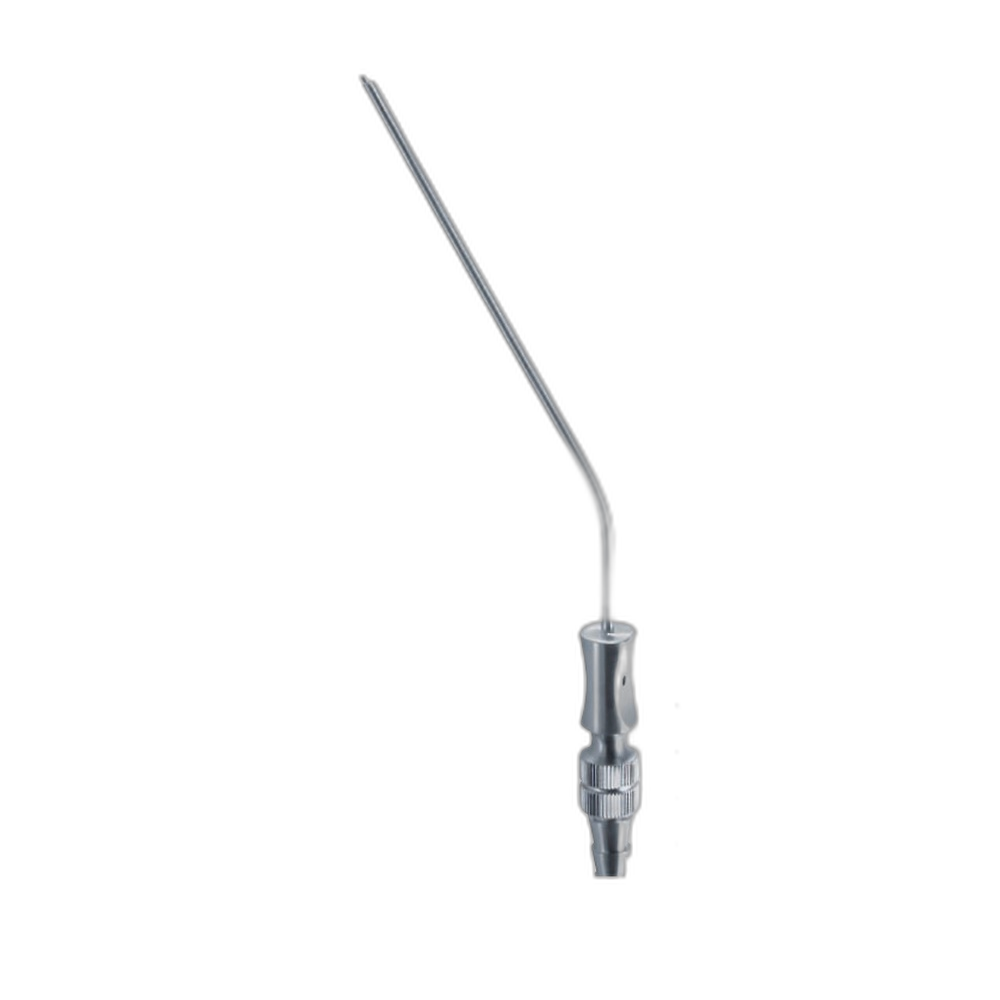
Bone drilling generates heat and debris, and a clear field is non-negotiable when the facial nerve is nearby. The House suction-irrigators are purpose-built for this: they suction blood and bone paste while delivering irrigation to cool the burr and clear the field. A standard tray carries graded French sizes — commonly 2.5×3 and 4×5 French — so the surgeon can match suction bore to the depth and width of the cavity.
The suction tubes must be smooth-bored and finishable. A burr-roughened internal lumen traps protein and bone, which is both an infection risk and a sterilisation failure waiting to happen. We hone and electropolish the internal bore on every suction instrument we produce for exactly this reason.
Fine middle-ear instruments
When the procedure extends to the ossicular chain — as in a canal-wall-down mastoidectomy with reconstruction — the tray needs the micro-instruments of middle-ear surgery: a sickle knife, a Rosen needle, angled picks at 45 and 90 degrees, a footplate hook, and fine crocodile or alligator forceps for placing grafts and prostheses. These overlap with a tympanoplasty set and are often kept in a separate micro-tray to protect their delicate tips.
Mastoidectomy set: representative contents
| Category | Instruments | Typical sizes / notes |
|---|---|---|
| Retraction | Jansen mastoid retractor (3×3, 3×4), Plester/Wullstein retractor, Senn retractor | 10–16.5 cm; sharp & blunt prongs |
| Bone removal | Lempert curettes, Lempert & Zaufel-Jansen rongeurs, Storz gouge, osteotome, Lucae mallet | Curettes size 000–4; bronze mallet head |
| Elevation | Lempert elevators (angled & bayonet), Freer elevator | Double-ended options common |
| Suction | House suction-irrigators | 2.5×3 and 4×5 French |
| Micro / middle ear | Sickle knife, Rosen needle, angled picks, footplate hook, alligator forceps | Often a separate micro-tray |
| Material | AISI 420 / 410 martensitic stainless; titanium for micro-instruments | Per ISO 7153-1 |
Material and manufacturing standards
Cutting instruments — curettes, rongeur jaws, gouges — are forged from martensitic stainless, usually AISI 420, hardened to hold a sharp working edge. The metallurgy here matters more than on a simple retractor: a curette that loses its edge after a handful of cycles forces the surgeon to press harder, and pressing harder near the facial nerve is precisely what good instrument design exists to prevent.
Fine middle-ear instruments are increasingly made in titanium. Titanium is lighter, non-magnetic, and resists corrosion in the warm, moist micro-environment of ear surgery. For graft-handling picks and hooks, the reduced weight genuinely improves control.
Every cutting and dissecting instrument should be manufactured to ISO 7153-1, the standard governing surgical instrument materials, and the set as a whole should come from an ISO 13485 quality system with CE marking for the European market. These are not marketing badges — they are the audit trail that tells a hospital the steel grade, the heat treatment, and the finishing were controlled.
Cleaning and sterilisation considerations
Mastoid instruments are bone-contact instruments, which puts them in the highest-risk category for retained debris. Curettes and rongeur jaws trap bone paste; suction lumens trap blood and bone. The set must be designed to come apart for cleaning — rongeurs that disassemble at the box joint, suction tubes that accept a cleaning stylet, retractors that open fully for brushing.
After ultrasonic and enzymatic cleaning, instruments are autoclaved at 134°C. The recurring enemy is pitting corrosion in the fenestrations and lumens, which is why passivation quality at manufacture is so consequential. For the full reprocessing workflow, our guidance on instrument care applies directly to ENT sets.
Canal-wall-up versus canal-wall-down: how the tray shifts
The two principal mastoidectomy techniques place different demands on the set. In a canal-wall-up (intact canal wall) procedure, the posterior bony canal wall is preserved, and the work is heavily drill-dependent with curettes and fine dissectors finishing the approach to the antrum and attic. The tray leans toward the bone-removal and dissection families.
A canal-wall-down procedure takes the posterior canal wall down, exteriorising the mastoid cavity. This is the technique for extensive choleasteatoma, and it puts more weight on rongeurs and gouges for the larger bone removal, plus a fuller set of middle-ear micro-instruments for the reconstruction that often follows. A unit that performs both should specify a tray that covers the heavier bone work without skimping on the fine dissectors — the two are not interchangeable.
Pre-use inspection checklist
Mastoid instruments work at the limit of safe tolerance, so the pre-use check is more than a formality.
- Curette edges — a sharp, intact cup. A dulled curette forces extra pressure near the facial nerve.
- Rongeur jaws — close with no gap, shear cleanly, hinge moves freely after cleaning.
- Suction lumens — pass a stylet to confirm a clear, smooth bore with no retained bone paste.
- Retractor ratchet — holds under tension without creeping open.
- Micro-instrument tips — picks and needles straight and true under magnification, no bent or burred ends.
- Insulation — on any powered or monopolar accessory, intact coating along the full shaft.
Any instrument that fails is set aside, not used “just for this case.” Near the structures a mastoidectomy approaches, a compromised instrument is not a minor inconvenience.
Frequently Asked Questions
How many instruments are in a complete mastoidectomy set?
A full set typically contains around 35 instruments, spanning retraction, bone removal, dissection, suction, and — where middle-ear work is involved — a separate micro-instrument tray.
Why is the mallet head made of bronze rather than steel?
A bronze head, such as on the Lucae mallet, delivers a softer, more controlled impulse than steel. In temporal bone work, where over-driving an osteotome can injure deep structures, that predictability is a safety feature.
Are hand curettes still needed if a surgical drill is used?
Yes. The drill removes bulk cortical bone efficiently, but surgeons switch to curettes and small elevators for the final bone layer near the facial nerve, dura, and sigmoid sinus, where tactile feedback is essential.
What sizes do Lempert curettes come in?
They are graded, commonly from 000 through 4, allowing the surgeon to step down to a finer scoop as the dissection deepens toward the antrum.
Should middle-ear micro-instruments be on the same tray?
They are usually kept in a separate micro-tray to protect their delicate tips from the heavier bone instruments and to keep the main mastoid tray organised.
Building or sourcing your set
Whether you are equipping a new ENT theatre or replacing a worn tray, the principles are the same: cutting instruments forged from the right steel grade, rongeurs and curettes with edges that hold, suction lumens that finish smooth, and full documentation behind every piece.
Fizza Surgical manufactures complete mastoidectomy and ENT instrument sets in Sialkot under ISO 13485, CE-marked and built to ISO 7153-1. Explore our surgical instruments range, our dedicated bone surgery instruments for the rongeurs and gouges in this set, and our certifications for the quality documentation your procurement team needs.
Need precision surgical instruments?
Configure complete instrument sets with our team — ISO 13485 certified, CE marked, made in Sialkot since 1980.
Related Guides
View all articles →
Where We Serve
Fizza Surgical exports to 50+ countries. Browse our country-specific pages with local regulatory guidance and pricing: