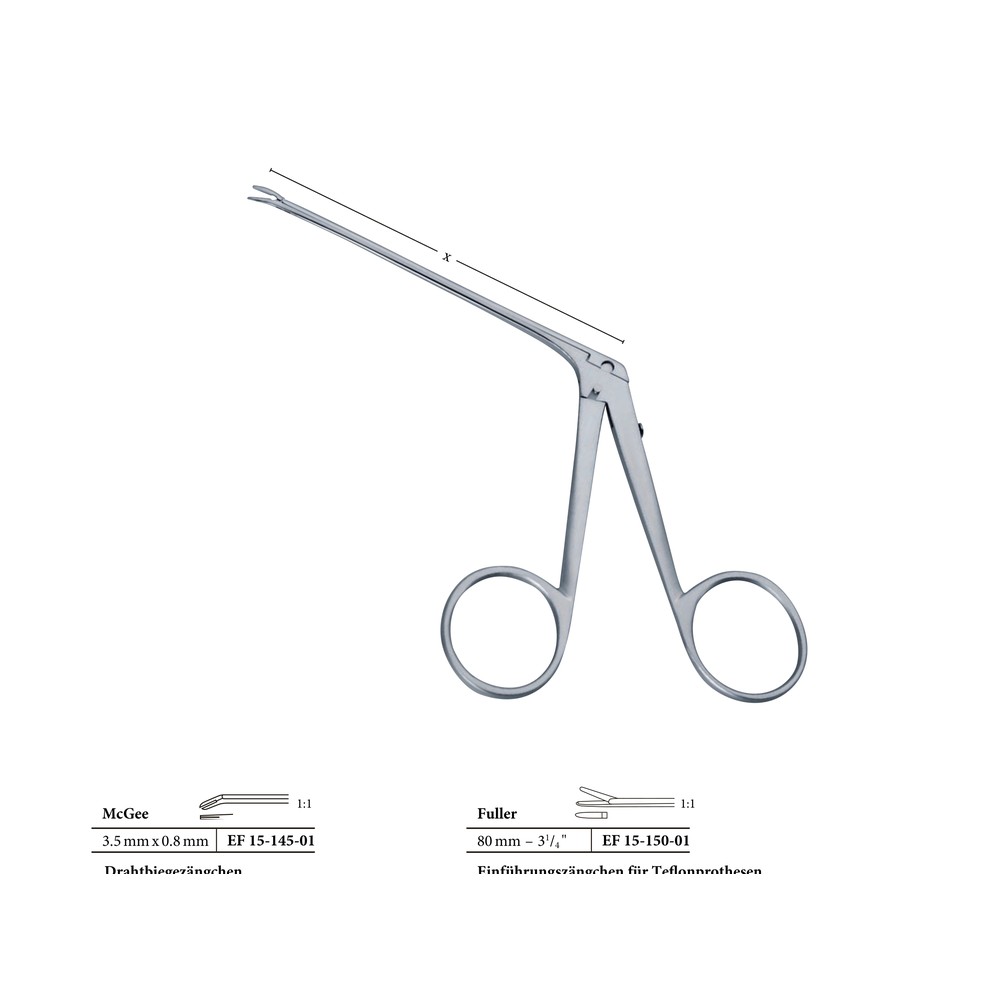
| Reference / SKU | EF 15-145-00 |
| Material | AISI 420 martensitic stainless steel |
| Sterilization | Steam autoclave to 134 °C · EtO compatible |
| Quality system | ISO 13485:2016 · CE-marked under EU MDR 2017/745 · FDA establishment-registered |
McGee Micro Ear Forceps — Piston Crimping Forceps · SKU EF 15-145-00 — manufactured to ISO 13485:2016.
- Buck Ear Polypus Forceps — American Pattern (EP 15-135-00)
- Mini-McGee Micro Ear Forceps — Narrow-Canal Stapes (EF 15-160-00)
- Quire Ear Polypus Forceps — Extended-Reach Variant (EP 15-130-00)
Dental instruments cover extraction forceps, elevators, excavators, scalers, scissors, mirror handles, and specialty patterns for endodontic and periodontal work. Extraction forceps are the workhorses — English-pattern (rotational grip) and American-pattern (lateral grip) cover the major tooth groups: incisors, canines, premolars, molars in both upper and lower arches. Dental scaler patterns (Gracey, Columbia, Younger-Good) target specific tooth surfaces during periodontal treatment. Elevators (Coupland, Cryer, Winter) loosen teeth before extraction. Modern dental instruments are manufactured from AISI 420 stainless for autoclavability and corrosion resistance; tungsten-carbide tips appear on scaler and curette variants where edge retention matters most. Fizza manufactures full dental sets to ISO 13485:2016.
Manufacturing compliance is verified through ISO 13485:2016 certification (the international medical-device quality standard), CE marking under EU MDR 2017/745, and FDA establishment registration. Certificate copies and regulatory documentation are available on request for inclusion in hospital procurement files and EU technical documentation packages. Sterilization validation follows ISO 17665 for steam autoclave at 134 °C.

Reviews
There are no reviews yet.