Cholecystectomy Instrument Set: Gallbladder Surgery Tools Guide
Cholecystectomy instruments for open & laparoscopic gallbladder surgery: full tray lists, the critical view of safety, and conversion essentials.
 Made in Sialkot · Since 1980
Two trays carry the same name and share almost no instruments. A laparoscopic cholecystectomy tray is built around ports, graspers, and a clip applier. An open cholecystectomy tray is a major laparotomy set with clamps long enough to reach the cystic pedicle through a subcostal incision. Most hospitals keep both, because even a planned laparoscopic case can convert to open in a minute when bleeding or unclear anatomy demands it.
This guide covers what each tray contains, why the instruments are chosen, and how to specify a set that holds up across thousands of gallbladder removals.
The two procedures, two instrument philosophies
Laparoscopic cholecystectomy is now the default for symptomatic gallstones. The surgeon works through three or four small ports, dissects Calot’s triangle, clips and divides the cystic duct and artery, and lifts the gallbladder off the liver bed with cautery. The instruments are long-shafted, insulated, and fine.
Open cholecystectomy is reserved for difficult anatomy, dense adhesions, suspected malignancy, or conversion from a laparoscopic start. Here the field is wide, the clamps are heavy, and the retraction must hold the liver and bowel out of the way for a sustained period.
Open cholecystectomy tray
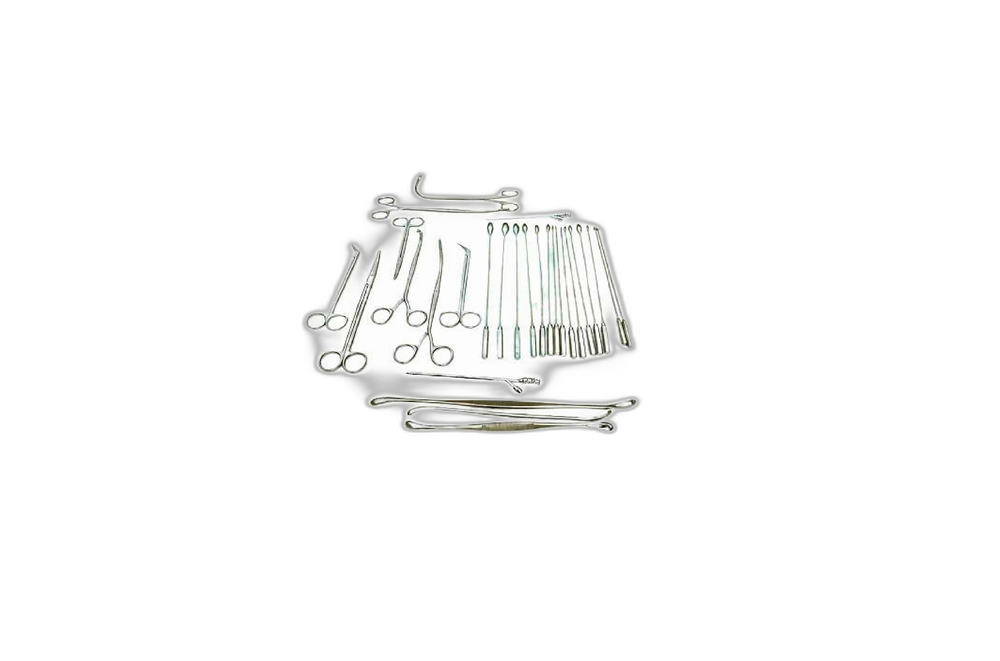
An open set is essentially a major general-surgery tray with a few procedure-specific additions. A representative 25-piece configuration includes the following families.
| Function | Instruments | Notes |
|---|---|---|
| Incision | No. 3 & No. 4 scalpel handles | Subcostal (Kocher) or upper midline |
| Cutting | Mayo scissors (straight & curved 6.5″), Metzenbaum scissors 7″ | Metzenbaum for fine dissection |
| Haemostasis | Mosquito hemostats, Kelly clamps 5.5″, Crile forceps | Two long Kelly clamps to control the gallbladder |
| Ligation / dissection | Mixter right-angle clamp 7″, Kitner dissectors | Right-angle clamp passes ties around the cystic duct |
| Grasping | Babcock forceps, Allis forceps, DeBakey forceps | Babcock on the gallbladder, Allis on specimen |
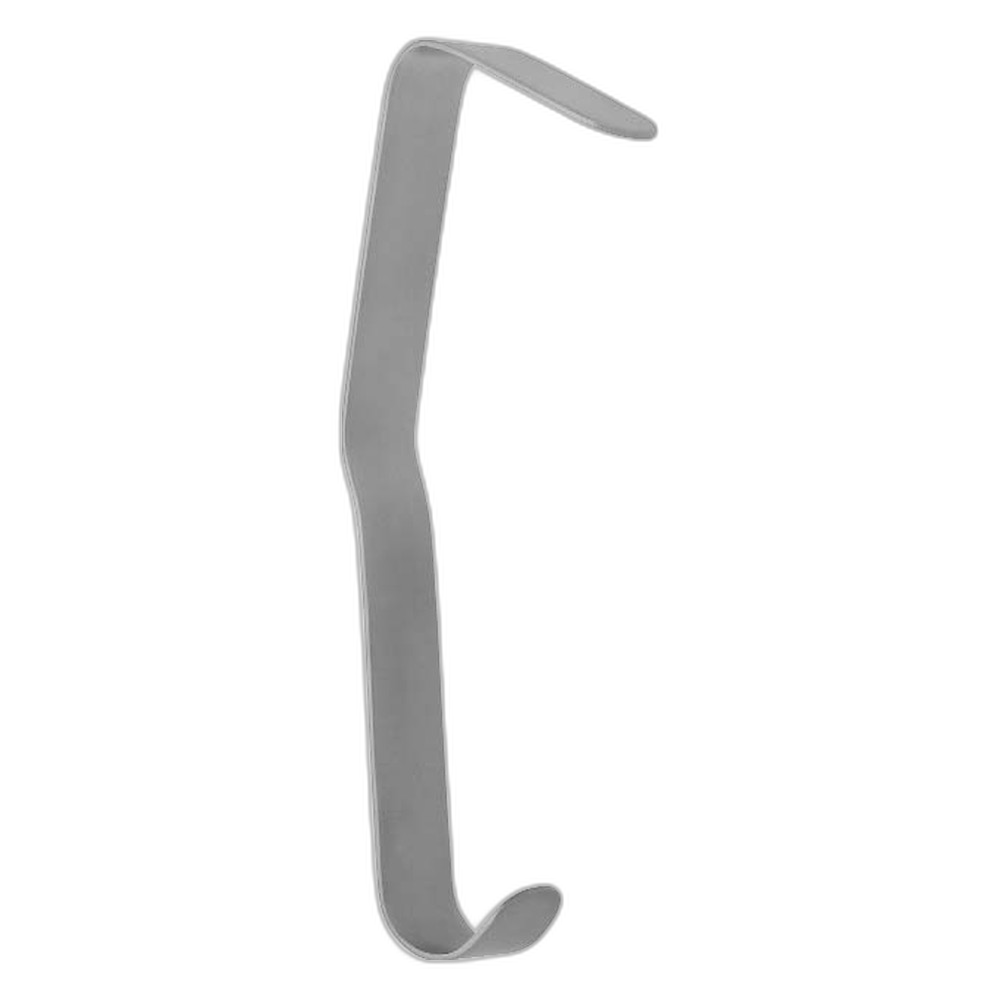
| Retraction | Army-Navy, Deaver, Balfour or Bookwalter self-retaining | Deaver for the liver edge |
| Closure | Needle holders, sponge (Rampley) forceps |
The right-angle Mixter clamp earns its place on this tray. Dissecting and passing a ligature around the cystic duct and artery is the defining manoeuvre of an open cholecystectomy, and the 90-degree jaw is what makes it possible to get behind those structures cleanly.
For the liver, a Deaver retractor held by the assistant lifts the right lobe to expose the gallbladder fossa. When the case is long or the patient is large, a self-retaining Balfour or Bookwalter system frees the assistant’s hands. We cover those in detail in our surgical instruments range.
Laparoscopic cholecystectomy tray
The laparoscopic set replaces brute reach with precision and insulation. The core instruments:
- Veress needle and trocars — for pneumoperitoneum and port placement, commonly one 10 mm and two to three 5 mm ports.
- Maryland dissector — the fine, curved-jaw workhorse for dissecting Calot’s triangle.
- Atraumatic grasper — to retract the gallbladder fundus over the liver edge.
- Clip applier — titanium or polymer clips for the cystic duct and artery.
- Laparoscopic hook or spatula diathermy — to divide the duct and dissect the gallbladder off the liver bed.
- Laparoscopic scissors — insulated, for dividing clipped structures.
- Specimen retrieval bag — to remove the gallbladder without spillage.
Every powered instrument in this group carries insulation, and every piece of that insulation is a potential failure point. A pinhole in the shaft coating creates a path for stray diathermy current to injure bowel outside the camera’s view — a recognised cause of delayed perforation. Insulation integrity testing belongs in the reprocessing cycle, not just at purchase.
Instruments and the critical view of safety
The single most important safety concept in modern cholecystectomy is the critical view of safety — the dissection of Calot’s triangle until only two structures, the cystic duct and the cystic artery, are seen entering the gallbladder. Misidentifying the common bile duct for the cystic duct is the classic catastrophic injury, and the instruments are part of preventing it.
The Maryland dissector does the patient work of opening the peritoneum over Calot’s triangle and teasing the duct and artery free. Its fine, curved jaw lets the surgeon spread tissue in small increments rather than tearing through it. A dissector with a sprung or misaligned jaw cannot do this delicately, and a hurried, blunt dissection is precisely how the wrong duct gets clipped.
The clip applier is the next decision point. Titanium clips have decades of track record; polymer locking clips resist slippage on a slightly larger duct. Either way, the applier must seat the clip squarely — a partially crossed clip can fail to occlude or can slip off entirely, and a slipped clip on the cystic artery means a bleed that may force conversion. The applier jaw alignment is therefore a pre-use check, not an afterthought.
When the gallbladder is thick-walled or the duct is wide — as in acute cholecystitis — clips may not hold, and the surgeon moves to an endoloop ligature or sutures. A well-equipped laparoscopic tray anticipates this with a pre-tied ligature on hand rather than discovering the gap mid-dissection.
Open conversion: what the tray must deliver fast
When a case converts, it usually converts under pressure. The two scenarios are bleeding the surgeon cannot control laparoscopically, and anatomy that cannot be clarified safely. In both, the open tray has to perform within a minute of the incision.
For bleeding, the long Kelly and Crile clamps and a deep Deaver retractor are what regain control — the assistant lifts the liver, the surgeon packs and clamps. For unclear anatomy, the open field plus a right-angle Mixter clamp lets the surgeon dissect the pedicle under direct vision and palpation, the advantage open surgery still holds over laparoscopy. A tray missing a working right-angle clamp at the moment of conversion is a tray that failed at the worst possible time.
Why a laparoscopic tray always sits beside an open one
Conversion rates for laparoscopic cholecystectomy run a few percent in elective cases and higher in acute cholecystitis. When a surgeon converts, they need the open tray opened within minutes — often because of bleeding that cannot be controlled laparoscopically. A theatre that stocks the laparoscopic set without an open backup on standby is gambling on anatomy. Good units keep the open major tray in the room, unopened but ready.
Material and build standards
Clamps, scissors, and needle holders are forged from martensitic stainless — AISI 410 or 420 — for the hardness that keeps a Mayo scissor cutting and a Mixter jaw closing true. Grasping forceps and DeBakey tissue forceps often use 420 for the spring temper their delicate jaws require.
The detail that separates a tray that lasts from one that fails early is the box joint and the ratchet. A Kelly clamp whose ratchet slips under load is dangerous when it is the clamp holding the gallbladder. We test every locking instrument through repeated open-close cycles and verify the ratchet engages cleanly at each tooth before it ships.
All instruments should be manufactured under ISO 13485 with CE marking, the steel conforming to ISO 7153-1. For hospitals procuring across the EU, EU MDR documentation is now part of the expected paperwork.
Sterilisation and tray care
Cholecystectomy instruments contact bile and blood, both of which are aggressive toward stainless if left to dry. Instruments should be wiped during the case, soaked or kept moist until decontamination, then run through enzymatic and ultrasonic cleaning before autoclaving at 134°C.
Box-joint clamps must be cleaned in the open position so the hinge is reachable. Laparoscopic instruments should be disassembled into their insert, shaft, and handle components for the cleaning brush to reach the inner lumen — the single most common site of retained protein on a laparoscopic tray.
Frequently Asked Questions
What is the key difference between an open and laparoscopic cholecystectomy set?
The open set is a major laparotomy tray with long clamps and large retractors for direct access. The laparoscopic set uses long-shafted, insulated instruments — trocars, a Maryland dissector, a clip applier, and graspers — for work through small ports.
Why is a right-angle clamp important in open cholecystectomy?
The Mixter right-angle clamp passes ligatures behind the cystic duct and artery, the defining step of the procedure. Its 90-degree jaw reaches around structures a straight clamp cannot.
Should an open tray be available during a laparoscopic case?
Yes. A small but real percentage of laparoscopic cases convert to open, sometimes urgently for bleeding. A ready open major tray should be in the theatre throughout.
Which grasping forceps holds the gallbladder?
A Babcock forceps, with its atraumatic fenestrated jaw, holds the gallbladder gently. An Allis is reserved for the specimen once it is being removed.
Specifying your set
Decide first whether you are equipping for laparoscopic, open, or both — most theatres need both. Then specify steel grade, ratchet quality on every locking instrument, and full ISO and CE documentation. For the heavier clamps and retractors that the open tray relies on, see our bone surgery instruments for comparable forging standards, and review our certifications for the compliance trail your procurement requires.
Fizza Surgical builds complete cholecystectomy sets — open and laparoscopic — in Sialkot under a 40-year manufacturing track record, ISO 13485 certified and CE marked.
Need precision surgical instruments?
Configure complete instrument sets with our team — ISO 13485 certified, CE marked, made in Sialkot since 1980.
Related Guides
View all articles →
Where We Serve
Fizza Surgical exports to 50+ countries. Browse our country-specific pages with local regulatory guidance and pricing: