Equine Castration Instruments: Emasculator Types & Sizes Guide
Equine castration instruments explained: Serra vs Reimer vs White's emasculators, crush times, sizes, full tray list and QC checks.
 Made in Sialkot · Since 1980
A two-year-old colt is standing sedated in a clean paddock, detomidine on board, local infiltrated into both cords. The vet has maybe forty seconds of reliable working time per side before the horse starts to shift weight. Everything depends on whether the emasculator in her hand crushes the cord properly on the first application — because there is no second attempt on a retracted stump.
That single instrument decides whether the procedure ends in twenty minutes or in an emergency referral for haemorrhage. Choosing it well is worth understanding properly.
What the Emasculator Actually Does
An emasculator performs two jobs in one squeeze: it crushes the spermatic cord to achieve haemostasis, and it transects the cord distal to the crush. The crushed vessel walls curl inward, platelets aggregate against the ruptured intima, and the vas deferens and pampiniform plexus seal without a ligature.
Get the orientation wrong — cutting blade toward the horse instead of away — and you transect above the crush line. The cord retracts into the inguinal canal bleeding freely. This is the single most common instrument-handling error in field castration, and it is entirely mechanical: the nut, or thumbscrew, always points toward the testicle being removed. “Nut to nut” is the phrase every equine resident learns in their first week.
Reported prevalence of persistent post-castration haemorrhage sits around 1.8–2.4% of cases. A slow ooze at the incision is normal. A stream, or drips faster than roughly one per second continuing past 15 to 30 minutes, is a surgical emergency.
Emasculator Patterns and When Each Earns Its Place
Three patterns dominate equine practice, with two more appearing in bovine and small-ruminant work. They differ in whether crushing and cutting happen simultaneously or sequentially.
| Pattern | Action | Jaw geometry | Typical lengths | Best suited to |
|---|---|---|---|---|
| Serra | Crush and cut in one squeeze | Curved jaws, grooves parallel to cord | 9″, 10.5″, 12″ | Routine standing and recumbent equine castration |
| Reimer | Two-stage: crush first, cut via separate lever | Double crushing surface, independent blade arm | 10″, 12″ | Older stallions, donkeys, large vessels |
| White’s / Modified White’s | Crush and cut simultaneously | Straight heavy jaws, wide crush band | 9″, 10″, 12″ | General large-animal use, ranch settings |
| Sand | Crush and cut, lighter frame | Narrow jaws, finer serration | 8″, 9″ | Colts, small ruminants, cryptorchid remnants |
| Frank / Hausmann | Crush and cut, heavy ratchet | Very broad crush surface | 12″, 14″ | Bulls and mature bovine cords |
The Serra is the default for most equine surgeons. Its curved jaws distribute the crush evenly across the cord, and because the grooves run parallel to the cord rather than across it, the crushing portion is far less likely to accidentally transect what it is meant to be sealing.
The Reimer is the instrument you reach for when the cord is thick. Because crushing and cutting are decoupled, the surgeon controls dwell time independently — you can hold the crush for a full minute on a nine-year-old stallion’s cord and only then engage the cutting lever. Donkeys in particular have larger, more vascular spermatic vessels than horses of comparable size and are recognised as a higher-haemorrhage group. A Reimer is a sensible default there.
Crush Time Is Not Optional
Holding the jaws closed for roughly 30 to 45 seconds is generally sufficient to seal transected vessels. On older animals, extend it. The four documented failure modes are all avoidable:
- Inverted application — blade on the wrong side of the crush
- Too much tissue in the jaws, including scrotal skin, which prevents full closure
- Oblique application, so the crush band sits diagonally across the cord instead of perpendicular
- Insufficient dwell time before release
The Rest of the Tray
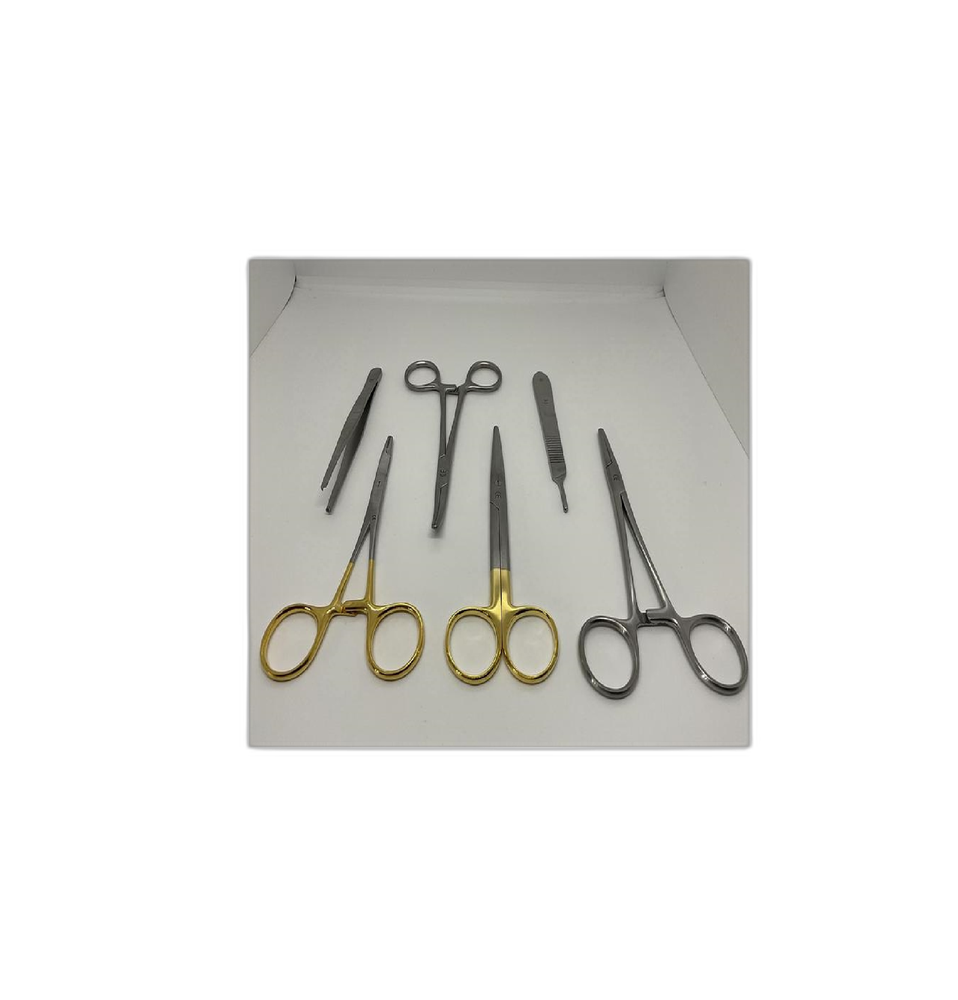
A castration kit is small, but every piece is load-bearing. A complete set of equine castration instruments for standing field work runs to roughly a dozen items.
| Instrument | Typical size | Function |
|---|---|---|
| Emasculator (Serra or Reimer) | 9–12″ | Crush and transect spermatic cord |
| Scalpel handle No. 4 + No. 22 blade | Standard | Scrotal incision |
| Castration knife (Newberry) | 7″ | Alternative scrotal splitting instrument |
| Rochester-Carmalt forceps | 8–10″ | Cord clamping, ligature placement |
| Metzenbaum scissors, curved | 7–9″ | Fascial stripping to isolate cord |
| Allis tissue forceps | 6–8″ | Tunic and skin retraction |
| Needle holder, Mayo-Hegar | 7–8″ | Primary closure in modified-open technique |
| Rat-tooth thumb forceps | 8″ | Tissue handling |
| Sponge forceps | 9–10″ | Scrotal preparation |
Rochester-Carmalt forceps deserve a note. In the closed and modified-open techniques where a transfixion ligature is placed proximal to the emasculator, the Carmalt holds the cord under tension while the suture is passed. Its longitudinal grooves grip vascular pedicles without shredding them — the same reason it is standard in hysterectomy trays. We cover its design in detail in our guide to the Rochester-Carmalt clamp for pedicle ligation.
Open, Closed, and Modified-Open Technique
Instrument choice follows technique.
In the open technique the parietal tunic is incised and the testicle exteriorised before emasculation. Haemostasis of the cord is generally better when tissues are crushed in an open rather than closed approach, because the emasculator engages the vessels directly rather than through an intervening layer of tunic.
In the closed technique the testicle is elevated from below, dissected free within its intact parietal tunic, and the spermatic fascia stripped back to isolate the cord. The emasculator then crushes tunic and cord together. This keeps the vaginal cavity sealed and reduces evisceration risk — relevant in draft breeds and Standardbreds, which carry a higher incidence of inguinal herniation.
The modified-open approach with primary closure splits the difference: tunic incised, cord emasculated, then the scrotal incision closed. It demands a needle holder and suture in the pack that a pure field-open castration does not.
Steel, Jaw Hardness, and Why Emasculators Fail
Emasculators live a brutal life. The crushing surfaces take repeated high compressive loads, and the cutting blade must shear fibrous tissue cleanly against a hardened seat.
We forge emasculator jaws from martensitic AISI 420 stainless, hardened to 52–56 HRC on the cutting edge with the frame drawn back to around 44–48 HRC so the arms flex rather than fracture under ratchet load. Grade selection matters here — austenitic 304 or 316 cannot be heat-treated to a cutting hardness, which is why they belong in holloware rather than in a cutting jaw. Our breakdown of 410 vs 420 vs 440 surgical steel explains where each grade belongs.
Failure almost always shows up in one of three places:
- Blade-to-seat gap. Hold the instrument to a light source with the jaws closed. Any visible daylight along the cutting line means the cord will be torn rather than cut.
- Ratchet slip. Close to the last tooth and pull the handles apart. A worn ratchet releases under cord tension mid-crush.
- Crush-groove wear. Rounded or polished grooves no longer bite. The cord slides during closure and the crush lands oblique.
Field instruments corrode faster than theatre instruments because they get rinsed rather than reprocessed. Blood left in the box-lock hinge is the usual origin of pitting. Our guide on instrument rust and staining covers the mechanism and the fix.
Sterilisation and Field Handling
Emasculators are hinged, jointed instruments with a ratchet — three features that trap organic soil. Reprocess them open, never latched. A latched ratchet during autoclaving leaves the box-lock unexposed and puts the joint under thermal stress.
- Ultrasonic clean at 40–45 °C with a neutral-pH enzymatic detergent, jaws fully open
- Brush the crush grooves and the box-lock manually — ultrasound alone does not clear packed fibrous tissue
- Lubricate the hinge with a steam-permeable instrument milk before packing
- Autoclave at 134 °C for 3 minutes or 121 °C for 15 minutes, unlatched
For ambulatory work, a rigid sterilisation container survives a truck bed far better than a wrapped tray. Practices running multiple castrations per day usually keep two or three complete packs in rotation rather than reprocessing between farms.
Buying Notes for Practices and Distributors
When sourcing equine castration instruments, test the emasculator before it enters the pack, not on a live animal. Three checks take ninety seconds: light test on the closed cutting line, ratchet pull test, and a crush test on a folded strip of 4-ply gauze — a sound instrument cuts the strip cleanly with no drag at the tip.
Fizza Surgical has manufactured large-animal instruments in Sialkot since 1980 under ISO 13485, and we supply emasculators in Serra, Reimer and White’s patterns across the standard length range. Our full veterinary instrument range covers small-animal, equine and bovine surgery, and our certifications page lists current CE and quality-system scope.
Frequently Asked Questions
Which way does an emasculator face during castration?
The nut or thumbscrew always faces the testicle being removed — “nut to nut.” This puts the crushing surface proximal and the cutting blade distal, so the cord is sealed above the point of transection. Reversing it transects proximal to the crush and causes free bleeding into the inguinal canal.
How long should the emasculator stay clamped?
Roughly 30 to 45 seconds is sufficient for most young horses. Extend it to 60 seconds or more for mature stallions and donkeys, which have larger spermatic vessels and a documented higher rate of excessive haemorrhage.
Serra or Reimer — which should a mixed practice buy first?
Buy the Serra first. It handles routine colt castration in a single squeeze and is the pattern most equine surgeons are trained on. Add a Reimer when your caseload includes mature stallions, donkeys or cryptorchid work, where decoupled crush and cut timing is a genuine advantage.
Can the same emasculator be used for cattle and horses?
Physically yes, but bovine cords are considerably thicker. A 9-inch Serra sized for colts will struggle on a mature bull. Practices doing both usually carry a 9–10″ pattern for equine work and a 12–14″ Frank or Hausmann for cattle.
How do I tell when an emasculator needs replacing?
Hold the closed jaws against a light. Visible daylight along the cutting line means the blade no longer meets its seat and the cord will tear rather than shear. Rounded, polished crush grooves and a ratchet that releases under hand pressure are the other two retirement signals.
Need precision surgical instruments?
Configure complete instrument sets with our team — ISO 13485 certified, CE marked, made in Sialkot since 1980.
Related Guides
View all articles →
Where We Serve
Fizza Surgical exports to 50+ countries. Browse our country-specific pages with local regulatory guidance and pricing: