Finochietto Rib Spreader: Sizes, Blades and Selection
Finochietto rib spreader sizes, blade dimensions, spread ranges, variants and reprocessing for thoracotomy and VATS conversion trays.
Enrique Finochietto designed his rib spreader in Buenos Aires in the 1930s, and the geometry has barely changed since. That is unusual. Most instruments from that era have been redesigned three times over. The Finochietto survived because the problem it solves — holding two ribs apart against the elastic recoil of the chest wall, for two hours, without the mechanism creeping shut — was solved correctly the first time.
What has changed is the number of variants on the market, and the number of thoracotomy sets that carry only one of them.
How the Mechanism Works
The instrument is a rack-and-pinion spreader. A fixed blade sits on one rib, a sliding blade rides along a toothed rack, and a crank drives a pinion gear that walks the sliding blade outward. A pawl prevents back-drive, so the spread holds without the operator maintaining force.
Three design details do the real work:
Blade fenestration. The circular or oval cut-outs in the blade faces are not weight reduction. They let the surgeon pass sutures and small instruments through the blade, and they reduce the contact area against periosteum, which lowers the pressure concentration that causes rib fracture.
Blade angulation. Blades sit at a slight angle to the arms rather than perpendicular. This keeps the blade seated in the intercostal space as the ribs separate and the geometry changes — a perpendicular blade progressively levers itself out of the space as the spread widens.
Arm curvature. Traditional curved arms arc away from the wound, keeping the rack and crank out of the operative corridor. Straight-arm versions exist and are cheaper, but they intrude.
Size Ranges and What Each Is For
The single most common configuration error in a thoracotomy tray is stocking one adult size and calling it complete. Chest wall compliance varies enormously across patients, and a spreader that is too large forces the surgeon to over-open in order to seat the blades at all.
| Class | Blade depth × width | Maximum spread | Typical application |
|---|---|---|---|
| Infant | ≈ 20 × 20 mm | ≈ 90 mm | Neonatal and infant thoracotomy, PDA ligation |
| Child / baby | ≈ 38 × 45 mm | ≈ 150 mm (6″) | Paediatric thoracotomy, congenital repair |
| Adult — narrow blade | ≈ 48 × 50 mm | ≈ 100–120 mm | Reoperation, scarred chest, smaller adult |
| Adult — standard | ≈ 48 × 65 mm | ≈ 200 mm (8″) | Standard posterolateral thoracotomy |
| Adult — large | ≈ 48 × 65 mm | ≈ 250–300 mm (10–12″) | Wide exposure, pneumonectomy, large habitus |
A standard adult posterolateral thoracotomy through the fourth or fifth intercostal space typically needs 150–180 mm of opening for comfortable working access. A smaller adult, or a reoperation through a scarred and tethered chest wall, may only tolerate 100–120 mm before rib stress becomes unacceptable — and that is precisely the case where a narrow-blade instrument earns its place, because it can be seated in a tight space and opened progressively.
Practical stocking recommendation for a general thoracic set: one narrow-blade adult and one standard adult, with a paediatric available on the shelf. Units doing congenital work carry the infant size in the set itself.
Named Variants You Will Encounter
Catalogue naming around this instrument is inconsistent, which causes real procurement confusion.
Finochietto (standard). Rack-and-pinion, fenestrated blades, curved or straight arms, crank handle. The reference pattern.
Finochietto–Burford. Adds interchangeable blade sets on the same frame. Useful for departments wanting one frame and three blade depths rather than three instruments, though the blade-locking mechanism is another thing to inspect and another place for bioburden to hide.
Finochietto “baby” / Haight. Small-frame paediatric versions. The Haight variant is common in congenital cardiac and paediatric general thoracic sets.
Tuffier. Often listed adjacent to Finochietto. Tuffier retractors are also rack-driven rib spreaders but generally use a simple ratchet bar rather than a geared crank, and carry solid rather than fenestrated blades. Lighter, cheaper, less controllable at wide spreads.
Rib approximator (Bailey, Rehbein). Not a spreader — the opposite instrument. Pulls ribs together at closure so pericostal sutures can be tied without fighting chest wall recoil. A thoracotomy set without an approximator makes closure unnecessarily hard, and it is a frequent omission from imported sets.
The full complement of what should sit alongside the spreader is covered in our thoracotomy instrument set guide.
Open Thoracotomy Versus VATS Conversion
The rise of video-assisted thoracoscopic surgery has changed how these instruments are used, not made them obsolete.
Every VATS list needs an open conversion tray available, and that tray needs a Finochietto rib spreader that can be deployed fast. Conversion happens for bleeding, and bleeding does not wait for someone to fetch an instrument from another room. The practical requirement is a spreader that opens from fully closed without the crank binding — which means the rack must be clean and the pinion lubricated, on an instrument that has been sitting sterile and unused for months.
This is a maintenance problem more than a purchasing one. Conversion-tray instruments get processed on every list and used on almost none, which means nobody notices a stiffening mechanism until the moment it matters. Departments that audit well pull the conversion spreader quarterly, cycle it through its full travel, and lubricate the rack.
For the scope-side instruments on those lists, see our VATS instrument set guide.
Placement Technique and Rib Fracture
Rib fracture during thoracotomy is common enough that many surgeons treat it as unavoidable. It is not — most of it is a placement and pacing problem rather than an instrument problem.
Three factors drive it. The first is blade seating: a blade that engages the rib body rather than sitting squarely in the intercostal space concentrates force on a single point of cortex. The second is spread rate. Rib cage tissue is viscoelastic, meaning it accommodates load applied slowly and fails under load applied quickly. Opening in stages — a few turns, pause, a few more — allows the intercostal muscles and costovertebral joints to relax into the new position. The third is over-opening, which happens when the surgeon opens to the limit of what the instrument will do rather than to the limit of what the exposure actually requires.
Practical sequence: incise the intercostal muscle along the superior border of the lower rib, confirm entry into the pleural space along the full length of the intended spread, seat both blades with the fenestrated faces flat against the ribs, then open incrementally over one to two minutes to the minimum spread that gives working access.
The instrument contributes at one point specifically. A spreader with deformed or roughened blade faces bites unevenly into periosteum. Blade faces should be smooth and the fenestration edges free of burrs — a burr on a fenestration edge acts as a stress raiser directly against cortical bone.
Where a fracture does occur, the approximator becomes more important at closure, because pericostal sutures around a fractured rib need the segments held in position while they are tied.
Material Specification and Build Quality
A rib spreader is a load-bearing mechanism, and it is one of the few instruments where a manufacturing shortcut produces a mechanical failure rather than a cosmetic one.
| Component | Specification | Failure mode if compromised |
|---|---|---|
| Frame and rack | AISI 420 martensitic, hardened; ISO 7153-1 compliant | Rack teeth deform, pawl skips, spreader creeps shut under load |
| Blades | AISI 304 or 420 depending on pattern | Blade flex at wide spread, loss of purchase on rib |
| Pinion and pawl | Hardened, precision cut | Crank binds or free-wheels |
| Finish | Satin, fully passivated | Pitting corrosion in the rack channel where cleaning is hardest |
| Weight (adult std.) | ≈ 600–900 g depending on pattern | Excessively light frames flex; excessively heavy ones drag the wound edge |
Frame flex is the quality tell. Open the instrument to about two-thirds of its travel and apply lateral force to the blades by hand. A well-made frame resists with almost no visible deflection. A poorly forged one visibly springs — and that spring translates directly into lost exposure once real chest wall tension is on it.
The rack channel is the corrosion trap. It is a narrow slot that holds blood and cannot be brushed effectively without dismantling. Instruments that spend years in thoracic sets accumulate deposits there, and the resulting pitting is usually what retires them. Our guide to instrument rust and staining covers the mechanism and the remedies.
Reprocessing a Rib Spreader Correctly
The mechanism is the whole difficulty. Steam has to reach the rack, the pinion housing and the pawl, and detergent has to be flushed back out of all three.
A workable protocol:
- Point of use. Open the spreader fully before it leaves theatre. Blood dries in the rack within minutes and a closed instrument traps it.
- Manual pre-clean. Brush the rack channel along its length with a narrow instrument brush under the water surface. Cycle the crank through full travel repeatedly while submerged.
- Ultrasonic. Process open, with the crank at mid-travel. Cavitation reaches recesses that brushes cannot — see our ultrasonic cleaning guide for cycle parameters.
- Lubricate. Water-soluble instrument lubricant on the rack and pinion after washing, before sterilisation. Never oil-based — it blocks steam contact.
- Sterilise open. Fully closed mechanisms do not steam-penetrate reliably. Pack open or at partial travel.
- Function test on assembly. Full travel, both directions, checking the pawl engages on every tooth.
The function test is the step most often skipped, and it is the one that catches the failure that matters.
Where Rib Spreaders Sit Beyond Thoracic Surgery
The instrument shows up in more sets than its name suggests.
Cardiac surgery through a lateral approach uses it directly. Minimally invasive mitral procedures through a small right anterolateral thoracotomy need a narrow-blade spreader specifically — the working incision is 40 to 60 mm and a standard adult frame simply will not seat. Departments running those lists and specifying a standard spreader end up with an instrument that cannot be used.
Thoracoabdominal aortic work uses large-spread patterns, often two spreaders at right angles.
Veterinary surgery is a substantial secondary market. Canine and feline thoracotomy uses paediatric and infant-scale human patterns, and large-animal work uses the widest human sizes. The requirement is identical; only the size distribution shifts.
Emergency departments running resuscitative thoracotomy protocols carry a spreader in the thoracotomy tray. In that setting speed and simplicity outrank fine control — a rack-and-ratchet pattern that opens in one motion is often preferred over a geared crank that requires winding.
For the cardiac side of this, see our cardiovascular surgery instruments guide.
Buying Considerations
Points worth putting in a specification rather than leaving to the supplier:
Name the spread, not just the size word. “Large” means different things in different catalogues. Specify maximum spread in millimetres.
Specify blade dimensions. Blade depth determines how much of the intercostal space is engaged. A 48 mm blade in a thin chest wall protrudes into the pleural cavity; a 38 mm blade in a heavy chest wall does not reach.
Specify arm form. Curved arms cost more and are worth it. State “traditional curved arms” explicitly if that is what you want.
Ask about the pawl release. Some patterns release in a single controlled action, others require the crank to be wound back. In an emergency closure the difference is meaningful.
Buy the approximator at the same time. It is the instrument nobody remembers until closure.
Fizza Surgical manufactures the Finochietto rib spreader across infant through large adult sizes, with fenestrated blades and traditional curved arms, to ISO 13485 quality systems. See the surgical instruments range or our certifications for regulatory documentation.
Frequently Asked Questions
What size Finochietto rib spreader do I need for adult thoracotomy?
A standard adult instrument with roughly 48 × 65 mm blades and around 200 mm maximum spread covers most posterolateral thoracotomies, which typically need 150–180 mm of opening. Stock a narrow-blade adult alongside it for reoperations and smaller patients.
Why are the blades fenestrated?
The openings allow sutures and small instruments to pass through the blade, and reduce the contact area against the periosteum. Lower contact area at the same spreading force means lower pressure concentration on the rib, which reduces fracture risk.
What is the difference between a Finochietto and a Tuffier retractor?
Both spread ribs. The Finochietto uses a geared crank with a rack and pinion and carries fenestrated, angled blades. Tuffier patterns generally use a simpler ratchet bar with solid blades — lighter and cheaper, but less controllable at wide spreads.
How do I stop the spreader creeping closed during a long case?
Creep almost always means a worn pawl or deformed rack teeth. Function-test the pawl on every tooth through full travel during assembly. An instrument that skips even one tooth should be pulled from service for repair.
Can rib spreaders be steam sterilised?
Yes, on standard 134°C pre-vacuum cycles, but the instrument must be packed open or at partial travel. A fully closed mechanism does not allow reliable steam contact with the rack, pinion housing and pawl.
Does a VATS programme still need a rib spreader?
Yes. Every thoracoscopic list requires an open conversion tray, and conversion is usually driven by bleeding. The spreader on that tray needs quarterly function checks precisely because it is processed constantly and used rarely.
Need precision surgical instruments?
Configure complete instrument sets with our team — ISO 13485 certified, CE marked, made in Sialkot since 1980.
Related Guides
View all articles →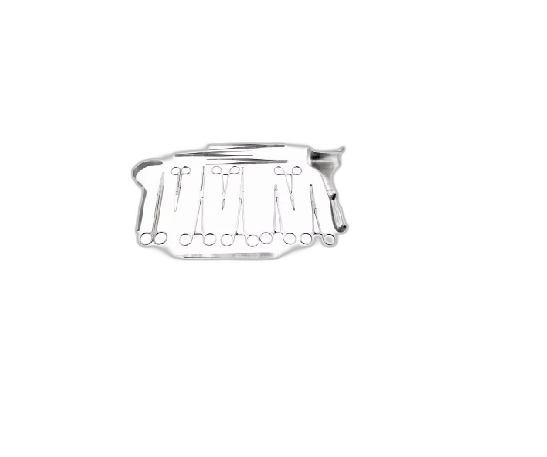

Where We Serve
Fizza Surgical exports to 50+ countries. Browse our country-specific pages with local regulatory guidance and pricing: