Tofflemire Matrix Retainer: Bands, Sizes and Setup Guide
How to assemble and place a Tofflemire matrix retainer: knob functions, band thickness, retainer sizes, wedging and burnishing technique.
Why does a system designed in the 1940s still dominate Class II restorations?
Because it does one thing extremely well: it converts a two-walled preparation into a temporarily four-walled one, so condensable material can be packed against something. Everything since — sectional matrices, ring systems, clear strips — has been an attempt to improve the contact point, not to replace the underlying principle.
The Tofflemire matrix retainer remains the instrument most dental students learn first and most practices keep in every operatory.
Anatomy of the Retainer
Four components, and confusion about any one of them causes the band to seat wrong.
- Outer knob (larger, at the end). Tightens or loosens the band around the tooth by moving the spindle against the band ends.
- Inner knob (smaller, on the frame). Moves the vise along the slotted body, adjusting the size of the band loop.
- Diagonal slot vise. Holds the two free ends of the band. Three slots — left, centre, right — determine which direction the band loop projects.
- Guide channels. The three slots on the vise head that set the loop’s exit direction.
The band loop always exits toward the gingiva when correctly assembled, and the retainer body sits on the buccal surface for most applications. The occlusal edge of the band is the smaller-circumference edge; the gingival edge is larger. Assemble it inverted and the band will not adapt at the cervical margin, which is exactly where the overhang forms.
Retainer Sizes
| Configuration | Frame size | Indicated for |
|---|---|---|
| Universal | Standard | Most adult permanent dentition; the default stock item |
| Junior | Reduced | Paediatric patients, small mouths, limited opening |
| Senior / large | Extended | Large arches, distal access on second and third molars |
Most practices run Universal only and manage. Paediatric-heavy practices should carry Junior — forcing a Universal frame into a child’s mouth compromises visibility and makes the operator work around the instrument rather than through it.
Band Selection
Bands are the consumable and where most of the clinical difference lives.
| Band property | Options | Clinical implication |
|---|---|---|
| Thickness | 0.0015″ (0.038 mm) and 0.002″ (0.05 mm) | Thinner bands give tighter proximal contacts; thicker bands resist tearing during heavy condensation |
| Profile | Straight (universal) or precontoured | Precontoured bands reproduce the natural cervical constriction with less burnishing |
| Extension | Standard, gingival extension, narrow gingival extension | Extended forms cover deep subgingival margins where a standard band falls short |
| Material | Stainless steel; dead-soft variants available | Dead-soft adapts more readily but tears more easily |
For amalgam, the thicker 0.002″ band is the safer choice — condensation pressure will split a thin band at the contact area. For composite, where placement pressure is lower, the 0.0015″ band gives a measurably tighter contact.
Placement Sequence
The steps that separate a clean restoration from one that needs a follow-up appointment:
- Assemble with the loop toward the gingiva. Occlusal (smaller) edge up, gingival (larger) edge down.
- Choose the slot by approach direction. Right slot for a retainer approaching from the patient’s right, left slot from the left, centre for straight buccal placement.
- Size the loop before insertion. Use the inner knob to open the loop wider than the tooth, then seat over the occlusal surface.
- Tighten with the outer knob until snug, not crushing. Over-tightening deforms the band and pinches gingival tissue.
- Wedge from the lingual on posteriors. The embrasure is wider lingually. The wedge seals the cervical margin, compresses the band against tooth structure, and produces slight tooth separation to compensate for band thickness.
- Burnish the contact area. A ball burnisher against the band at the marginal ridge level, working against the adjacent tooth, restores proximal contour that a flat band cannot produce on its own.
- Verify the cervical seal before placing material. An unsealed gingival margin produces an overhang, and an overhang produces periodontal breakdown a decade later.
Step five is the one most consistently rushed. The wedge is not optional and it is not a gingival retraction device — it is what closes the gap between band and tooth at the very margin that matters most.
When to Reach for Something Else
The circumferential design has a known limitation: it produces a flat proximal wall and a contact that sits slightly too far occlusally, because a continuous band cannot follow the natural convexity of two adjacent surfaces at once.
Sectional matrix systems with separating rings address this directly, and for a single-surface Class II in the aesthetic zone they generally produce a better contact. For MOD preparations, for amalgam, for badly broken-down teeth needing full circumferential containment, and for anything where a ring cannot be seated, the Tofflemire matrix retainer remains the more reliable choice.
Related reading: our guides to composite placement instruments and the rubber dam kit, which pairs directly with matrix work.
Troubleshooting the Five Common Failures
The band will not seat past the contact. The loop is too small or the wedge from a previous quadrant is still in place. Back the inner knob off, widen the loop, and seat over the occlusal surface rather than forcing it through the embrasure. A band driven through a tight contact shreds at the leading edge.
The band pops out of the vise during condensation. The two free ends were not fully seated in the slot before tightening, or the outer knob was only partially engaged. Both band ends must sit flat and level in the diagonal slot with the spindle bearing on them squarely.
Overhang at the gingival margin. Almost always inadequate wedging, or a band whose gingival edge sits short of the cervical floor. If the preparation extends subgingivally, a standard band is the wrong choice — switch to a gingival extension band.
Open or weak proximal contact. Either the band was not burnished at the marginal ridge level, or the band was too thick for the restorative material. A 0.002″ band with no burnishing and no wedge separation will leave a contact that flosses far too easily.
The band tears during amalgam condensation. Too thin for the material. Move to 0.002″, and confirm the wedge is providing support at the gingival third rather than leaving the band unsupported against condenser pressure.
Instrument Care
Retainers fail in predictable ways. The spindle threads gall if the instrument is autoclaved dry and dirty, and the vise slot rounds off after enough band changes.
Clean with both knobs backed fully off so the threads and slot are exposed. Ultrasonic processing is appropriate. Lubricate the spindle threads with water-soluble instrument lubricant before sterilisation — not oil. Retire any retainer where the outer knob turns without producing band tension, because that means the spindle has stripped and the band will loosen mid-condensation.
Standard 134°C pre-vacuum steam cycles are appropriate. Autoclave with the knobs loose.
Fizza Surgical produces Tofflemire retainers in Universal, Junior and Senior configurations alongside the full dental instruments range, manufactured under ISO 13485 — details on our certifications page.
Frequently Asked Questions
Which way does the Tofflemire band face?
The smaller-circumference (occlusal) edge faces upward toward the occlusal surface, and the larger (gingival) edge faces the gingiva. The band loop must exit the vise toward the gingiva. Assembled inverted, the band will not adapt at the cervical margin.
What is the difference between the two knobs?
The outer knob at the end of the instrument tightens the band around the tooth. The inner knob on the frame slides the vise along the body to enlarge or reduce the band loop before placement.
Which band thickness should I use?
0.002″ for amalgam, where condensation pressure can split a thinner band. 0.0015″ for composite, where lower placement pressure allows the thinner band and yields a tighter proximal contact.
Do I still need a wedge if the band feels tight?
Yes. Band tension seals nothing at the cervical margin. The wedge compresses the band against tooth structure at the gingival floor, prevents overhang, and separates the teeth enough to compensate for band thickness once it is removed.
Is a sectional matrix better than a Tofflemire?
For a single-surface posterior composite where contact quality is critical, sectional systems with separating rings generally perform better. For MOD preparations, amalgam, and grossly broken-down teeth needing full circumferential support, the circumferential retainer is more reliable.
Need precision surgical instruments?
Configure complete instrument sets with our team — ISO 13485 certified, CE marked, made in Sialkot since 1980.
Related Guides
View all articles →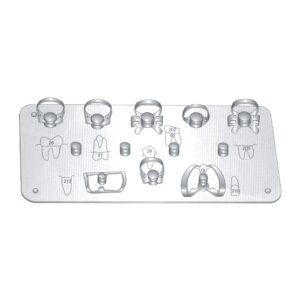
Where We Serve
Fizza Surgical exports to 50+ countries. Browse our country-specific pages with local regulatory guidance and pricing: