Combination Needle Holders: Olsen-Hegar vs Gillies
Olsen Hegar needle holder vs Gillies: ratchet, cutting notch, sizes and hand fatigue compared, with guidance on choosing by procedure.
A single-handed operator is closing a 14 cm flank laceration at two in the morning. There is no scrub assistant. Every throw of the suture means putting down the needle holder, picking up the scissors, cutting, and picking the holder back up again. Forty knots later, that instrument swap has cost more time than the closure itself.
That problem is exactly what combination needle holders were designed to solve. Two patterns dominate the category, and they solve it in opposite ways. The Olsen-Hegar keeps the ratchet and adds a cutting notch. The Gillies throws the ratchet away entirely and rebuilds the handle around finger control. Choosing between them is not a matter of preference — it comes down to whether your hand or the instrument should hold the needle.
What “Combination” Actually Means in a Needle Holder
A conventional needle holder does one job: it grips a curved needle at the junction of the body and swage, and holds it at a stable angle while the wrist drives it through tissue. Serrated jaws or tungsten carbide inserts supply the grip. A box joint supplies the rigidity. A ratchet holds the clamp shut so the operator’s hand can relax between throws.
A combination instrument adds a second function — suture cutting — by grinding a short shearing edge into the jaws just proximal to the gripping surface. That single design decision cascades. The cutting edge occupies jaw length, which pushes the effective pivot geometry and changes how much finger force reaches the needle. It also puts a blade permanently inside an instrument you are clamping a needle in, which is either an efficiency gain or a liability depending on how disciplined the hand is.
Both patterns discussed here are true combination instruments. They are not interchangeable.
The Olsen-Hegar Needle Holder: Ratchet Plus Cutting Notch
The Olsen-Hegar is a Mayo-Hegar body with a cutting notch machined into the jaws behind the needle-gripping serrations. Ring handles, box joint, and a full three-tooth ratchet on the shanks — all standard. The distinguishing feature is that short shear immediately caudal to the jaw tips.
The workflow is straightforward. Drive the needle, tie the knot, then slide the suture tails back into the notch and squeeze. No instrument change, no reaching across the field, no second pair of hands. In a solo-operator setting the time saving over a long closure is substantial.
Catalogue listings vary in spelling — the same instrument appears as an Olsen Hegar needle holder, an Olsen-Hegar scissor-needle holder, or simply a needle holder with suture cutter. All refer to the same pattern.
Standard Sizes and Configurations
| Length | Typical application | Jaw type |
|---|---|---|
| 12 cm (4¾”) | Small animal, ophthalmic adnexa, fine skin closure | Serrated or TC |
| 14 cm (5½”) | General skin and subcutaneous closure — the most stocked size | Serrated or TC |
| 16 cm (6¼”) | Deeper closure, abdominal wall, equine field work | TC preferred |
| 18 cm (7″) | Deep cavity, large animal, obese abdominal wall | TC preferred |
Fizza Surgical manufactures the Olsen-Hegar pattern in 14, 16 and 18 cm, in both serrated-steel and tungsten carbide insert configurations. The 12 cm variant appears in some catalogues for fine adnexal and small-animal work but is a specialty order rather than a stock line.
Tungsten carbide insert versions carry gold-plated ring handles by convention. The inserts are brazed into recessed jaw seats and can be replaced when the serrations flatten, which is the main reason a TC instrument outlives a solid-steel one by a factor of three or more in a busy theatre. Solid instruments are typically AISI 420 martensitic stainless, hardened to roughly 48–52 HRC through the jaws.
The Accidental Cut — A Real Failure Mode
The cutting notch does not know the difference between a knot tail and the suture you are still working with. Operators new to the pattern routinely sever a running suture mid-closure because the tails drifted back into the shear during a throw.
The habit that prevents it is simple: grip the needle at the jaw tips, never mid-jaw. Keeping the working suture forward of the notch removes the geometry that causes the accident. Most surgeons unlearn the error within a dozen closures, but it is worth flagging to anyone converting from a conventional Mayo-Hegar, and it is a reason some theatres keep the pattern off the standard laparotomy tray.
The Gillies Needle Holder: No Ratchet, Angled Handle
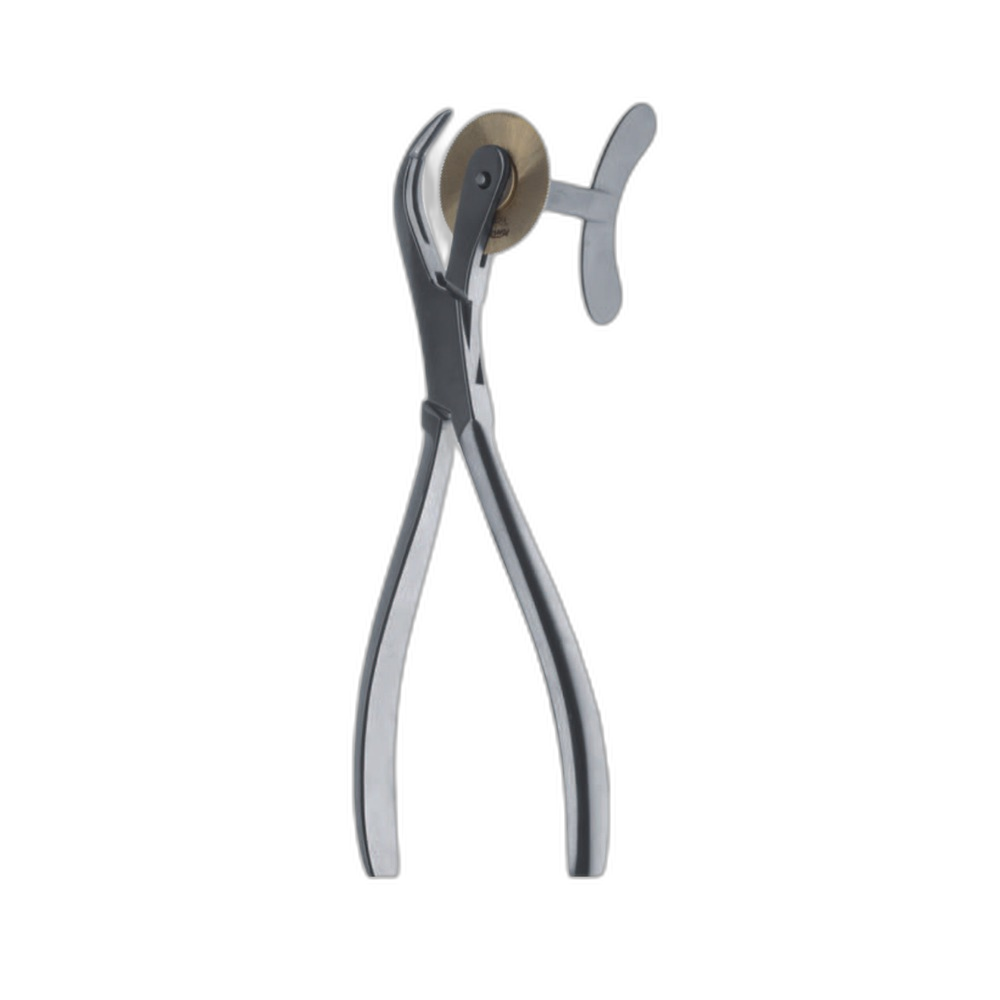
The Gillies takes the opposite approach. It has cutting edges built into the jaws, no ratchet at all, and — most distinctively — asymmetric ring handles set at an angle to the shanks. One ring is a large thumb grip; the other is smaller and offset.
That handle geometry is the whole point. With no ratchet, closure pressure comes entirely from sustained finger and thumb force. The angled, unequal rings let the hand apply that force in a natural pronated position and give the operator continuous, graduated control of jaw pressure rather than the binary open-or-locked behaviour of a ratcheted instrument.
For fine plastic and ENT work that continuous control matters. A ratchet releases with an audible click and a small jolt as the teeth disengage. On 6-0 monofilament in facial skin, that jolt is enough to drag the needle. The Gillies has no click because it has nothing to release.
Handedness Is Not Optional
Because the rings are asymmetric and angled, Gillies needle holders are handed. A right-handed instrument used in the left hand puts the thumb ring in the wrong plane and the cutting edges facing the wrong way. Left-handed versions exist but must be ordered explicitly — they are rarely stocked and almost never appear in a general instrument set. Any procurement specification for this pattern should state handedness alongside length.
Why It Fatigues the Hand
Two factors compound. First, no ratchet means the hand carries the load for the entire time the needle is held. Second, incorporating the cutting edge into the jaws moves the effective pivot further back, shortening the lever arm and reducing the mechanical advantage delivered to the jaw tips. More finger pressure is needed for the same grip.
Over a short facial closure this is irrelevant. Over a two-hour case it is not. This is the single most common reason surgeons who trained on the Gillies switch patterns for longer procedures.
Where the Two Patterns Came From
The divergence is not arbitrary — it reflects two different specialties solving the same problem in the same era.
The Hegar lineage runs through obstetric and general surgery. Alfred Hegar’s name attaches to a family of heavy, ratcheted, ring-handled instruments built for control under load. The Olsen modification simply grafted a cutting notch onto that established body. Nothing about the grip philosophy changed; a function was added.
The Gillies pattern comes out of reconstructive plastic surgery, where Harold Gillies’ facial reconstruction work drove a demand for instruments that behaved like an extension of the fingers rather than a clamp. Removing the ratchet was deliberate. In tissue where a millimetre of needle drag shows in the scar, an instrument that releases with a mechanical click is a liability.
Understanding that origin explains why the comparison so often produces disagreement between surgeons. A veterinary surgeon and a plastic surgeon evaluating the same two instruments are applying incompatible criteria, and both are right within their own field.
Head to Head
| Feature | Olsen-Hegar | Gillies |
|---|---|---|
| Ratchet lock | Yes, standard 3-tooth | None |
| Suture cutting | Notch proximal to jaw tips | Edges within the jaws |
| Handle design | Symmetric rings, in-line shanks | Asymmetric angled rings, handed |
| Grip force source | Ratchet holds; hand can relax | Continuous finger pressure |
| Hand fatigue over long cases | Low | High |
| Needle release feel | Ratchet click, slight jolt | Smooth, fully graduated |
| Common lengths | 12, 14, 16, 19 cm | 15–18 cm |
| TC insert versions | Widely available | Available, less common |
| Best for | Solo operators, long closures, veterinary | Fine plastic, ENT, facial skin |
Choosing by Procedure
Small animal spay and neuter. The Olsen-Hegar is close to a default. Ovariohysterectomy closure runs three layers — linea alba, subcutaneous, skin — and the operator is frequently alone. The ratchet and the notch together remove most of the instrument handling from the closure. Veterinary sets across our veterinary instrument range commonly specify the 14 cm TC pattern for exactly this reason.
Facial laceration repair and blepharoplasty. The Gillies wins. Suture calibre is 6-0 or finer, throws are numerous but short, and the smooth release is worth more than the ratchet.
Equine and bovine field surgery. Olsen-Hegar at 16 or 19 cm, tungsten carbide, no question. Field conditions punish solid-steel jaws and reward anything that reduces instrument juggling.
General laparotomy closure. Neither, usually. A conventional Mayo-Hegar with dedicated Mayo scissors remains the standard, because a scrub nurse is present and the accidental-cut risk on a mass closure is not worth accepting. The trade-offs between the heavier general-purpose patterns are covered in our comparison of the Crile-Wood and Mayo-Hegar needle holders.
Microvascular and ophthalmic anastomosis. Neither. Both are too heavy and the cutting edges are a hazard at that scale. A round-handled non-locking micro instrument is the correct choice, as described in our Castroviejo needle holder guide.
Suture Calibre Sets the Ceiling
One variable overrides specialty preference: the suture you are actually tying.
Jaw serrations and cutting edges are ground for a working range. Below roughly 5-0, a standard combination holder is the wrong tool — the jaws crush fine monofilament, and the cutting notch, ground for braided suture in the 2-0 to 4-0 range, tends to chew 6-0 polypropylene rather than shear it. Above 0, the shear struggles with heavy braid and the notch loads unevenly.
| Suture calibre | Suitable pattern | Note |
|---|---|---|
| 1 to 0 | Conventional Mayo-Hegar + separate scissors | Notch shear inadequate for heavy braid |
| 2-0 to 3-0 | Olsen-Hegar, 14–16 cm TC | The pattern’s design centre |
| 4-0 to 5-0 | Olsen-Hegar 12 cm or Gillies | Either works; choose on case length |
| 6-0 and finer | Gillies, or a dedicated micro holder | Combination shear unreliable at this calibre |
If a single instrument has to cover a wide calibre range — common in a small district theatre with one closure tray — the 14 cm tungsten carbide Olsen-Hegar is the most defensible compromise, with the explicit understanding that anything finer than 5-0 gets cut with dedicated suture scissors.
Steel, Inserts and What to Inspect Before You Buy
Both patterns are forged from martensitic stainless — AISI 420 for the body, with 440-series or tungsten carbide at the working surfaces. Under ISO 7153-1 these are the standard grades for cutting and gripping instruments. Four checks separate a serviceable instrument from a returnable one:
- Jaw closure under light. Close the jaws and hold them to a light source. Any visible gap along the serrated surface means the needle will rotate. Reject it.
- The cutting edge. Cut 3-0 braided suture. A correct edge shears cleanly at the first squeeze. A poor grind crushes and drags the braid.
- Ratchet engagement (Olsen-Hegar). Each tooth should engage with a distinct click and hold under a firm pull. A ratchet that skips a tooth or releases spontaneously is a manufacturing defect, not a break-in issue.
- Box joint play. Hold the shanks and try to rock the jaws laterally. Detectable side-to-side movement means the joint was not properly lapped.
Instruments supplied under a certified quality system carry documented steel grade and hardness. Fizza Surgical manufactures to ISO 13485 with CE marking under EU MDR; our certifications page lists current scope.
Care, Sterilization and the Failure Nobody Checks
Standard reprocessing applies: enzymatic pre-clean, ultrasonic cycle with jaws open, thorough rinse in deionised water, instrument-milk lubrication at the box joint, then autoclave at 134 °C for 3 minutes with the ratchet on the first tooth only. Never autoclave a ratcheted instrument fully locked — thermal expansion against a closed ratchet stresses the box joint and is a leading cause of premature joint play.
The failure that gets missed is the cutting edge. Instrument inspection protocols check jaw alignment and ratchet function routinely. Almost none test the shear. A combination needle holder with a dulled edge still passes visual inspection, still grips needles perfectly, and quietly frustrates every operator who picks it up because it crushes suture instead of cutting it.
Add a suture-cut test to the inspection cycle for these instruments. It takes five seconds and a scrap of 3-0 braid.
Frequently Asked Questions
Can an Olsen-Hegar needle holder replace scissors entirely?
For suture cutting during closure, yes. For tissue dissection, no — the notch is a short shear ground for suture calibre only and will not cut fascia, and using it that way destroys the edge quickly.
Why does my Olsen-Hegar keep cutting the suture accidentally?
The needle is being gripped too far back in the jaws, which leaves the working suture sitting across the notch. Grip at the jaw tips and keep the running suture forward of the cutting edge.
Is the Gillies needle holder available left-handed?
Yes, but it must be specified at order. The angled asymmetric rings make the pattern genuinely handed, and standard stock is right-handed. Confirm handedness on any purchase order for this instrument.
Which is better for veterinary surgery?
The Olsen-Hegar, in almost all small and large animal work. Solo operating is the norm in veterinary theatres, and the ratchet plus cutting notch removes most instrument handling from a multi-layer closure.
Do tungsten carbide inserts justify the price on a combination holder?
In any theatre running more than a few cases a week, yes. TC jaws hold needle grip roughly three times longer than hardened steel serrations, and the inserts can be replaced at service rather than scrapping the instrument.
Need precision surgical instruments?
Configure complete instrument sets with our team — ISO 13485 certified, CE marked, made in Sialkot since 1980.
Related Guides
View all articles →
Where We Serve
Fizza Surgical exports to 50+ countries. Browse our country-specific pages with local regulatory guidance and pricing: