If you’re procuring laryngoscope blades for a hospital, clinic, or emergency medical service, one question comes up more than any other: Macintosh or Miller? Both blades have been in continuous clinical use since the 1940s, and both remain indispensable in 2026 — but they serve different clinical scenarios. Choosing the wrong one costs time in critical moments and, in some cases, complicates a difficult airway.
This guide is written for procurement officers, anesthesia leads, and distributors who need a clear, no-nonsense comparison of the Macintosh and Miller laryngoscope blades. We’ll cover the design differences, the clinical situations each excels in, the sizes you actually need to stock, and the procurement considerations most guides ignore.
The short answer
For most adult intubations, the Macintosh (curved) blade is the default choice. It’s the most widely used laryngoscope blade design globally, and the Mac 3 size fits the majority of adult patients.
For neonates, infants, and difficult pediatric airways, the Miller (straight) blade is the clinical preference because it directly lifts the epiglottis rather than engaging the vallecula.
In practice, most anesthesia departments stock both — the Macintosh as the workhorse, the Miller for pediatric and difficult-airway scenarios. If you’re building a complete laryngoscope set for a new facility, plan on roughly 70% Macintosh blades and 30% Miller blades across the size range.
Design: curved vs straight
Macintosh blade
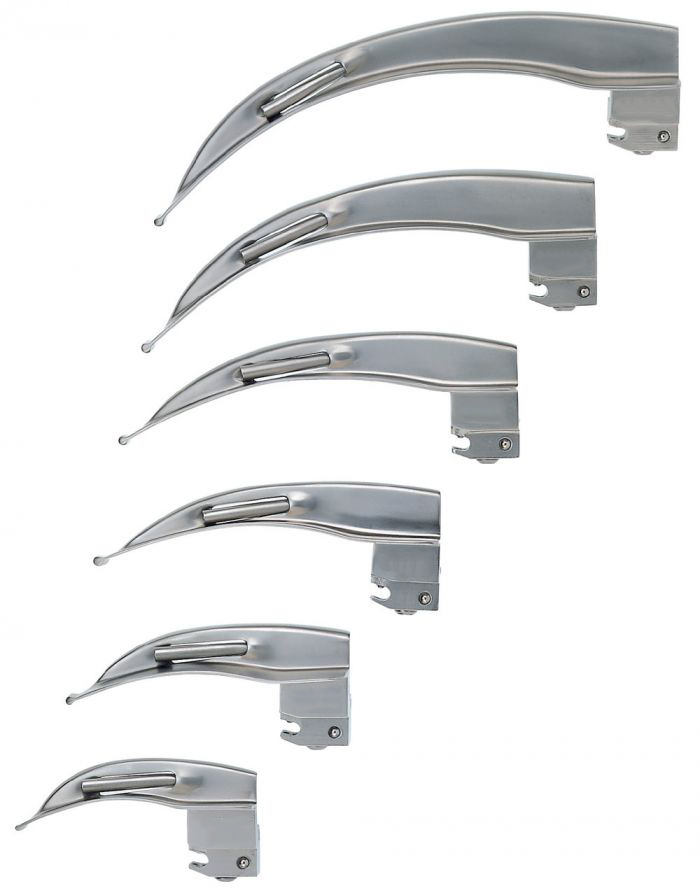
Designed in 1943 by Scottish anesthetist Robert Macintosh, this blade has a distinctive curved shape that follows the natural contour of the tongue. The tip sits in the vallecula (the space between the base of the tongue and the epiglottis), and upward-anterior traction indirectly lifts the epiglottis by pulling on the hyo-epiglottic ligament.
Key design features:
- Curved blade body with a broad flange on the left side
- Blade tip designed to sit in the vallecula, not on the epiglottis
- Light source positioned on the right side of the blade tip
- Available in sizes 0 through 5, with Mac 3 being the most common adult size
Miller blade
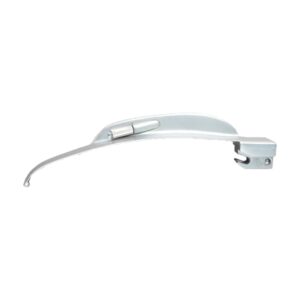
Designed in 1941 by American anesthesiologist Robert Miller, this blade uses a straight design with a slight upward curve at the tip. Unlike the Macintosh, the Miller blade is placed underneath the epiglottis — the blade tip directly lifts the epiglottis anteriorly to expose the vocal cords.
Key design features:
- Straight blade body, slim profile
- Slight distal curve to engage and lift the epiglottis
- Light source at the distal tip
- Available in sizes 0 through 4, with Miller 2 and 3 being common adult sizes
Clinical advantages — which blade wins in which scenario
| Scenario | Preferred blade | Why |
|---|---|---|
| Routine adult intubation (OR, ICU) | Macintosh 3 | Familiar to most clinicians; broad flange displaces the tongue effectively; vallecula technique is gentler on the epiglottis |
| Neonatal intubation | Miller 0 or Miller 00 | Neonates have a floppy, anteriorly-placed epiglottis that the Miller blade directly lifts — Macintosh technique fails in this anatomy |
| Infant intubation (up to 12 months) | Miller 1 | Same anatomical reasoning as neonates; the straight blade gives better view in the small airway |
| Pediatric (1–8 years) | Miller 1 or 2, or Macintosh 2 | Mixed preference — depends on clinician training and specific patient anatomy |
| Obese or bariatric patient | Macintosh 4 | Longer blade reaches deeper; broader flange handles larger tongues |
| Difficult airway (anterior larynx, large tongue) | Miller 3 or McCoy | Straight blade provides better view when the larynx is anterior and Macintosh view is poor |
| Emergency field intubation (EMS) | Macintosh 3 (usually) | Paramedics are trained primarily on Mac technique; less thinking in a crisis |
| Dental or oral surgery | Macintosh 3 or 4 | Curved blade handles the oral anatomy better during shared-airway procedures |
Sizing chart — what to stock
For a mid-size hospital anesthesia department serving general OR, ICU, and EMS, here’s a practical starting inventory. Multiply based on the number of intubations per month and your sterilization turnaround.
| Blade | Size | Patient population | Recommended stock |
|---|---|---|---|
| Macintosh | Mac 0 | Neonates | 2–4 (backup to Miller) |
| Macintosh | Mac 1 | Infants | 2–4 |
| Macintosh | Mac 2 | Children 1–10 years | 4–6 |
| Macintosh | Mac 3 | Most adults | 10–20 (workhorse size) |
| Macintosh | Mac 4 | Large adults, bariatric | 6–10 |
| Miller | Miller 0 | Neonates, premature | 4–6 (primary neonatal) |
| Miller | Miller 1 | Infants to 12 months | 4–6 |
| Miller | Miller 2 | Children, small adults | 4–6 |
| Miller | Miller 3 | Adults — difficult airway backup | 4–6 |
For a complete kit approach, consider Fizza Surgical’s pre-packed laryngoscope sets which bundle a handle with the most-used blade sizes for specific clinical areas (pediatric, adult OR, emergency).
Fiber optic or conventional?
Both Macintosh and Miller blades are available in two illumination configurations, and this is a separate decision from the blade design.
Fiber optic blades
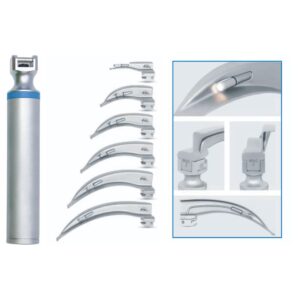
The light bulb sits in the handle; fiber optic bundles carry the light to the blade tip. Advantages: brighter, cooler illumination; no bulb in the mouth; easier cleaning; longer lifespan. Compliant with ISO 7376 (Green Spec), which is the international standard for modern laryngoscope systems and allows cross-brand handle-blade compatibility.
Choose fiber optic if: you want modern, long-lasting equipment; you need cross-brand handle compatibility; your sterilization protocols are strict.
Conventional bulb blades
A small incandescent bulb is mounted directly on the blade tip. Advantages: lower unit cost; simpler design; familiar to clinicians trained before ~2005. Disadvantages: bulbs burn out; heat at the blade tip; less bright than fiber optic.
Choose conventional if: budget is a hard constraint; you’re replacing an existing conventional fleet; your clinicians prefer the familiar design.
Most new purchases in 2026 favor fiber optic — and our fiber optic laryngoscope range is our best-selling category for exactly this reason.
What about video laryngoscopes?
Video laryngoscopes are a separate category and don’t replace Macintosh or Miller blades — they augment them. Most modern video laryngoscopes use a curved blade (Macintosh-style) or specialty hyperangulated blades. For facilities evaluating video laryngoscopy, the decision framework is different and depends on case mix, budget, and existing equipment. A mid-range video laryngoscope typically costs $3,700–$8,335, compared to $65–$600 for reusable direct laryngoscopes.
Procurement checklist
When evaluating laryngoscope blade suppliers, verify the following:
- ISO 7376 compliance (for fiber optic blades) — guarantees handle-blade compatibility across compliant brands
- ISO 13485 certification — medical device quality management system
- CE Marking or FDA registration — regulatory clearance for your market
- Material specification — AISI 304 or 420 stainless steel at minimum
- Sealed fiber bundle — prevents fluid intrusion during autoclaving
- Autoclavability — should withstand 134°C (273°F) steam sterilization indefinitely
- Warranty — reputable manufacturers offer lifetime warranty on the metal blade body
- Sample policy — legitimate suppliers offer sample units for quality verification before bulk commitment
Why buy Macintosh and Miller blades from Fizza Surgical
Fizza Surgical is a direct manufacturer of Macintosh, Miller, McCoy, and Phillips laryngoscope blades in Sialkot, Pakistan. We’ve been producing surgical instruments since 1985 and export to 50+ countries.
- Complete size range: Macintosh 0 through 5, Miller 0 through 4, specialty patterns on request
- Both fiber optic (ISO 7376 compliant) and conventional bulb configurations
- ISO 13485:2016, CE Marked, FDA Registered
- OEM manufacturing with custom branding from 100-unit orders
- 30–50% lower than equivalent Welch Allyn / Heine pricing (direct-from-factory model)
- Free sample units for qualified distributors
Request a factory quote with your exact blade size mix, or browse our full laryngoscope range.
FAQ
Can I use a Macintosh handle with a Miller blade?
Yes, if both are ISO 7376 Green Spec compliant. Fiber optic handles and blades from different manufacturers will interoperate as long as they both meet this standard. Conventional (pre-Green Spec) handles and blades are not universally interchangeable.
What’s the difference between Macintosh and McCoy blades?
The McCoy blade is based on the Macintosh design but adds an articulating tip — a lever on the handle flexes the distal tip upward, which can improve view in difficult airway scenarios. McCoy blades are considered a backup for failed Macintosh intubations and are usually stocked alongside (not instead of) standard Macintosh blades.
How often should laryngoscope blades be replaced?
A quality stainless steel laryngoscope blade should last thousands of sterilization cycles — effectively the lifetime of the instrument. Replace only if the fiber bundle dims significantly, the latch mechanism wears, or visible damage appears. Disposable plastic blades are single-use and discarded after each patient.
Do I need the same brand of handle and blade?
Not if both are ISO 7376 Green Spec compliant. This is the international standard designed specifically to allow cross-brand compatibility. If your existing handles are pre-Green Spec, however, stick with matching-brand blades.
Where We Serve
Fizza Surgical exports to 50+ countries. Browse our country-specific pages with local regulatory guidance and pricing: