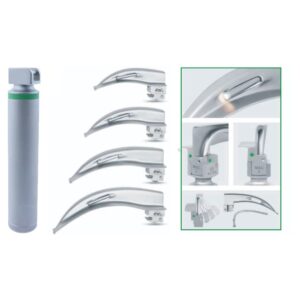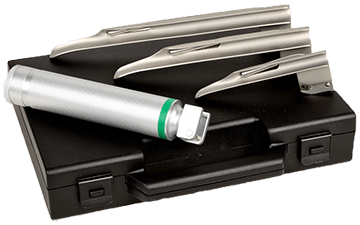
Fiber optic laryngoscopes have become the dominant illumination technology in direct laryngoscopy since the ISO 7376 Green Spec standard was established. Compared to the older conventional (bulb-in-blade) design, fiber optic blades deliver brighter, cooler, more reliable light — and they’re now the default choice for new hospital purchases.
This guide covers the technical fundamentals, the major blade types, the ISO 7376 standard explained in plain English, and the procurement criteria that matter when sourcing fiber optic laryngoscope blades for a hospital or distributor operation.
What is a fiber optic laryngoscope blade?
A fiber optic laryngoscope blade is a direct laryngoscopy device that uses optical fiber bundles to transmit light from a source in the handle to the distal tip of the blade. The light source (halogen, xenon, or LED) sits inside the battery handle, and a sealed fiber bundle running through the blade body carries the illumination to exactly where the clinician needs it — at the tip, illuminating the larynx.
This is fundamentally different from the older conventional design, where a small incandescent bulb is mounted directly on the blade tip. Conventional bulbs burn out, run hot, and require the clinician to swap bulbs during emergencies. Fiber optic blades eliminate all three problems.
Why fiber optic has replaced conventional blades
Brighter, cooler illumination
A well-designed fiber optic laryngoscope delivers 3,000+ lux at the blade tip — roughly 3× brighter than a conventional bulb. More importantly, the light is cool because the heat source (the bulb) stays in the handle, not in the patient’s mouth. This matters during long intubations and in pediatric cases.
No bulb to burn out
Fiber bundles don’t fail the way bulbs do. A well-manufactured sealed fiber bundle will transmit light consistently for the lifetime of the blade body — typically thousands of sterilization cycles. The LED or halogen light source in the handle is easily replaced if needed.
Autoclave-compatible without degradation
Because the fiber bundle is sealed (hermetically bonded to the blade body), repeated steam sterilization at 134°C doesn’t degrade light output. A conventional bulb blade’s contacts and bulb socket corrode over time under autoclave stress.
Cross-brand compatibility
ISO 7376 Green Spec defines a common mechanical and electrical interface between handles and fiber optic blades. A Green Spec compliant Fizza Surgical blade will work with a Green Spec compliant handle from Heine, Welch Allyn, Riester, or any other compliant manufacturer. This gives procurement teams real flexibility.
ISO 7376 (Green Spec) explained
ISO 7376 is the international standard for laryngoscopes for tracheal intubation. The “Green Spec” name comes from the green anodized handle collar used to indicate compliance. The standard specifies:
- Mechanical fit — the hook-on connection between blade and handle dimensions
- Light output — minimum illumination at a defined distance from the tip
- Color temperature — light quality for accurate tissue visualization
- Durability — resistance to autoclaving, chemical sterilization, and mechanical stress
- Safety — electrical isolation, material biocompatibility
If you’re sourcing fiber optic laryngoscope blades, insist on ISO 7376 compliance documentation. This is the single most important specification you can verify. Suppliers that can’t provide this documentation should be avoided.
The major fiber optic blade types
Macintosh fiber optic blade
The most common blade worldwide. Curved design, broad flange, sits in the vallecula. Our Macintosh fiber optic range covers sizes 0 through 5, plus specialty variants including the reduced-flange “English profile” and the “without screws” pediatric pattern.
Miller fiber optic blade
Straight blade, slim profile, lifts the epiglottis directly. Preferred for neonates and pediatric intubations. Available sizes 0 through 4, including the “Mega” Miller pattern with extended illumination.
McCoy fiber optic blade
A Macintosh-style curved blade with an articulating tip controlled by a lever on the handle. Used as a backup when direct Macintosh laryngoscopy fails. The fiber optic version gives better illumination of the anterior larynx.
Phillips fiber optic blade
A curved blade with a profile between Macintosh and Miller — it’s sometimes described as “the best of both.” Popular in pediatric anesthesia. Available in 113mm and 166mm lengths.
Specialty patterns
Robertshaw, Wisconsin, Seward, and Oxford blades are less common but are stocked by specialty departments. Most manufacturers including Fizza Surgical can produce these on request as part of custom orders.
Fiber optic vs LED laryngoscopes
A common point of confusion: fiber optic and LED are not mutually exclusive. The fiber optic blade carries light from the handle; the light source in the handle can be either halogen or LED. Modern fiber optic laryngoscope systems typically use LED handles because LEDs are brighter, cooler, more energy-efficient, and longer-lasting than halogen.
When you see a product marketed as an “LED laryngoscope,” you’re usually buying an LED handle + fiber optic blade combination — the “LED” refers to the light source, not a different blade technology.
Material & construction standards
Quality fiber optic laryngoscope blades are manufactured to these specifications:
- AISI 304 or 420 surgical stainless steel — corrosion-resistant, autoclavable, non-magnetic
- Hermetically sealed fiber bundle — prevents fluid intrusion during sterilization
- Satin or matte finish — reduces reflective glare during visualization
- Radiused edges — no sharp edges that could traumatize the patient’s oral mucosa
- Color-coded sizing — quick size identification in a crisis
- Laser-etched markings — size, manufacturer, and ISO 7376 compliance marks that survive sterilization
Sterilization protocols
Fiber optic laryngoscope blades are rated for repeated autoclave cycles at 134°C (273°F). A typical sterilization workflow:
- Immediately after use, pre-clean to remove visible contamination
- Enzymatic soak (5–15 minutes) to break down proteins
- Manual scrubbing with a soft brush under running water
- Rinse thoroughly with deionized water
- Inspect for damage — check fiber bundle integrity, blade tip, latch mechanism
- Autoclave at 134°C for 4 minutes (pre-vacuum) or 121°C for 30 minutes (gravity displacement)
- Store in a clean, dry environment until next use
Avoid: ultrasonic cleaning that exceeds 30 minutes (can damage fiber bundles over time), chemical sterilants not approved by the manufacturer, and dropping the blade onto hard surfaces (can fracture the internal fiber bundle invisibly).
Fiber optic laryngoscope blade cost in 2026
Price ranges for quality fiber optic blades in 2026:
| Source | Typical retail price per blade | Notes |
|---|---|---|
| Premium brands (Welch Allyn, Heine, Riester) | $150–$400 | High brand premium; long-established |
| Mid-tier medical device companies | $80–$200 | US/EU-based with some manufacturing outsourced |
| Direct Pakistani manufacturers (Fizza Surgical, GERATI) | $25–$80 | Factory-direct, ISO 7376 compliant, same quality |
| Chinese OEM suppliers | $15–$60 | Variable quality — verify ISO compliance carefully |
For bulk orders (500+ units), direct manufacturer pricing drops significantly. Fizza Surgical’s wholesale pricing for qualified distributors can reach $15–$30 per blade at high volumes with OEM branding.
How to evaluate a fiber optic laryngoscope supplier
Before committing to bulk orders, verify:
- ISO 13485:2016 certification — quality management system
- CE Mark or FDA registration — depending on your target market
- ISO 7376 compliance documentation for fiber optic blades
- Material traceability — steel grade and supply chain
- Shipment history — Volza, Panjiva, ImportYeti for verifiable export records
- Sample unit policy — quality suppliers ship free samples to qualified distributors
- OEM capability — if you need custom branding
- Lead time guarantees — standard should be 4–6 weeks for custom orders
- Warranty terms — lifetime on blade body is the industry standard
Sourcing fiber optic laryngoscope blades from Fizza Surgical
Fizza Surgical manufactures the complete fiber optic laryngoscope range from Sialkot, Pakistan. As a direct manufacturer (no intermediaries), we offer:
- Full Macintosh, Miller, McCoy, and Phillips fiber optic blade ranges
- ISO 7376 Green Spec compliance across all fiber optic products
- ISO 13485, CE Mark, FDA registration
- OEM manufacturing with custom branding from 100-unit orders
- Free sample units for qualified distributors
- 4–6 week lead times for custom orders
- Direct-to-port shipping worldwide
Browse our complete laryngoscope range or request a factory quote with your specific size mix and volume requirements.
Related reading
- Macintosh vs Miller Blade: Which Should You Buy in 2026?
- Reusable vs Disposable Laryngoscopes: Total Cost of Ownership Analysis
Where We Serve
Fizza Surgical exports to 50+ countries. Browse our country-specific pages with local regulatory guidance and pricing: