Senn Retractor: Double-Ended Retractor for Superficial Surgery
Senn retractor guide: double-ended blade and three-prong rake, sharp vs blunt tips, sizes, cat's paw pattern and uses in superficial surgery.
 Made in Sialkot · Since 1980
Why does a retractor barely longer than a finger turn up in plastic, thyroid, vascular and small-bone trays alike? Because most of surgery happens in the first centimetre of tissue, and the Senn is built precisely for that shallow, delicate work.
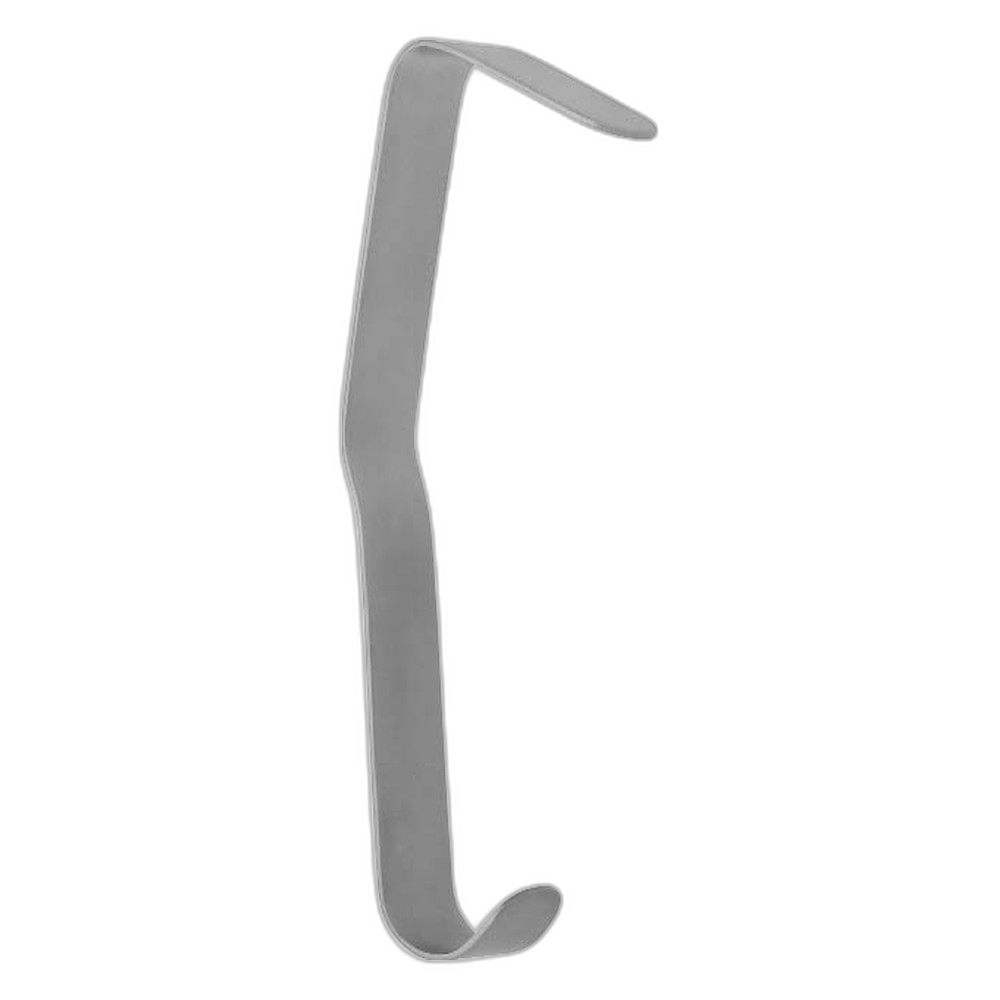
Named for the American surgeon Nicholas Senn, this double-ended hand retractor is one of the most-handled instruments in any superficial procedure. One end is a small right-angled blade; the other is a three-pronged rake. Flip it in the hand and you switch between holding a flat skin edge and lifting a fine flap — no second instrument needed.
The Two Ends, and When to Use Each
The whole value of this retractor is in its dual head.
- The right-angle blunt blade (roughly 9–10 mm wide) holds back a flat wound edge — skin, subcutaneous fat, a fascial margin — without piercing it.
- The three-prong rake end hooks under and lifts a wound edge or flap, spreading the opening for visibility. Prongs come sharp for a firm grip on tough dermis, or blunt for safe work near vessels and nerves.
The sharp-versus-blunt choice is the one decision that matters. Sharp prongs anchor skin and fascia securely; blunt prongs trade a little grip for safety around delicate structures. Many surgeons keep both patterns on the tray.
Sizes and Pattern Names
| Feature | Specification |
|---|---|
| Overall length | Typically 16–16.2 cm (6⅜″) |
| Blade end | Right-angle, blunt, ~9×9 mm |
| Rake end | Three prongs, ~10×11 mm spread |
| Prong options | Sharp or blunt tips |
| Common patterns | Senn-Miller, Senn-Mueller (“cat’s paw”), Senn-Green |
You will hear the same instrument called a cat’s paw retractor — that nickname refers to the Senn-Mueller pattern, after the resemblance of the curved three-prong rake to a paw. Senn-Miller and Senn-Green are minor variations on blade and prong geometry.
Where It Is Used
The Senn shows up wherever the dissection is shallow and the tissue is delicate:
- Thyroid and parathyroid surgery — retracting strap muscles and skin during the approach to the neck.
- Plastic and reconstructive surgery — lifting skin flaps without crushing them.
- Hand, finger and small-bone orthopedics — holding a tiny incision open over a tendon or phalanx.
- Vascular access and minor general procedures — superficial wound-edge control.
For deeper or wider exposure the surgeon moves up to a handheld blade like the Army-Navy retractor; the Senn stays the tool of choice when the target sits just under the skin. Our overview of retractor types shows where each one belongs.
Material and Care
A good Senn is forged from AISI 410 or 420 stainless steel and finished to ISO 7153-1 tolerances. The vulnerable feature is the prong tips: thin, fine, and easy to bend or dull if the instrument is tossed loose into a tray. Inspect the three prongs under magnification at reprocessing — a splayed or bent tip loses its grip and can scratch tissue. Sharp-tip versions should be checked for burrs after every cycle.
A Note on Nicholas Senn
The instrument carries the name of Nicholas Senn (1844–1908), a Swiss-American surgeon and one of the founders of modern American surgical practice. His name endures on a tool used thousands of times a day precisely because the design solved a permanent problem: how to hold a shallow wound open delicately, with a single instrument that does two jobs. More than a century on, the geometry is unchanged.
Senn vs. Other Small Retractors
Several instruments compete for the same shallow-wound role, and choosing well sharpens any superficial tray.
| Instrument | Form | Best At |
|---|---|---|
| Senn (cat’s paw) | Blade + 3-prong rake, double-ended | Versatile superficial retraction, one hand |
| Skin hook | Single fine hook | Atraumatic flap-edge lifting in plastics |
| Ragnell / double-ended | Two small flat blades | Flat soft-tissue retraction, no prongs |
| Army-Navy | Larger double-ended blade | Deeper, wider exposure |
The Senn’s edge is that it carries both a flat blade and a rake on one shaft, so the assistant adapts to the moment without reaching for a second instrument. A skin hook is gentler on a fragile flap edge; the Army-Navy reaches deeper. The Senn sits in the sweet spot between them for routine superficial work.
Technique Tips for Clean Flap Retraction
A few practical points separate tidy retraction from torn tissue:
- Engage the rake at the dermal edge, not the surface. Hook the prongs just under the wound margin so they lift the full thickness of the flap, not just skin.
- Pull in the plane of the dissection, not straight up — vertical traction tents and tears delicate tissue.
- Use the blunt blade end on fat and friable tissue; reserve the sharp rake for tougher dermis and fascia.
- Keep traction steady, not jerky. The double-ended design lets the assistant flip the instrument rather than re-grip, keeping tension continuous.
For matching the Senn to a full superficial set, our retractor types guide places it alongside the deeper and self-retaining options.
Reusable vs. Single-Use Senn Retractors
Both reusable and disposable versions of this retractor are now common, and the right choice depends on volume and setting rather than on the instrument itself.
A reusable forged Senn, in AISI 410 or 420 stainless, is the standard for any theatre running a sterile-services department. Properly maintained, it lasts for years and thousands of cycles, and the fine prong geometry holds up well when the instrument is reprocessed with care. The cost per use falls steeply over its service life, which makes it the economical choice for hospitals with established CSSD sterilization workflows.
Single-use “cat’s paw” retractors have a place in low-resource clinics, field settings, and outreach surgery where reprocessing is impractical, as well as for procedures where cross-contamination risk is the overriding concern. The trade-off is a lighter, lower-grade stamping rather than a forged instrument, and a recurring per-procedure cost.
For most fixed surgical facilities the forged reusable pattern remains the better long-term investment. Where a department does adopt disposables, it is usually for specific high-turnover minor-procedure lists rather than across the board.
Tray Placement and Instrument Count
Because the Senn is small, double-ended and easy to bury under drapes, it earns a fixed place in the count. Position it in the retractor row of the tray, paired with its opposite-pattern twin, so the scrub nurse can confirm both are present at the opening and closing counts.
Two are usually needed at once — one each side of the wound — so most superficial sets carry the retractor in pairs. Keep the sharp-prong and blunt-prong versions visibly distinguished, either by tray position or by a coloured identification band, so the correct tip type reaches the surgeon without a fumble. A bent or mismatched prong should be flagged at the count and pulled before it reaches the field, where a splayed tip can scratch a flap it was meant to protect.
Frequently Asked Questions
What is a Senn retractor used for?
It retracts shallow, delicate wound edges in thyroid, plastic, vascular and small-bone surgery. The blunt right-angle blade holds flat tissue while the three-prong rake lifts skin flaps and spreads the incision for visibility.
Why is it called a cat’s paw retractor?
The nickname applies to the Senn-Mueller pattern, whose curved three-prong rake resembles a cat’s paw. It is the same family of double-ended superficial retractor.
Should I choose sharp or blunt prongs?
Sharp prongs grip tough skin and fascia firmly and are preferred for secure flap retraction. Blunt prongs are safer near nerves and vessels and cause less tissue trauma. Many trays carry both.
Fizza Surgical manufactures Senn-Miller, Senn-Mueller and Senn-Green retractors in sharp and blunt patterns. See the range in our surgical instruments catalogue.
Need precision surgical instruments?
Configure complete instrument sets with our team — ISO 13485 certified, CE marked, made in Sialkot since 1980.
Related Guides
View all articles →
Where We Serve
Fizza Surgical exports to 50+ countries. Browse our country-specific pages with local regulatory guidance and pricing: