Bariatric Surgery Instrument Set: Long Laparoscopic Tools
Bariatric surgery instruments explained: why 45cm shafts, the core tray, port geometry, revisional needs and insulation testing.
Standard laparoscopic instruments have a 33 cm working shaft. In a patient with a BMI of 55, the distance from skin to the angle of His can exceed 25 cm before the instrument has done anything useful — and the last 8 cm of shaft has to accommodate the full arc of the surgeon’s wrist.
That single measurement drives almost every difference in a bariatric tray.
Everything else follows from it: shaft length, trocar length, retractor reach, stapler jaw geometry, even the height the table has to drop to. This guide sets out what a set of bariatric surgery instruments contains, why 45 cm became the standard, and which specification details actually change outcomes rather than just catalogue text.
The Working Length Problem
Abdominal wall thickness in bariatric patients commonly runs 6–10 cm at the umbilicus, against roughly 2–3 cm in a normal-weight patient. Add omental bulk, hepatomegaly from steatosis, and a stomach that sits deeper than expected, and a 33 cm instrument runs out of usable reach precisely where the dissection matters.
The consequences are mechanical rather than dramatic:
- The trocar hub sits close to the instrument handle, so the surgeon’s hands collide
- Angulation at the port is restricted because there is no shaft left to angle
- Torque on the abdominal wall increases, which enlarges port sites and raises hernia risk
- The instrument tip loses the last few centimetres of travel exactly at the hiatus
Extending to 45 cm restores roughly 12 cm of usable reach and moves the handles far enough apart to work. Trocars lengthen in parallel — 100–150 mm rather than the standard 75–100 mm — otherwise the cannula bottoms out in the abdominal wall and the seal fails.
Core Instrument Set
A laparoscopic sleeve or bypass tray is smaller than most general sets. The pieces just have to be right.
| Instrument | Diameter × Length | Role |
|---|---|---|
| Maryland dissecting forceps | 5 mm × 45 cm | Greater curve dissection, retrogastric plane |
| Atraumatic bowel grasper | 5 mm × 45 cm | Stomach and jejunal handling |
| Babcock grasper | 10 mm × 45 cm | Bowel retraction without crush |
| Curved scissors, monopolar | 5 mm × 45 cm | Adhesiolysis, mesenteric windows |
| L-hook diathermy | 5 mm × 45 cm | Crural exposure, precise division |
| Needle holder, curved jaw | 5 mm × 45 cm | Intracorporeal anastomosis and oversewing |
| Clip applicator | 10 mm × 45 cm | Vessel control |
| Suction irrigation cannula | 5 and 10 mm × 45 cm | Leak testing, lavage |
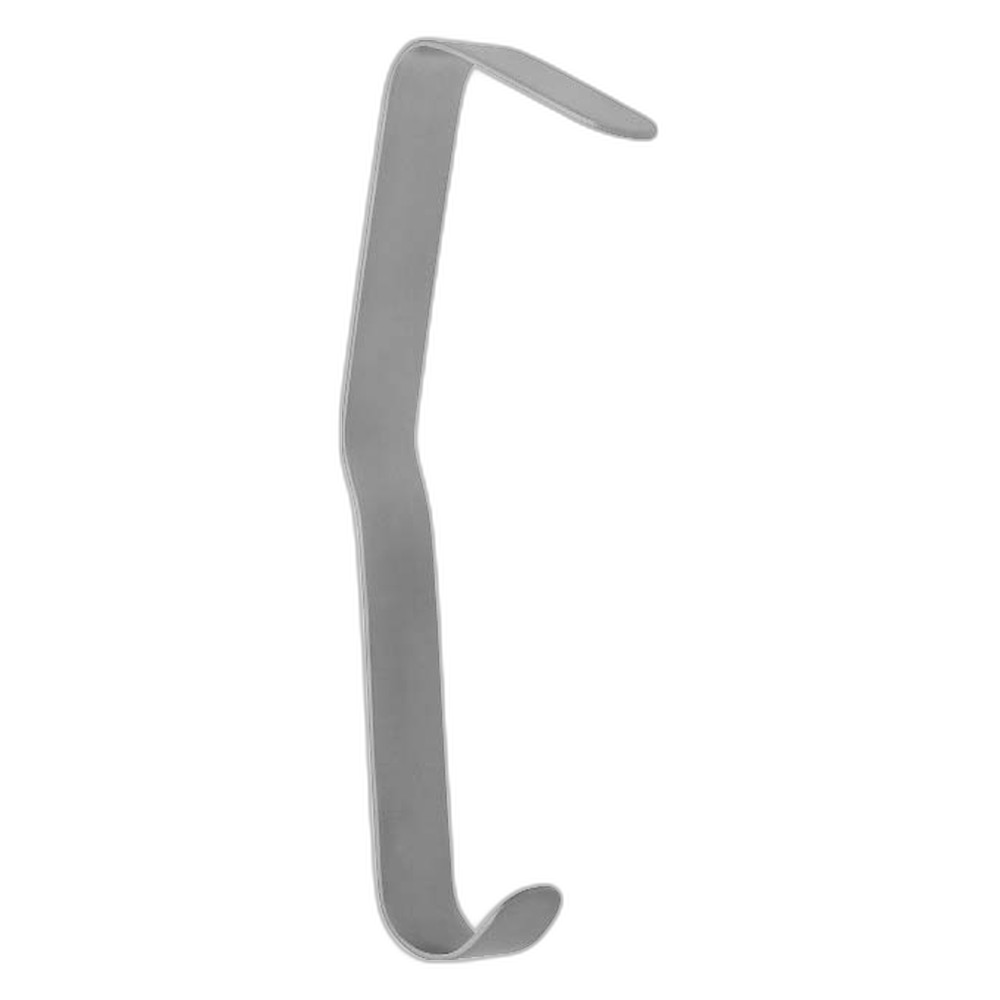
| Nathanson liver retractor | Bariatric length | Left lobe elevation |
| Fan retractor | 10 mm | Alternative liver retraction |
| Optical trocar | 12 mm × 150 mm | Initial entry under vision |
| Working trocars | 5 and 12 mm × 100–150 mm | Ports; 12 mm for stapler |
| Bougie / calibration tube | 32–40 Fr | Sleeve sizing |
The Nathanson retractor deserves particular attention. A fatty, enlarged left lobe is the single most common cause of poor exposure at the angle of His, and a retractor that is too short simply will not seat. Bariatric-length Nathanson blades with a rigid table-mounted holder free an assistant and hold position through a two-hour case without drift.
Why Jaw Design Changes
The reflex is to assume bariatric instruments are just longer. Jaw engineering changes too, for a reason worth understanding.
A 45 cm shaft transmits less closing force to the jaw than a 33 cm shaft for the same handle input — deflection along the shaft absorbs it. Manufacturers compensate by increasing mechanical advantage at the jaw, stiffening the shaft wall, or both. A poorly made long instrument feels spongy: the handle closes, the jaw does not fully, and a grasper that will not hold a thickened gastric wall is worse than useless during retraction.
Two features distinguish instruments built for this rather than stretched into it:
- Shaft wall thickness — visibly heavier gauge on a 45 cm 5 mm shaft than on the 33 cm equivalent
- Insulation integrity — a longer shaft means more insulated surface area, so more opportunity for a pinhole defect and capacitive coupling burn out of the camera’s view
Insulation testing on monopolar instruments is not optional in this specialty. The bowel injury that results from an unseen shaft defect typically presents at day three, well after discharge planning has begun. Our guide to monopolar and bipolar electrosurgical instruments covers the failure mode in detail.
Sleeve Gastrectomy: Instrument Sequence
Following a case makes the tray logic clearer than a list does.
Entry is usually optical trocar at the left upper quadrant, then ports placed under vision. The Nathanson goes in through a subxiphoid stab and lifts the left lobe. Greater curve dissection starts 4–6 cm proximal to the pylorus using an energy device, working up the curve, staying on the stomach wall to avoid the gastroepiploic arcade. The Maryland handles the short gastric vessels near the spleen, where the plane is tightest and traction injury to the splenic capsule is a genuine risk.
The retrogastric plane comes next — posterior adhesions must be taken down completely, or the sleeve twists. An atraumatic grasper retracts the stomach anteriorly and to the patient’s right while the dissection proceeds.
The bougie passes to the pylorus, and stapling starts 4–6 cm from the pylorus, angling away from the incisura to avoid a stricture. Successive firings run parallel to the bougie up to the angle of His, with the final firing kept a few millimetres lateral to the gastroesophageal junction — the most common leak site in the entire operation.
Oversewing or clipping the staple line follows if the surgeon’s practice includes it, then a leak test with methylene blue or air via the suction irrigation cannula, and specimen extraction through the 12 mm port site.
Bypass Adds Anastomotic Requirements
Roux-en-Y adds intracorporeal suturing to the workload, which changes what the tray must support.
Two anastomoses — gastrojejunal and jejunojejunal — mean a needle holder that closes reliably at 45 cm becomes the most critical instrument on the tray. Curved-jaw and left-curved needle holders are both worth stocking; the angle at the gastrojejunostomy frequently makes a straight jaw awkward. Mesenteric defect closure at Petersen’s space and the jejunojejunostomy requires the same suturing capability at depth.
Practical additions for bypass:
- A second needle holder, so a suture can be parked without swapping
- Bowel graspers with a wide atraumatic jaw for running small bowel
- Endoscopic capability for intraoperative leak testing at the gastrojejunostomy
Port Placement and Table Geometry
Instrument selection and port placement are the same problem viewed from two ends, and a tray specified correctly can still be defeated by geometry.
A steep reverse Trendelenburg position — often 30 degrees or more — drops the viscera away from the hiatus and is essential for exposure. It also means the patient must be secured against a footboard, and that the table has to be rated for the weight. Bariatric tables are commonly specified to 450 kg and drop lower than standard tables, because a surgeon operating on an abdomen raised by 10 cm of adipose tissue on a standard-height table ends up working at shoulder level with no control.
Port positions shift upward and spread wider than in standard laparoscopy. The camera port sits above the umbilicus — often 15–18 cm below the xiphoid rather than at the umbilicus itself, since in a tall or heavy patient the umbilicus can lie well below the working field. Working ports are placed to preserve triangulation despite the thicker wall, and the assistant’s port is placed laterally on the left.
Two consequences for the instrument tray follow directly:
- Ports sited high on a thick abdominal wall angle steeply, so instruments need enough shaft beyond the wall to reach the hiatus without the hub fouling the costal margin
- A displaced or poorly sited port cannot be compensated for by a longer instrument — the trocar has to be resited, which is why entry is done under vision
Revisional Surgery Raises the Requirement
Revisional cases — band to sleeve, sleeve to bypass, or reversal — are a growing share of bariatric practice and are appreciably harder than primary surgery.
Adhesions from the index operation obliterate the planes the primary procedure relied on. Dissection is slower, sharper, and more likely to need scissors rather than an energy device near bowel. Tissue is thickened and scarred, which means graspers must hold reliably on a substrate that slips.
What a revisional tray should add:
- Additional Maryland dissectors, since adhesiolysis blunts and fouls them faster than primary dissection does
- Curved scissors in duplicate, for sharp adhesiolysis where diathermy near bowel is unsafe
- Extra atraumatic graspers with a wide jaw for handling scarred, non-compliant stomach
- Band removal instruments where applicable — the capsule around a gastric band is dense and needs sharp dissection off the stomach wall
- A lower threshold for having the open tray immediately available, as conversion rates are meaningfully higher
Operative times for revisional work commonly run 50 to 100 percent longer than primary sleeve gastrectomy, which puts more reprocessing cycles on the same instruments per case. Sets used mainly for revisional surgery wear faster and should be inspected on a shorter interval.
Open Conversion and Contingency
Conversion rates are low but never zero, and the open tray for a bariatric patient is not a standard laparotomy set.
Retractors need extra depth — a standard Balfour will not reach the hiatus through a thick abdominal wall, and deep Deaver blades or an extra-long self-retaining system are required. Long instruments, extended needle holders and heavy closure sutures should be immediately available rather than fetched. Keeping a designated bariatric open tray on standby in the room, not in the store, is the practical answer; the instrument tray setup guide covers organising for that kind of contingency.
Material, Reprocessing and Service Life
Long modular laparoscopic instruments live or die on their reprocessing.
Most 45 cm instruments are three-piece: handle, outer shaft, inner jaw assembly. That design exists so the lumen can be cleaned, and it only works if staff actually dismantle them. A 45 cm lumen at 5 mm diameter cannot be verified visually along its length, so flushing with an enzymatic solution under pressure, followed by a lumen brush of correct length, is the only reliable method.
Failure points to inspect on receipt and periodically thereafter:
- Insulation along the full 45 cm — test electrically, do not eyeball
- Jaw alignment when closed, checked at eye level down the shaft
- Play at the jaw hinge, which develops before it becomes obvious in use
- Rotation wheel engagement — a slipping wheel makes needle presentation unreliable
Shafts are typically 304 or 316L austenitic stainless for corrosion resistance, with martensitic 420 at the jaws for edge retention and hardness. The CSSD workflow guide sets out the decontamination sequence these instruments need.
Procurement Notes
A first purchase of bariatric surgery instruments is substantial, so a few decisions carry more weight than the rest.
Buy the 45 cm length as standard rather than mixing lengths on one tray — a 33 cm instrument that reaches in a BMI 40 patient will not in a BMI 60 one, and mid-case swaps waste time. Specify insulation testing capability from the outset. Stock duplicates of the Maryland, the atraumatic grasper and the needle holder, since those three see almost continuous use and a single failure stops the case.
Certification governs market access: EU MDR and CE marking for Europe, and an ISO 13485 quality system as the baseline expectation from any manufacturer. Fizza Surgical has produced instruments in Sialkot since 1980 under both — see our certifications and the full surgical instruments range.
Frequently Asked Questions
Why are bariatric surgery instruments 45 cm rather than 33 cm?
Abdominal wall thickness of 6–10 cm plus omental bulk consumes reach that a standard 33 cm shaft does not have. The extra 12 cm restores usable travel at the hiatus and separates the surgeon’s hands from the trocar hubs.
Do trocars need to be longer as well?
Yes. Standard 75–100 mm cannulas can bottom out in a thick abdominal wall and lose their seal. 100–150 mm trocars are the usual specification, with a 12 mm port for stapler access.
What bougie size is used for a sleeve gastrectomy?
Most surgeons calibrate between 32 and 40 Fr. Smaller bougies produce a tighter sleeve with greater restriction but a higher stricture and leak risk; the choice is surgeon preference within that band.
How often should insulation be tested on long laparoscopic instruments?
Before first use and at every reprocessing cycle in most protocols. A 45 cm shaft has more insulated area than a 33 cm one, and a pinhole defect outside the camera view can cause a bowel burn that presents days after discharge.
Can standard laparoscopic instruments be used for lower-BMI bariatric cases?
They can reach in many BMI 35–40 patients, but running two lengths on one tray causes mid-case swaps when the anatomy proves deeper than expected. Standardising on 45 cm is simpler and avoids the problem.
The tray for this specialty is defined by reach and by jaw integrity at reach. Specify both properly, test insulation as a routine, and the set will handle the full BMI range without compromise.
Need precision surgical instruments?
Configure complete instrument sets with our team — ISO 13485 certified, CE marked, made in Sialkot since 1980.
Related Guides
View all articles →
Where We Serve
Fizza Surgical exports to 50+ countries. Browse our country-specific pages with local regulatory guidance and pricing: