DeBakey Clamp vs Satinsky Clamp: Vascular Clamp Comparison
DeBakey vs Satinsky clamp: how full-occlusion and tangential partial-occlusion vascular clamps differ, and when surgeons reach for each.
 Made in Sialkot · Since 1980
Both clamp a major vessel. That is where the similarity ends. A DeBakey is a hemostatic occlusion clamp; a Satinsky is a tangential, partial-occlusion clamp. Confusing the two on the back table is the kind of error that shows up at exactly the wrong moment—when the aorta is open and flow needs to be controlled around a clamp, not stopped by it.
| DeBakey clamp | Satinsky clamp | |
|---|---|---|
| Primary role | Full or segmental occlusion | Partial / tangential occlusion |
| Jaw shape | Straight or single-angled | Double-angled (S-curve) |
| Tooth pattern | Fine longitudinal DeBakey rows | DeBakey-style or cross-hatch atraumatic |
| Flow control | Stops flow through the clamped segment | Leaves part of the lumen open |
| Classic use | Cross-clamping, bypass, vessel grafting | Side-biting the aorta or vena cava |
The mechanical difference is the whole story, so it is worth understanding before the named indications.
The Atraumatic Jaw They Share
The reason both clamps carry the DeBakey name on their jaws is the tooth pattern Michael DeBakey designed: fine, multiple rows of longitudinal teeth that interdigitate when the jaws close. Instead of biting through the vessel wall the way a crushing clamp would, these rows distribute pressure across a wide footprint and grip the adventitia without shearing the delicate intima. A damaged intima is where thrombus forms, so atraumatic occlusion is not a comfort feature—it is the difference between a vessel that stays patent and one that clots downstream.
That jaw geometry migrated onto a whole family of vascular instruments, the Satinsky included. So when surgeons say a Satinsky has “DeBakey jaws,” they mean it borrows the same atraumatic tooth pattern—the clamps differ in the shape of the shank and jaw, not the gripping surface.
The DeBakey Clamp: Controlled Occlusion
A DeBakey is built to take a vessel out of circulation cleanly. Straight and angled patterns let the surgeon reach across the field and occlude a segment—an iliac, a renal, a length of aorta for an end-to-side anastomosis—with the ratchet holding a calibrated, gentle pressure. In aneurysm repair and bypass grafting, where a length of vessel is cross-clamped above and below the working zone, the DeBakey is the default.
The angled variants matter more than they look. A vessel lying deep in the retroperitoneum or behind other structures cannot always be reached with a straight jaw without kinking it; the bayonet and angled DeBakey patterns bring the jaw onto the vessel at an approach angle that keeps the shaft and the surgeon’s hand out of the line of sight.
The Satinsky Clamp: Leaving the Lumen Open
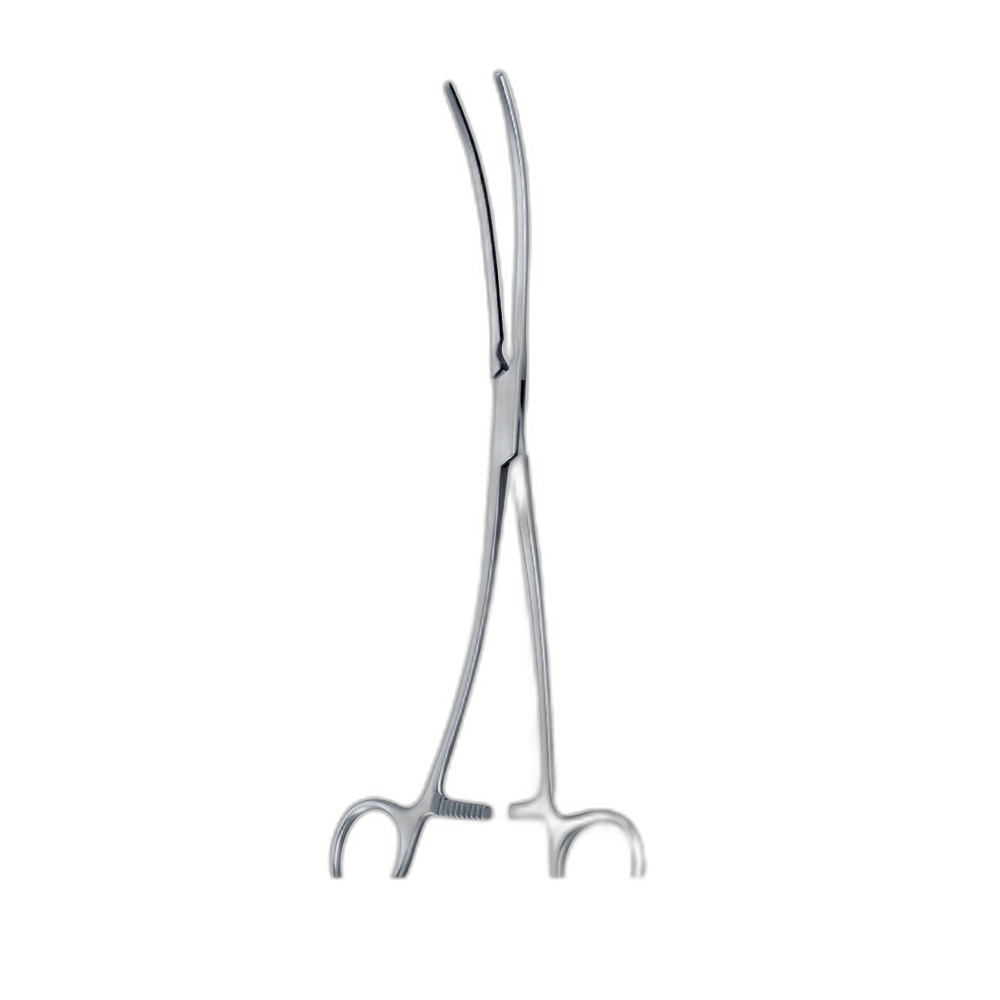
The Satinsky exists for one problem the DeBakey cannot solve: you need to work on the wall of a great vessel without stopping flow through it. Its double-angled, S-shaped jaw is applied tangentially—it bites a curved bite across one side of the aorta or vena cava, isolating a crescent of vessel wall while blood continues to flow past the clamped segment.
That is what makes a side-to-side anastomosis, a partial aortotomy for a proximal graft attachment, or the repair of a lateral venous injury possible without fully cross-clamping and arresting distal perfusion. In cardiac surgery the partial-occlusion Satinsky on the ascending aorta lets a vein graft’s proximal end be sewn on while the heart keeps ejecting. The clamp’s reach—those long, double-bent jaws—is engineered to seat that tangential bite on a deep, pressurised vessel and hold it.
This is the same tangential principle behind the dedicated Satinsky clamp range, where jaw length and curvature are matched to the depth of the vessel being side-clamped.
Choosing Between Them
Framed as DeBakey vs Satinsky clamp, the decision is driven by the operation, not preference:
- Need to stop flow through a segment? Reach for a DeBakey—straight for superficial vessels, angled for deep ones.
- Need flow to continue while you work on the vessel wall? That is a Satinsky, every time.
- Working in a deep or shadowed field? Both come in angled forms; match the jaw angle to your line of approach.
- Operating on small or fragile vessels? A bulldog or a fine straight DeBakey applies less load than a large Satinsky.
In practice a vascular tray carries both, plus bulldog clamps for small-vessel and temporary occlusion. The clamps are complements, not substitutes.
Where Bulldogs and Sizing Fit In
Neither the DeBakey nor the Satinsky is the right tool for a small or short-segment vessel that needs brief, light occlusion. That is the bulldog clamp’s job—a small self-retaining clamp, often spring-loaded, applied without a ratchet handle to isolate a renal branch, a coronary, or a digital vessel during anastomosis. Many vascular sets carry a range of bulldogs precisely so the larger ratcheted clamps are not overused on delicate targets.
Sizing matters as much as pattern. A DeBakey is specified by jaw length and angle—short straight jaws for superficial vessels, long angled or bayonet jaws for deep retroperitoneal or thoracic work. A Satinsky is chosen by the depth of its double bend and the length of the tangential bite it must take; a clamp whose curve is too shallow will not seat a stable side-bite on a deep, pressurised aorta. Stocking two or three jaw lengths in each pattern covers the realistic range of cases a vascular or cardiothoracic theatre will see, and prevents the temptation to force an ill-fitting clamp onto a vessel it cannot grip cleanly.
Material and Build Quality
Vascular clamps are precision instruments where the jaw alignment is everything. If the fine DeBakey tooth rows do not meet perfectly along their length, the clamp leaks at the malaligned point—or worse, concentrates pressure and injures the intima. These clamps are manufactured from austenitic stainless steel (commonly AISI 304 or 316) for corrosion resistance through repeated sterilisation, with the jaws lapped so the tooth rows interdigitate cleanly under spring tension.
The atraumatic insert is the part that wears. After heavy use, jaw rows can flatten or spring tension can relax, and a clamp that no longer grips evenly should be retired or serviced rather than trusted on an aorta. Fizza Surgical manufactures its vascular clamps under ISO 13485 with CE marking, and every instrument is inspected for jaw alignment and closure pressure before it leaves the bench—part of the wider surgical instruments range.
Frequently Asked Questions
Can a DeBakey clamp be used for partial occlusion?
Not effectively. A DeBakey is designed to occlude a vessel segment, not to side-bite it. For tangential partial occlusion that keeps flow moving past the clamp, the double-angled Satinsky jaw is the correct instrument.
Why do both clamps have DeBakey teeth?
The fine, interlocking longitudinal tooth pattern Michael DeBakey designed is atraumatic to the vessel intima, so it was adopted across many vascular instruments—including the Satinsky. The shared jaw surface is why people describe a Satinsky as having “DeBakey jaws.”
What is a Satinsky clamp mainly used for?
Partial, tangential occlusion of great vessels—side-clamping the ascending aorta for a proximal graft anastomosis, partially occluding the vena cava, or controlling a lateral vessel injury while distal blood flow continues.
Are these clamps atraumatic?
Yes, when in good condition. The fine tooth rows distribute closing pressure to grip the vessel wall without crushing the intima. A clamp with worn or misaligned jaws loses that property and should be serviced or retired.
In Short
Think of it as a question of flow. The DeBakey takes a vessel out of circulation; the Satinsky keeps blood moving while you operate on the vessel’s edge. They share an atraumatic jaw and nothing else about their purpose. A vascular surgeon stocks both because the operation—not the instrument—decides which one belongs in the hand. Fizza Surgical produces both patterns to ISO 13485 and full CE-certified standards, with jaw alignment verified on every unit.
Need precision surgical instruments?
Configure complete instrument sets with our team — ISO 13485 certified, CE marked, made in Sialkot since 1980.
Related Guides
View all articles →

Where We Serve
Fizza Surgical exports to 50+ countries. Browse our country-specific pages with local regulatory guidance and pricing: