Hospital Bedpan & Urinal: Stainless Steel Specifications
Hospital bedpan stainless steel specs: 304 vs 316L, wall gauge, capacity, finish and the five delivery checks that catch substitution.
 Made in Sialkot · Since 1980
Why does one ward’s bedpans last fifteen years while another’s develop rust speckling inside eighteen months, when both were bought as “stainless steel”?
Almost always, the answer is a specification that named a material without naming a grade, a gauge, or a finish. Those three numbers do most of the work. This is a short, practical guide to writing a holloware specification that gets you what you think you are buying.
Grade First: 304 Versus 316L
Ward holloware lives in urine, faeces, blood, and whatever disinfectant the infection-control policy currently favours. Urine is a chloride solution. Chlorides are what attack the passive chromium-oxide film on stainless steel and initiate pitting.
Grade 304 (18/8 austenitic — 18% chromium, 8% nickel) is the industry baseline and is genuinely adequate for most general-ward use. It resists routine disinfection and repeated autoclaving well.
Grade 316L adds 2–3% molybdenum, and molybdenum specifically improves resistance to chloride pitting. Where it earns its premium is in high-chloride, high-disinfection settings: urology wards, long-stay geriatric units, anywhere hypochlorite is used routinely rather than occasionally. Our article on why 316L belongs in hospital holloware covers the electrochemistry in more detail.
When you write a hospital bedpan stainless steel specification, state the grade explicitly — “AISI 304” or “AISI 316L” — not “surgical stainless” or “18/8,” both of which are marketing terms that a supplier can satisfy with the cheapest conforming material.
Gauge and Wall Thickness
This is where cost-cutting hides. A bedpan drawn from 0.5 mm sheet looks identical to one drawn from 0.8 mm on a product photograph, and costs roughly a third less in material.
It also deforms when a patient shifts weight on it, and a deformed rim is both a comfort problem and a pressure-injury risk.
| Item | Recommended wall | Approx. gauge | Typical finished weight |
|---|---|---|---|
| Adult bedpan, standard | 0.7–0.8 mm | 22–21 gauge | 680–760 g |
| Fracture (slipper) bedpan | 0.7 mm | 22 gauge | 520–600 g |
| Male urinal | 0.6–0.7 mm | 24–22 gauge | 390–450 g |
| Female urinal / urine pot | 0.6 mm | 24 gauge | 330–400 g |
| Bedpan lid | 0.5–0.6 mm | 26–24 gauge | 180–240 g |
Weight is the field test. If a supplier’s adult bedpan arrives at 480 g when the specification called for 0.8 mm wall, the material is thinner than agreed. You do not need a micrometer to catch this — a kitchen scale is sufficient for goods-inward inspection.
Dimensions and Capacity
Standard adult bedpan geometry has converged internationally, with minor regional variation.
| Item | Length | Width | Height | Usable capacity |
|---|---|---|---|---|
| Adult bedpan, standard | 355–365 mm | 285–295 mm | 60–95 mm | 3.8–4.2 L |
| Fracture / slipper bedpan | 350 mm | 250 mm | 30 mm at lip, 75 mm at rear | 1.8–2.2 L |
| Male urinal | 250 mm | 110 mm dia. | — | 1.0–1.2 L |
| Female urinal | 230 mm | 120 mm | — | 0.8–1.0 L |
The fracture bedpan is the one most often under-ordered. Its front lip drops to around 30 mm, letting it slide under a patient who cannot lift their pelvis — hip fracture, spinal precautions, post-operative orthopaedic cases. A ward that stocks only standard bedpans will improvise, and improvising with a standard bedpan under a hip-fracture patient is how pressure injuries and re-displacement happen. A reasonable stocking ratio is one fracture pan for every four standard pans on a general ward, rising to one in two on orthopaedics.
Finish and Radii — the Hygiene Details
Two features determine whether an item can actually be cleaned:
Surface finish. Specify a mirror or bright-polished interior at Ra 0.4 µm or better. Rougher surfaces hold organic soil in the machining texture, and no amount of washer-disinfector time removes what is mechanically trapped. A satin exterior is acceptable and hides handling marks; the interior should be bright.
Internal radii. There should be no sharp internal corner anywhere in the vessel. Every internal junction should carry a radius of at least 3 mm. Sharp corners are where residue accumulates and where the washer-disinfector spray pattern does not reach.
Rolled rim. The rim should be rolled over a wire or fully hemmed, not left as a cut edge. A cut edge work-hardens, corrodes preferentially, and is a laceration risk on a patient’s skin.
Seamless drawing. Bedpans should be deep-drawn from a single blank, not fabricated from welded sections. A weld seam inside a bedpan is a corrosion initiation site and a soil trap. Urinals with a welded handle are acceptable provided the weld is ground flush and passivated.
Reprocessing Expectations
Reusable holloware is normally processed in a dedicated bedpan washer-disinfector rather than a CSSD tunnel washer.
- Thermal disinfection at 80 °C for 1 minute, or 90 °C for 1 minute where local policy requires a higher A0 value
- Neutral or mildly alkaline detergent — strongly alkaline agents above pH 11 will dull the finish over time
- No hypochlorite soaking as routine practice. Hypochlorite is the single most common cause of pitting on ward holloware. If policy mandates it for a specific pathogen, rinse thoroughly with deionised water immediately afterward
- Final rinse water should be deionised or softened; hard-water spotting on a bright interior looks like corrosion and generates avoidable complaints
Autoclaving is possible — 121 °C for 15 minutes causes no harm to 304 or 316L — but is rarely necessary for ward holloware and consumes sterilizer capacity better used elsewhere.
What to Check on Delivery
A five-minute goods-inward check catches most substitution problems:
- Weigh it. Compare against the specified weight range. Light means thin.
- Magnet test. 304 and 316L are austenitic and essentially non-magnetic in the annealed state. A strongly magnetic bedpan is ferritic 430 or a martensitic grade — cheaper, and it will rust.
- Run a fingertip around the rim. Any sharp or gritty section is an unfinished edge.
- Look inside at a low angle under light. Grinding lines, weld marks or a dull patch mean the interior finish is below specification.
- Check the drawn corner radii. Anything that looks like a crease rather than a curve will trap soil.
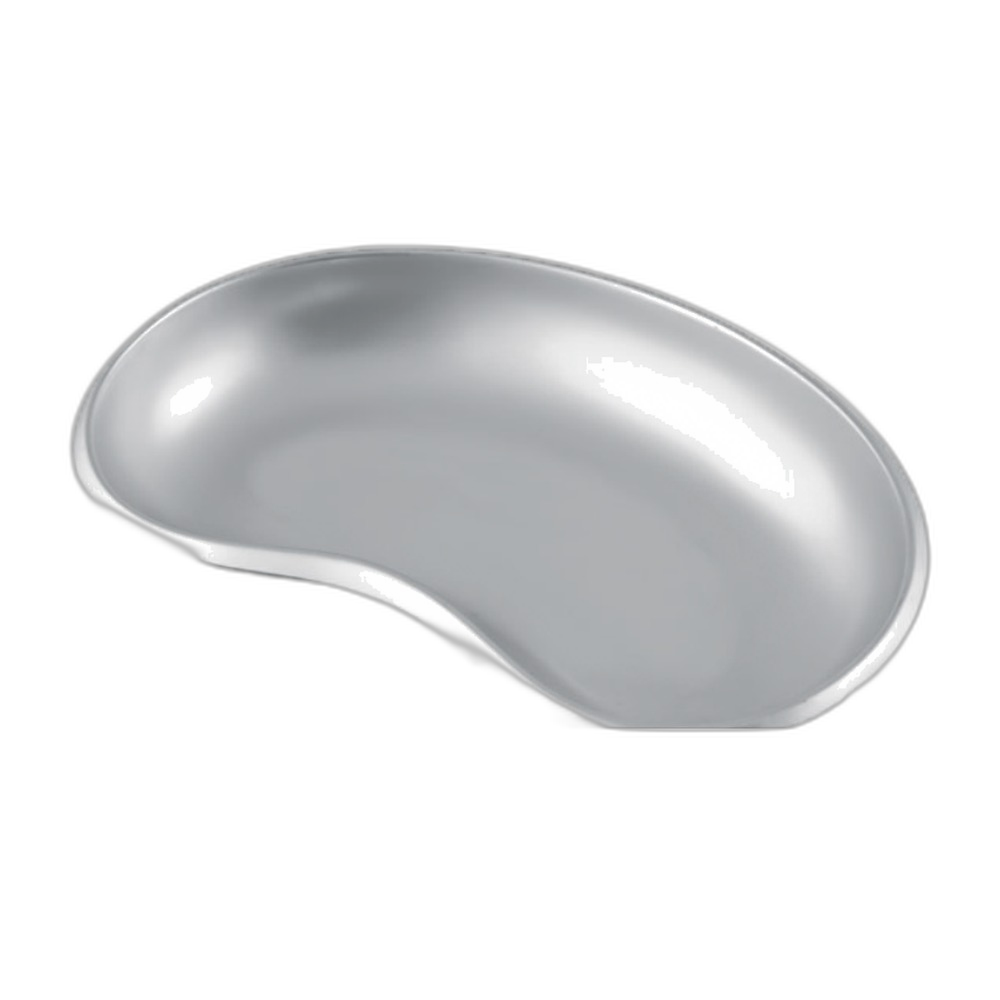
The same discipline applies across the rest of the ward range. Our guides to stainless steel kidney tray sizes and buying hospital holloware cover the equivalent checkpoints for dishes, bowls and trays.
Fizza Surgical has deep-drawn hospital bedpan stainless steel holloware in Sialkot since 1980, in both 304 and 316L, under an ISO 13485 quality system. The complete range is on our hospital holloware page, and current certification scope is listed on our certifications page.
Frequently Asked Questions
Is 304 good enough, or should I specify 316L?
304 is adequate for general wards with routine detergent-based reprocessing. Specify 316L for urology, long-stay geriatric care, and any unit where hypochlorite disinfection is used regularly — the molybdenum content in 316L substantially improves resistance to chloride pitting.
What capacity should an adult bedpan have?
Usable capacity of roughly 3.8 to 4.2 litres, with external dimensions around 360 × 290 mm and a rear height of 60 to 95 mm. Fracture bedpans hold considerably less — typically 1.8 to 2.2 litres — because their profile is much shallower at the front.
Why are my stainless bedpans rusting?
Three usual causes: the grade is ferritic 430 rather than austenitic 304 or 316L (check with a magnet); routine hypochlorite soaking is stripping the passive layer; or the items were never properly passivated after manufacture. Brown speckling that wipes off is usually deposited iron contamination rather than the bedpan corroding, and can be removed with a passivating paste.
How many fracture bedpans should a ward stock?
Roughly one fracture pan for every four standard pans on a general medical ward, and one in two on orthopaedics or any unit routinely managing hip fractures and spinal precautions. Under-stocking them leads staff to improvise with standard pans on patients who cannot lift their pelvis.
Need precision surgical instruments?
Configure complete instrument sets with our team — ISO 13485 certified, CE marked, made in Sialkot since 1980.
Related Guides
View all articles →
Where We Serve
Fizza Surgical exports to 50+ countries. Browse our country-specific pages with local regulatory guidance and pricing: