Instrument Drum vs Sterilization Container: Which to Choose
Instrument drum vs container: Schimmelbusch drums and rigid containers compared on sterility barrier, shelf life, cost and best use.
 Made in Sialkot · Since 1980
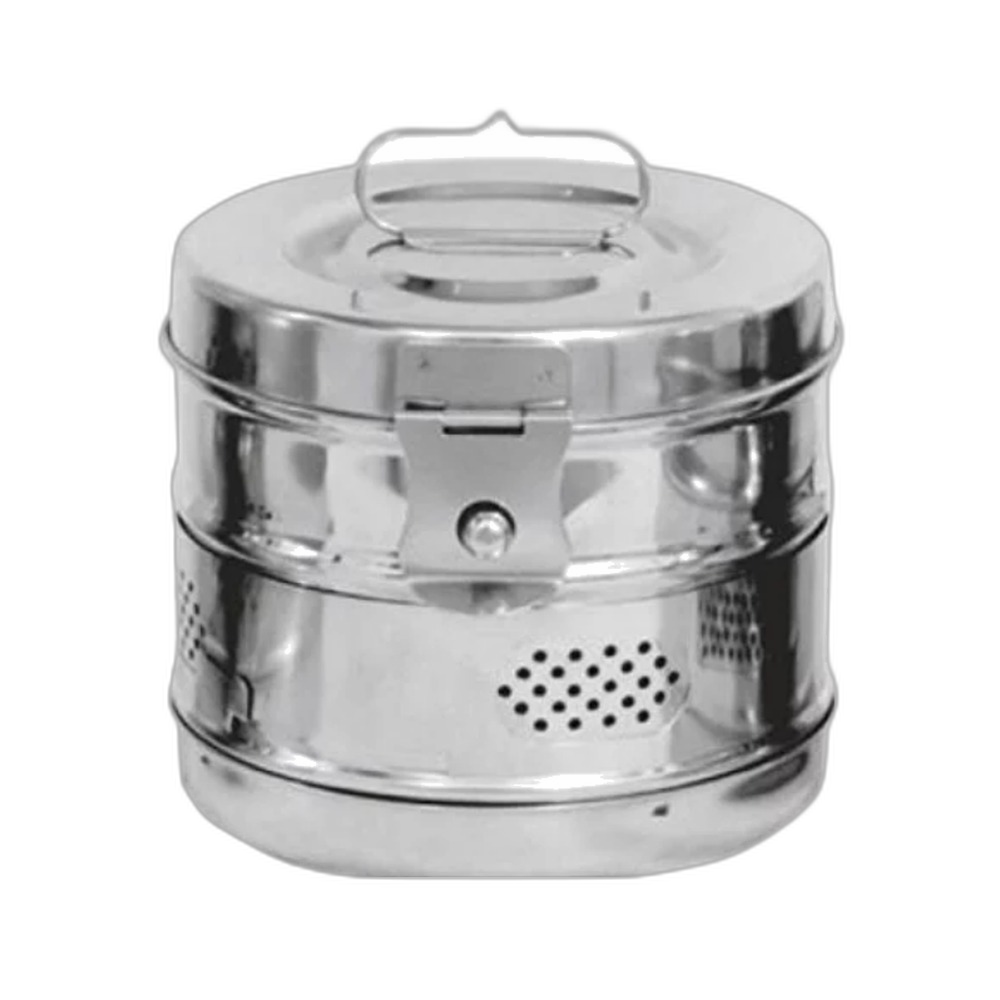
Curt Schimmelbusch published his sterilisation drum design in 1889, three years after Ernst von Bergmann introduced steam sterilisation of surgical dressings in Berlin. The drum solved a specific problem: how to get steam into a packed load of gauze and then keep the sterilised contents protected on the way to theatre. The answer was a perforated cylinder with a sliding outer band — open the band in the autoclave, close it on removal.
That design is still in production, essentially unchanged, and still in daily use across large parts of Asia, Africa, Eastern Europe and Latin America. Meanwhile most of Western Europe and North America moved to rigid sterilisation containers with valved filter ports during the 1980s and 90s.
Both are in the catalogue. Both work. They are not interchangeable, and the choice has real consequences for your sterility assurance, your CSSD throughput, and your cost per cycle.
How Each One Actually Works
The Schimmelbusch Drum
A cylindrical stainless steel body, perforated with a ring of vent holes around the circumference, and a sliding band that covers or exposes those holes. The lid is a simple lift-off or hinged cap.
The operating sequence: pack the drum, slide the band to expose the vents, load into the autoclave. Steam enters through the vent holes and displaces air from the load. At the end of the cycle, before the drum leaves the sterile side, an operator slides the band closed to seal the vents. The contents are now protected by a metal-on-metal sliding fit.
The critical dependency should be obvious: sterility maintenance depends entirely on a human remembering to close the band, at the right moment, every time.
The Rigid Sterilisation Container
A rectangular anodised aluminium or stainless base and lid, sealed by a gasket, with one or more filter ports. Steam enters through the ports, which are covered by either a disposable paper filter, a reusable PTFE membrane, or a spring-loaded valve that opens under pressure differential and closes when pressure equalises.
No operator step is required to seal the container. The physics does it. There is also a tamper-evident seal on the latch, so a container that has been opened cannot be presented as still-sterile.
Head to Head
| Factor | Schimmelbusch drum | Rigid container |
|---|---|---|
| Sterility maintenance | Depends on manual band closure | Automatic via gasket + filter/valve |
| Microbial barrier | Sliding metal fit, no filter media | 0.2 µm filter or valve |
| Tamper evidence | None inherent | Numbered seal on each latch |
| Typical safe storage life | Event-related, commonly limited to 24–48 h locally | Event-related, commonly 90–180 days per validation |
| Shape efficiency in chamber | Cylindrical — poor packing density | Rectangular — stacks efficiently |
| Consumable cost per cycle | Nil | Filter + seal, or nil with PTFE/valve |
| Capital cost per unit | Low | 4–8× higher |
| Service life | 15–25 years | 10–15 years, gasket replaced periodically |
| Validation documentation | Rarely supplied | Supplied by manufacturer |
| Suited to | Dressings, gauze, gowns, drapes | Instrument sets, implants, powered tools |
The Sterility Assurance Argument
This is where the instrument drum vs container comparison stops being a matter of preference.
A drum’s seal is a metal band sliding over metal perforations. It is a mechanical obstruction, not a microbial barrier. There is no filter medium with a defined retention rating. Air exchange through the residual clearance is possible, particularly as the sliding fit wears with age and repeated thermal cycling. A drum that has been in service twelve years does not seal the way it did new, and there is no simple test that tells you when it has crossed the line.
A rigid container’s barrier is a filter with a stated retention efficiency, or a valve with a validated closing characteristic, compressed against a gasket. The manufacturer supplies validation data. The filter is replaced every cycle (paper) or on a defined schedule (PTFE). Failure modes are visible: a torn filter, a cracked gasket, a bent lid.
The practical consequence shows up in shelf life. Facilities using drums generally cannot justify more than a day or two of storage before reprocessing, because they have no data supporting longer. Container systems come with manufacturer validation supporting event-related sterility over months. If your CSSD is trying to build a buffer stock of ready sets to smooth theatre demand, drums make that mathematically difficult.
Steam Penetration and Load Behaviour
An interesting finding from the sterilisation literature: steam penetration behaves differently with load weight depending on packaging type. In rigid containers, penetration was found to be higher for heavier loads; in soft wrapping — pouches, non-woven fabric, crepe — it was lower for heavier loads.
The mechanism is thermal mass. A heavier load in a rigid container holds more energy and generates a stronger local pressure differential across the filter port, which improves air removal. Soft wrapping compresses under its own weight and creates dead pockets.
Drums sit awkwardly between the two. The body is rigid, but the classic drum load is dressings and gauze, which compress exactly like soft packaging. Overfill a drum with gauze and the centre of the load may never see saturated steam, regardless of the vent holes being open.
Practical limits for drum loading:
- Fill to no more than 75% of drum volume by loose height — the load should not need compression to fit
- Pack dressings on edge, not stacked flat, so steam channels run vertically
- Place a Class 5 or Class 6 chemical indicator at the geometric centre, not near the vents
- Load drums on their side with vents facing horizontally, never stacked lid-to-base
- Maximum practical load weight around 5 kg for a 290 mm drum
Our guide to autoclave loading patterns covers chamber arrangement for mixed loads in more detail.
Where the Drum Is Still the Right Answer
It would be easy to read the above as “drums are obsolete.” They are not, and it is worth being precise about why.
Dressings and textiles. The drum was designed for gauze, cotton wool, gowns and drapes, and for that job the economics are excellent. A container system for bulk dressings costs several times more with no clinical advantage, because dressings are typically opened and used the same day.
High-volume, same-day turnover. If a set goes from autoclave to theatre within hours, the extended shelf life of a container buys you nothing. Wards and small theatres running a same-day cycle get genuine value from drums.
Capital-constrained facilities. A drum costs a fraction of a container of equivalent capacity and lasts twenty years. For a district hospital equipping ten theatres, the difference is a meaningful capital number. A well-managed drum programme with disciplined band closure and short storage windows is far better than an underfunded container programme with reused paper filters.
Existing validated workflows. If your CSSD has a documented, audited drum process with short storage intervals and it passes inspection, switching has a cost and a risk of its own.
Related holloware — catheter drums, dressing drums and instrument drums — follows similar reasoning, which we cover in our catheter and surgical drum guide.
Where the Container Wins Decisively
Instrument sets. Heavy, contoured, hinged instruments benefit from a rigid tray with retention that stops them shifting in transit. Instruments loose in a drum collide, and tip damage on microsurgical or dental instruments is expensive.
Implants and implant instrumentation. Traceability requirements around implants effectively mandate tamper-evident sealing and documented barrier performance. A drum cannot provide either.
Powered instruments and cannulated devices. These need controlled air removal and specific cycle parameters. Containers are validated for named cycle types; drums generally are not.
Long storage intervals. Any facility building sterile buffer stock needs the validated shelf life that only a documented barrier system supports.
Accreditation-driven environments. Facilities working toward or maintaining international accreditation will find drum-based sterility maintenance difficult to defend to an auditor who asks for the barrier’s retention rating.
Specification Points for Buyers
If you are buying drums:
| Specification | Recommended |
|---|---|
| Material | AISI 304 minimum; 316L for coastal or high-chloride regions |
| Body wall | 0.7–0.8 mm |
| Band fit | Slides with firm hand pressure, no rattle, no binding |
| Common diameters | 165, 190, 240, 290, 340 mm |
| Handles | Riveted or welded and ground flush, both sides |
| Finish | Bright interior, satin exterior |
| Vent geometry | Full circumferential ring, deburred both faces |
If you are buying containers, insist on the manufacturer’s validation report for the specific cycle types you run, a stated filter retention rating, a defined gasket replacement interval, and confirmation that replacement filters and gaskets will remain available for the container’s service life. Orphaned container systems — where the consumables are discontinued — are a recurring and expensive procurement failure.
A Reasonable Hybrid
Most facilities that think carefully about this end up running both rather than choosing one. A workable split:
- Drums for gauze, dressings, cotton, gowns and drapes on same-day or next-day turnover
- Rigid containers for all instrument sets, implants, powered tools and anything stored beyond 48 hours
- Wrapped trays or pouches for single instruments and small add-on items
This is not a compromise so much as matching the barrier to the risk. Our overview of sterile packaging options — wraps, pouches and containers sets out the full decision matrix, and the CSSD workflow guide covers where each fits in the dirty-to-sterile process.
The honest summary of the instrument drum vs container question: the drum is a well-engineered nineteenth-century solution that remains economically sensible for textiles and short storage windows, and the container is the correct answer for instrument sets, implants, and any facility that needs to prove its sterility assurance rather than assert it.
Fizza Surgical manufactures Schimmelbusch drums in 304 and 316L across the standard diameter range in Sialkot, under an ISO 13485 quality system. The full range is on our hospital holloware page.
Frequently Asked Questions
Can a Schimmelbusch drum be used for instrument sets?
It can hold them, but it is not the right choice. Instruments shift in transit and damage each other’s tips, and the drum provides no filter-rated microbial barrier or tamper evidence — both of which matter more for instruments than for dressings. Use a rigid container with retention for instrument sets.
How long do contents stay sterile in a drum?
There is no universal figure, because a drum has no validated barrier rating. Most facilities that use drums responsibly limit storage to 24 to 48 hours and reprocess anything beyond that. Rigid containers with manufacturer validation commonly support event-related sterility over 90 to 180 days.
Do I have to close the band before or after the drum leaves the autoclave?
Immediately after the cycle completes, while the drum is still on the sterile side of the barrier and before it is handled or moved into storage. Closing it late exposes the load to room air during the cooling phase, which is exactly when a warm load draws in air as it contracts.
How full should a sterilisation drum be packed?
No more than about 75% of its volume, with the load loose enough that it does not need compression to fit. Pack dressings on edge rather than stacked flat so steam can channel vertically, and put the chemical indicator at the geometric centre of the load, not near the vent holes.
Are aluminium containers safe to autoclave repeatedly?
Yes, when they are hard-anodised, which is the standard for medical containers. The anodised layer resists the alkaline detergents used in washer-disinfectors. Untreated aluminium is attacked by alkaline chemistry and should not be used. Check the gasket at every cycle and replace it on the manufacturer’s schedule — a hardened or cracked gasket is the most common cause of container barrier failure.
Need precision surgical instruments?
Configure complete instrument sets with our team — ISO 13485 certified, CE marked, made in Sialkot since 1980.
Related Guides
View all articles →

Where We Serve
Fizza Surgical exports to 50+ countries. Browse our country-specific pages with local regulatory guidance and pricing: