Hudson Brace and Cranial Perforators: Burr Hole Guide
Hudson brace guide: chuck fitting, perforator vs burr, 10-22 mm bit sizes, burr hole technique and reprocessing for cranial drill sets.
 Made in Sialkot · Since 1980
Every craniotomy tray in a well-equipped theatre has a pneumatic or electric craniotome on it. Every craniotomy tray that has ever been useful in a power cut, a field hospital, or a district facility three hours from a biomedical engineer also has a hand brace on it.
The design dates to the early twentieth century and has barely changed, for the same reason a Gigli saw has barely changed: there is not much left to improve. It is a carpenter’s brace, scaled and finished for the operating theatre, and it opens a skull using nothing but the surgeon’s shoulder.
Anatomy of the Brace
Four parts, and each one is doing something specific.
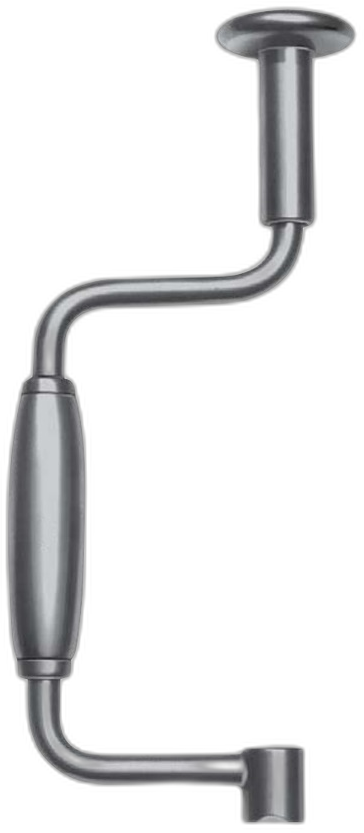
The head is a free-spinning dome that sits in the heel of the palm or against the sternum. It has to rotate independently of the frame — if it binds, the surgeon’s hand turns with the crank and all the downward force is lost.
The frame is the offset U. The distance the crank is thrown out from the axis sets the leverage; a wider throw turns a stiff bit more easily but is harder to control in a confined field. Theatre braces are deliberately narrower than joinery braces for exactly this reason.
The grip spins freely on the crank so the hand rolls rather than scuffs.
The chuck is where the compatibility question lives, and it deserves its own section.
The Hudson Chuck and Why It Became a Standard
The Hudson brace uses a thumbscrew chuck that grips a shank with a specific flatted, grooved profile. That profile — the Hudson fitting — became the de facto standard for cranial bits, and it is now the reason a bit bought from one manufacturer will seat in a brace bought from another.
It also means the same bits will chuck into a powered drill fitted with a Hudson coupling. Departments that have a modern craniotome and a manual brace can therefore hold one set of perforators and burrs that serves both. When specifying, the phrase to use in the tender is “Hudson fitting shank” rather than any particular brand name.
The thumbscrew itself is a wear point. It should tighten smoothly and hold a bit against firm hand torque with no rotational play. Any perceptible slip means the jaws or the screw thread are worn, and a bit that slips mid-perforation is a bit that skates across the outer table.
Perforators and Burrs Are Not the Same Bit
This distinction gets blurred in catalogues and it should not be.
A perforator is conical or stepped, designed to cut down through the outer table, the diploë, and the inner table. The good ones have a clutch or a shoulder that disengages, or at least sharply resists, once the shank meets the bone surface — the mechanical stop that keeps the bit from plunging through the inner table and into dura the moment the resistance disappears.
A burr is spherical or acorn-shaped and does not cut a hole from scratch. It enlarges, smooths, and bevels one that already exists. Running a burr on intact skull is slow and produces a shallow saucer rather than a hole.
The working sequence is perforator first, burr second. Trying to do the whole job with a burr is the classic error of someone who has only ever seen the set laid out and not used.
Standard Bit Sizes
A representative cranial drill set covers a small range of diameters, and the spread is deliberate rather than arbitrary.
| Bit | Diameter | Role |
|---|---|---|
| Hudson burr | 10 mm | Small burr holes; paediatric skull; enlarging a perforation in thin bone |
| Hudson burr | 14 mm | General-purpose adult burr hole — the size most often reached for |
| Cushing burr | 16 mm | Bevelling and smoothing the margin; wider saucerisation |
| Hudson burr | 22 mm | Large exposure; decompressive work; joining holes for a bone flap |
| Cranial perforator | Conical, stepped | Initial penetration through outer table, diploë and inner table |
| Cerebellar extension | ~5–7 cm added reach | Posterior fossa, where thick nuchal muscle keeps the brace off the bone |
The cerebellar extension is the component most often left out of a budget tender and most often missed in the posterior fossa. Without it the brace frame fouls the muscle bulk and the surgeon cannot get the bit perpendicular to the skull, which is the one geometry requirement the technique has.
Making the Hole — Technique and Feel
The whole technique is a feedback exercise. There is no depth gauge; there is only what the hands report.
The perforator is seated perpendicular to the skull. Not approximately perpendicular — a bit that is off-axis cuts an oval, walks, and loses its mechanical stop, because the shoulder meets bone on one side before the other. Steady body weight goes through the head of the brace; the crank turns at a slow, even rate. Speed achieves nothing here and generates heat.
Cutting through the outer table is firm and consistent. The diploë is noticeably softer and often bleeds — a sudden easing of resistance partway is diploë, not breakthrough, and this is where inexperienced hands push harder and get into trouble. Resistance rises again at the inner table.
The moment that matters is the second easing. If the perforator has a clutch it will disengage; if it does not, the surgeon must stop on feel alone. From that point the hole is finished with the burr, working the margin and bevelling the edge.
Three details that separate a clean hole from a messy one. Irrigate continuously — bone is a poor conductor and a dry bit generates enough heat at the margin to cause thermal necrosis and a hole that never heals cleanly. Collect the bone dust; it is autologous graft and it is free. And clear the flutes frequently, because a packed burr stops cutting and starts burnishing.
Once holes are made, they are joined. Classically with a Gigli saw passed between adjacent holes on a guide, or with a footplate craniotome where one is available. Dura is separated from the inner table first with a dissector — a Penfield No. 3 is the usual choice — before anything is passed through.
Where the Manual Brace Still Beats a Powered Craniotome
It would be easy to file this instrument under historical interest. That would be wrong, and the reasons are practical rather than sentimental.
It has no dependencies. No compressed air line, no electrical supply, no battery, no sterile motor cable. In a facility where the generator is the power supply, that is not a hypothetical advantage.
It gives better tactile feedback than any powered tool. The whole technique is built on feeling the transition from inner table to nothing. A high-speed drill removes that signal, which is why powered perforators need an engineered clutch to substitute for it.
It is repairable anywhere. The failure modes are a worn chuck, a stiff head bearing, and a dull bit. All three are fixable with hand tools.
It is a credible emergency airway-of-the-skull. Military and pre-hospital surgical teams have retained the hand brace precisely because an emergency decompression may have to happen where no theatre exists; a 2020 aide-memoire in the British military surgical literature set out the technique for front-line surgeons for exactly this reason.
None of which argues against a craniotome for elective work. For a long elective flap, powered instrumentation is faster and less tiring, and fatigue is itself a safety factor. The argument is for keeping the manual set current and sterile rather than letting it decay at the back of a CSSD shelf.
Care, Reprocessing and Inspection
The brace is a jointed mechanical assembly, which puts it in a different reprocessing class from a plain retractor.
Bone dust and blood pack into the chuck jaws and around the head bearing. Both need to be flushed and brushed before ultrasonic cleaning, not after — ultrasonics will not shift compacted bone paste. After cleaning and drying, the head bearing and the chuck thread take a water-soluble instrument lubricant. Never an oil-based one; oil is not steam-permeable and it will shield bioburden from the sterilant.
Steam at 134 °C is standard. The assembly must be sterilized with the chuck open, not clamped shut on a bit.
At inspection, check four things. The head must spin freely under thumb pressure. The chuck must hold a bit with no rotational play. The frame must be true — sight along it; a bent frame throws the bit off-axis and you will not notice until the hole is oval. And the bits themselves must be sharp, because a dull perforator is dangerous rather than merely slow: it needs more force, and more force is exactly what you do not want stored in the system at the moment the inner table gives way.
Bits are consumable. Perforator flutes and burr teeth do wear, and a set that has done many cases should be re-cut or replaced rather than nursed along.
Fizza Surgical manufactures cranial braces, Hudson-fitting perforators and burrs, and cerebellar extensions, alongside the wider bone surgery instrument range. Full set contents are covered in our craniotomy instrument set guide. All instruments are manufactured under ISO 13485 and CE marked under MDR 2017/745.
Frequently Asked Questions
What is a Hudson brace used for?
Making burr holes in the skull by hand. It is a manual, non-powered drill that accepts cranial perforators and burrs on a standard Hudson-fitting shank, and it is used to open the cranium for decompression, for evacuating a haematoma, or as the first step in raising a bone flap.
What is the difference between a perforator and a burr?
A perforator is conical or stepped and cuts the initial hole through the full thickness of the skull, usually with a clutch or shoulder that resists plunging once the inner table is breached. A burr is spherical and enlarges, smooths or bevels an existing hole. Perforator first, burr second — a burr will not efficiently start a hole in intact bone.
What bit sizes come in a standard cranial drill set?
A representative set covers burrs at roughly 10 mm, 14 mm and 22 mm, a Cushing burr around 16 mm for bevelling, at least one cranial perforator, and a cerebellar extension for posterior fossa access. The 14 mm burr is the general-purpose adult size.
Are hand braces still used now that powered craniotomes exist?
Yes, in three settings: as the backup when power or gas fails, in field and military surgery where no powered instrumentation exists, and in facilities where craniotome servicing is not practical. It also gives better tactile feedback at the inner table than any high-speed tool, which is why the technique is still taught.
Will bits from one manufacturer fit another maker’s brace?
If both use the Hudson fitting, yes — that is the point of the standard, and it also lets the same bits chuck into a powered drill with a Hudson coupling. Specify “Hudson fitting shank” in the tender rather than a brand name, and check the thumbscrew chuck holds without rotational play on receipt.
How should the brace be cleaned and sterilized?
Flush and brush bone dust out of the chuck jaws and head bearing before ultrasonic cleaning — ultrasonics will not remove compacted bone paste. Dry, then lubricate the bearing and chuck thread with a water-soluble instrument lubricant, never oil. Steam sterilize at 134 °C with the chuck open.
Need precision surgical instruments?
Configure complete instrument sets with our team — ISO 13485 certified, CE marked, made in Sialkot since 1980.
Related Guides
View all articles →

Where We Serve
Fizza Surgical exports to 50+ countries. Browse our country-specific pages with local regulatory guidance and pricing: