ISO 7376 is the most important technical standard in direct laryngoscopy. If you’re procuring fiber optic laryngoscope blades or handles, ISO 7376 compliance determines whether your equipment will interoperate with existing hospital inventory, meet regulatory requirements, and deliver consistent clinical performance. Yet most product pages describe it only as “Green Spec certified” without explaining what that actually means.
This guide covers what ISO 7376 specifies, why the “Green Spec” name matters, and what procurement teams should verify before placing orders.
What is ISO 7376?
ISO 7376 is the International Organization for Standardization standard titled “Anaesthetic and respiratory equipment — Laryngoscopes for tracheal intubation.” First published in 1983, with successive revisions through 2020, the standard defines:
- The physical connection between handle and blade (the hook-on fitting)
- Minimum light output at the blade tip
- Color temperature range for tissue visualization
- Material requirements for biocompatibility
- Durability requirements for repeated sterilization
- Electrical safety requirements
- Labeling and marking requirements
In plain English: ISO 7376 is what makes any Green Spec blade work with any Green Spec handle, regardless of manufacturer.
Why it’s called “Green Spec”
Prior to ISO 7376, laryngoscopes used proprietary connection systems. A Welch Allyn blade only worked with a Welch Allyn handle, a Heine blade only with a Heine handle, and so on. Hospitals that mixed brands faced expensive, fragmented inventories.
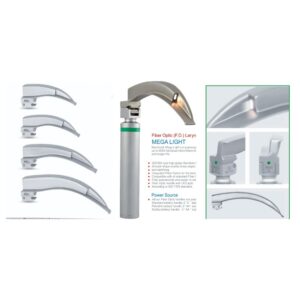
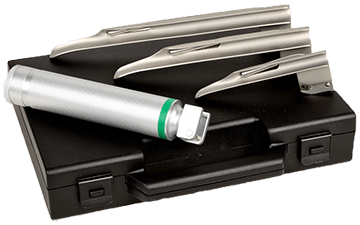
ISO 7376 defined a universal mechanical and electrical interface. To distinguish compliant equipment from legacy proprietary equipment, compliant handles wear a green anodized collar at the hook-on connection. Compliant blades are marked with green labels or etching. Hence “Green Spec” or “Green System.”
Before buying: look for the green marking. It’s a visual shortcut to confirm compliance.
What the standard actually specifies
The hook-on connection
ISO 7376 defines a 4.0mm diameter hook on the handle that engages a 4.0mm slot on the blade heel. Tolerances are tight — hooks are specified to ±0.05mm. This precision is what allows any Green Spec blade to lock cleanly onto any Green Spec handle with the standard 90-degree rotation-to-engage action.
Electrical contact (fiber optic)
For fiber optic handles, the standard specifies the position and dimensions of the light-transmitting window. The fiber bundle end in the blade must align with this window within defined tolerances, ensuring consistent light transmission.
Illumination requirements
Minimum light output is specified at the blade tip, measured under defined conditions. Modern ISO 7376 compliance requires approximately 700 lux minimum at 20mm from the tip — though quality manufacturers routinely deliver 3,000+ lux with LED-handle fiber optic systems.
Color temperature
Light color must fall within a specified color temperature range (approximately 3,000-6,000 Kelvin) to ensure accurate tissue color perception during intubation. Light that’s too yellow or too blue distorts the appearance of the vocal cords and surrounding tissue.
Autoclavability
Green Spec equipment must withstand repeated autoclave cycles at 134°C (273°F) without mechanical degradation or loss of light output. Compliant fiber bundles are hermetically sealed to prevent fluid intrusion during sterilization.
Electrical safety
Handle batteries and electrical contacts must meet medical-device electrical safety standards — isolation, no risk of short-circuit during normal use, low leakage currents.
What ISO 7376 does NOT cover
Some things are explicitly outside ISO 7376:
- Blade shape and size — Macintosh vs Miller design is not standardized. Manufacturers design their blades for clinical preference.
- Handle grip style — smooth, knurled, ribbed, etc. are manufacturer choices.
- Battery type — most use 2× C-cell or AA alkaline, but some use rechargeable lithium-ion. Not all handles are cross-compatible at the battery level.
- Disposable blade compatibility — disposable plastic blades are a separate standard and do not follow ISO 7376 for the hook-on connection.
How to verify ISO 7376 compliance
Visual inspection
- Handle: look for the green anodized collar at the hook-on end
- Blade: look for green marking on the heel or laser-etched “ISO 7376” text
- Try a physical cross-brand test: does the blade lock onto a known Green Spec handle with the standard action?
Documentation
- Request the technical file or Declaration of Conformity from the manufacturer
- Look for specific reference to “ISO 7376” or “ISO 7376-3” (the fiber optic section)
- Check whether testing was done by an accredited lab
Performance
- Sample testing: borrow a reference Green Spec handle from a trusted source and confirm blade fit
- Light output testing: verify blade tip illumination meets manufacturer’s published lux rating
- Thermal cycling: autoclave sample units 100 times and re-verify fit and light output
Common ISO 7376 compliance pitfalls
“Compatible with ISO 7376” ≠ “ISO 7376 compliant”
Some manufacturers carefully word their marketing as “compatible with Green Spec” without claiming actual compliance. This suggests the product will physically fit but hasn’t been tested to the full standard. Always insist on actual compliance.
Compliance at manufacture, not at supply
Dropshippers may sell blades that were ISO 7376 compliant when originally manufactured but have been stored in conditions that degraded the fiber bundle or corroded the steel. Buying from the manufacturer (not an unverified intermediate trader) reduces this risk.
Old non-compliant equipment mixed with new compliant equipment
If your hospital has pre-2000 handles, they may not be ISO 7376 compliant. Mixing a new Green Spec blade with a non-compliant handle can work mechanically but may not deliver specified light output. Standardize on all-Green-Spec equipment during replacement cycles.
ISO 7376 and Fizza Surgical
All Fizza Surgical fiber optic laryngoscope blades are manufactured to ISO 7376 Green Spec compliance. This means:
- Universal handle compatibility — our blades work with any Green Spec handle including Heine, Welch Allyn, Riester replacements
- Guaranteed light output of 700+ lux (typically 3,000+ with modern LED handles)
- Autoclave durability through 1,000+ sterilization cycles
- Mill certificates and technical documentation available on request
- Sample testing welcome — we ship free samples for distributor evaluation
Browse our ISO 7376 compliant laryngoscope range or request the technical documentation package.
FAQ
Is every fiber optic laryngoscope ISO 7376 compliant?
No. Fiber optic is a technology; ISO 7376 is a compliance standard. A fiber optic blade can be manufactured without ISO 7376 compliance — often with a proprietary handle connection that only works with the matching manufacturer’s handles. Always verify compliance specifically.
What’s the difference between ISO 7376 and ISO 7376-3?
ISO 7376 has multiple parts: ISO 7376-1 covers laryngoscope blades generally, ISO 7376-3 specifically addresses fiber optic laryngoscopes. When procuring fiber optic equipment, ISO 7376-3 is the specific reference.
Can disposable blades be ISO 7376 compliant?
Some disposable plastic blades are designed to the Green Spec hook-on dimensions and will fit Green Spec handles. However, most disposable blades use simpler proprietary connections optimized for single-use applications. Check specifications case by case.
Where We Serve
Fizza Surgical exports to 50+ countries. Browse our country-specific pages with local regulatory guidance and pricing: